

Recent gamma-ray observations suggest we may be witnessing the first hints of dark matter’s faint glow in the Milky Way’s center. This unexplained excess aligns with predictions that dark matter particles could decay or annihilate, releasing detectable energy. While scientists remain cautious, this potential breakthrough could reveal key details about dark matter’s properties. Continuing to explore these signals could uncover astounding insights into the universe’s unseen mass and how it shapes cosmic structures.
Key Takeaways
- Recent gamma-ray observations from the Milky Way’s center show an excess that may indicate dark matter particle decay.
- This faint glow aligns with theoretical predictions of signals produced by dark matter interactions.
- Confirming the glow as dark matter requires ruling out astrophysical sources like pulsars or supernova remnants.
- Detecting such a signal could reveal dark matter properties, such as particle mass and decay mechanisms.
- Ongoing and future observations across multiple wavelengths aim to verify this potential first glimpse of dark matter.
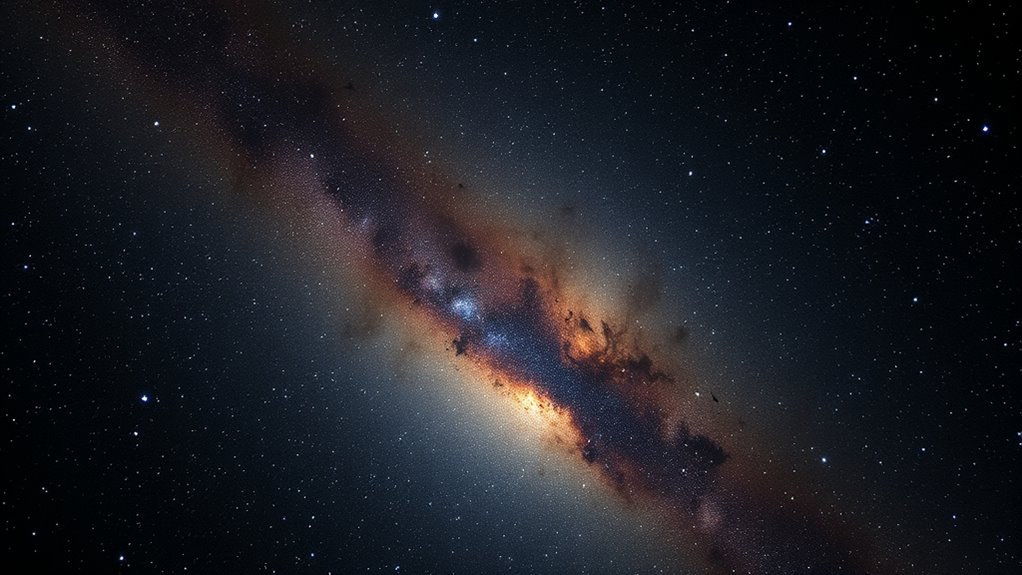
Dark matter, the elusive substance that makes up most of the universe’s mass, doesn’t emit light or energy we can directly detect. Despite its invisibility, scientists believe it’s out there, influencing the cosmos through gravity alone. Recently, researchers might have caught a rare glimpse of dark matter’s glow within our own galaxy, the Milky Way. If confirmed, this discovery could revolutionize our understanding of the universe’s hidden scaffolding.
You might wonder how researchers can observe something that doesn’t emit or reflect light. The key lies in the indirect evidence dark matter leaves behind. It shapes the movement of stars and gas, creating gravitational effects that can be mapped. But detecting a faint glow, a potential signature of dark matter’s particles interacting or decaying, would be an entirely different breakthrough. This glow, if real, would be faint but detectable with sensitive instruments, revealing a new aspect of dark matter’s nature.
Scientists have been searching for this kind of signal for years. The idea is that dark matter particles could occasionally annihilate or decay, releasing energy in the form of photons. These photons might manifest as an excess of gamma rays or X-rays in specific regions of space. Now, recent observations from advanced telescopes have shown an unexplained excess of such high-energy photons emanating from the core of the Milky Way. This anomaly has sparked excitement because it’s consistent with predictions of dark matter decay signals, though alternative explanations like pulsars or other astrophysical phenomena remain plausible.
Recent telescopic observations reveal unexplained gamma-ray excesses from the Milky Way’s core, hinting at dark matter decay signals.
If this glow originates from dark matter, it would provide a direct clue about the particles’ properties—such as their mass, how they interact, and how they decay. This information could pave the way for new physics beyond the Standard Model, fundamentally altering our understanding of particle physics and cosmology. You’d see a shift in scientific consensus, pushing us closer to reveal one of the universe’s greatest mysteries. Advances in indirect detection methods are crucial for confirming such signals and understanding their origins.
However, scientists approach these findings cautiously. Confirming the dark matter origin of this glow requires ruling out all other sources. Multiple telescopes, observations across different wavelengths, and detailed modeling are necessary to verify that this isn’t just a coincidental or astrophysical effect. Still, the possibility that we might be witnessing the first direct hint of dark matter’s glow is tantalizing. It hints at a future where dark matter stops being just a gravitational placeholder and becomes a tangible, observable part of our universe.
In the end, this discovery invites you to imagine the universe in a new way—one where the unseen becomes seen, and the dark matter glow could finally illuminate the cosmos’s deepest secrets.

Particle Astrophysics with Gamma-Ray Telescopes (Series in Astronomy and Astrophysics)
As an affiliate, we earn on qualifying purchases.
As an affiliate, we earn on qualifying purchases.
Frequently Asked Questions
How Does Dark Matter Influence Galaxy Formation?
Dark matter plays a vital role in galaxy formation by providing the gravitational pull necessary to pull gas and stars together. You might not see it directly, but its presence shapes the structure of galaxies, including our Milky Way. It acts like a cosmic scaffold, helping galaxies grow and evolve over time. Without dark matter, galaxies wouldn’t form as efficiently, and the universe’s large-scale structure wouldn’t look the way it does today.
What Instruments Are Used to Detect Dark Matter Glow?
You use instruments like the Fermi Gamma-ray Space Telescope and ground-based Cherenkov telescopes to detect dark matter glow. These devices observe high-energy gamma rays that may originate from dark matter particle interactions. By analyzing the gamma-ray signals from regions like the Milky Way’s center, you can identify potential dark matter signatures. These instruments help you gather vital data, bringing you closer to understanding the elusive nature of dark matter.
Could Dark Matter Glow Impact Earth’s Environment?
No, dark matter glow isn’t likely to impact Earth’s environment. Since dark matter interacts very weakly with normal matter, it doesn’t produce radiation that affects our planet. You won’t notice any changes or disruptions caused by it. Instead, its presence is mainly detected through indirect signals, like faint gamma rays, which don’t influence Earth’s atmosphere or living conditions. So, you can rest assured it won’t impact your daily life.
How Certain Are Scientists About Dark Matter’s Properties?
Scientists aren’t completely certain about dark matter’s properties yet. They have strong evidence that it exists based on gravitational effects, but its exact nature remains elusive. You should know that researchers are actively studying it through experiments and observations, but many details, like its composition and how it interacts with other particles, are still uncertain. So, while confidence grows, there’s still a lot to learn about dark matter.
What Are the Next Steps in Dark Matter Research?
You should focus on developing more sensitive detectors and conducting targeted observations of areas with high dark matter density. Collaborate with international research teams to analyze data from telescopes and particle experiments. Prioritize experiments that can distinguish dark matter signals from background noise. Keep an eye on new technologies like quantum sensors, and participate in upcoming missions to gather vital data, bringing us closer to understanding dark matter’s true nature.

EG Air Quality Pollution Monitor and PM2.5 Detector with AQI Readings; Portable Meter, Sensor, and Tester That Detects PM2.5 Micron Dust and Particulate Matter
MULTIFUNCTIONAL & SCIENTIFIC – This air quality monitor accurately assesses fine particulate dust matter measuring <2.5 microns as…
As an affiliate, we earn on qualifying purchases.
As an affiliate, we earn on qualifying purchases.
Conclusion
Could this be the first whisper of dark matter’s glow in our galaxy? As you stand beneath the night sky, imagine uncovering a secret universe hidden in the shadows. This discovery isn’t just a faint hint; it’s a cosmic invitation to explore what’s beyond what you see. Just think—what if the universe’s greatest mysteries are quietly waiting to be uncovered, like a story written in the dark, enthusiastic for you to read between the lines?
high-sensitivity space observatory
As an affiliate, we earn on qualifying purchases.
As an affiliate, we earn on qualifying purchases.

Large Area Networked Detectors For Particle Astrophysics
As an affiliate, we earn on qualifying purchases.
As an affiliate, we earn on qualifying purchases.