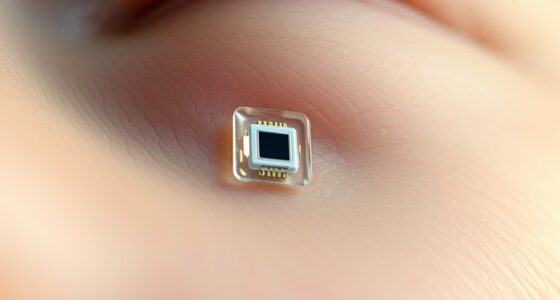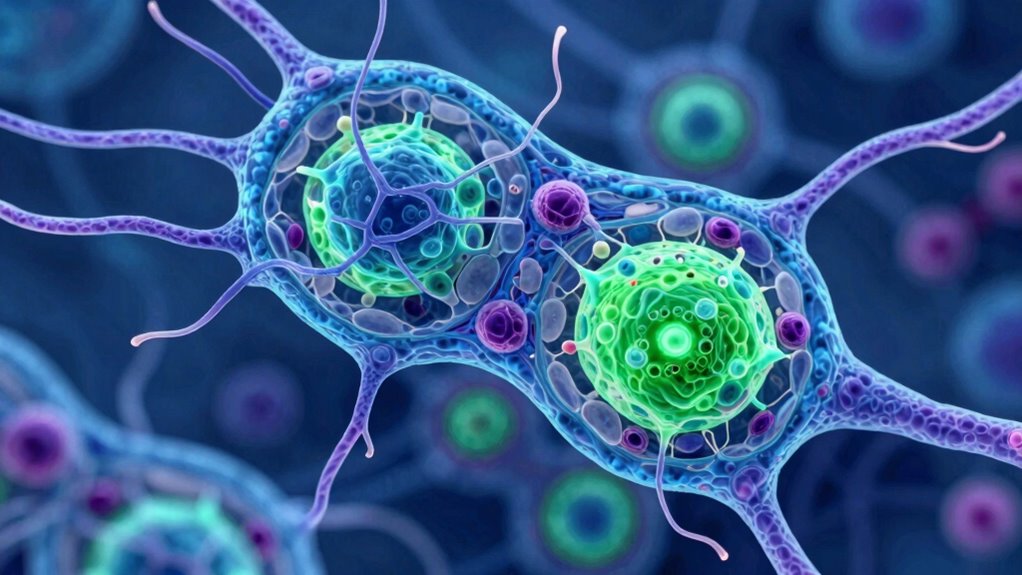

Recent advancements in imaging tools have revolutionized how you see cell self-organization. Super-resolution microscopy lets you visualize structures at the nanometer scale, revealing how proteins and organelles coordinate. Live-cell imaging captures real-time dynamics, showing how cells move and respond to stimuli. Techniques using fluorescent markers enable detailed tracking without harming cells. As these tools improve, you’ll gain even deeper insights into the complex choreography inside cells—if you keep exploring, you’ll discover more behind the scenes.

Get the latest gadgets delivered free with Prime
- Fast, free delivery on millions of items
- Prime Video, Amazon Music and more included
- Member-only deals all year
Key Takeaways
- Super-resolution microscopy uncovers nanoscale details of cellular structures and protein interactions involved in self-organization.
- Live-cell imaging techniques track dynamic cellular processes and reorganization in real time.
- Fluorescent markers and advanced modalities visualize specific molecules and organelles, revealing organizational patterns.
- Continuous improvements in resolution enable visualization of cellular components at increasingly smaller scales.
- These tools deepen understanding of cellular self-assembly, coordination, and responses to stimuli.
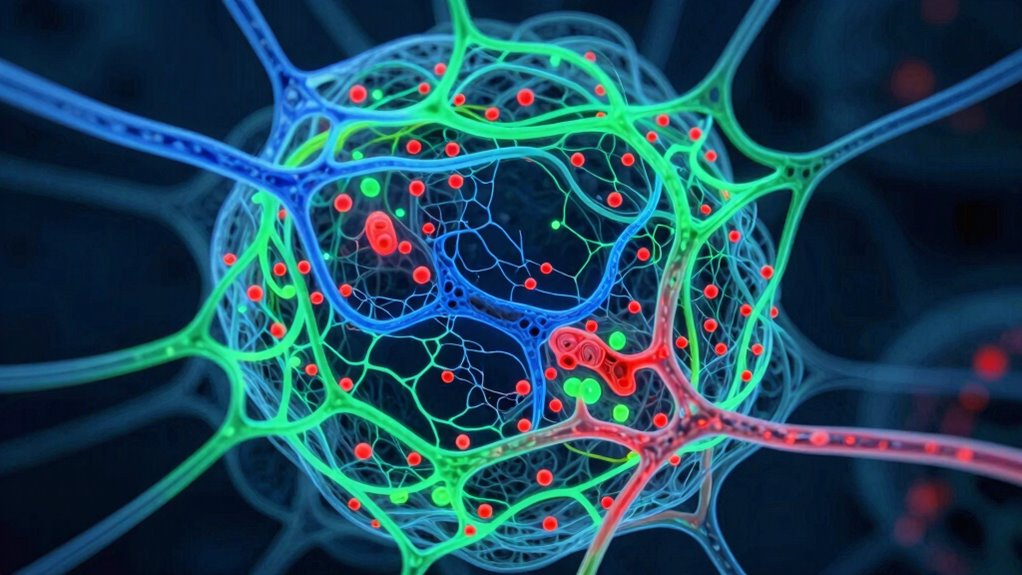
Imaging tools are essential for exploring the intricate world of cells, allowing scientists to visualize structures and processes that are otherwise invisible to the naked eye. With these tools, you can observe cellular dynamics in real time, gaining insights into how cells move, divide, and organize themselves. Recent imaging advancements have revolutionized our ability to study these tiny worlds, pushing the boundaries of resolution and speed, and enabling you to explore cellular processes with unprecedented clarity.
Imaging tools reveal cellular structures and dynamics, transforming our understanding of life’s microscopic foundations with unprecedented clarity.
Thanks to innovations like super-resolution microscopy, you’re no longer limited by the diffraction of light that once restricted the level of detail achievable with traditional microscopes. These advancements allow you to see structures at the nanometer scale, revealing how proteins, organelles, and cytoskeletal elements coordinate during cellular activities. As a result, you can track the dynamic reshaping of the cell’s interior, understanding how it maintains its structure and responds to environmental cues.
Furthermore, live-cell imaging techniques now let you follow cellular dynamics in real time. You can observe how cells migrate across surfaces, how they communicate through signaling pathways, and how internal components like the nucleus and mitochondria reposition themselves during various processes. This real-time perspective is crucial for understanding the self-organization of cells, as it highlights the intricate choreography underpinning cellular behavior. You’re able to see not just static snapshots but the fluid, ever-changing landscape of cellular life.
The integration of fluorescent markers and advanced imaging modalities enhances your ability to pinpoint specific molecules and track their interactions within living cells. Techniques such as confocal microscopy and light-sheet imaging minimize photodamage, allowing you to study cells over extended periods without compromising their health. These imaging advancements have opened doors for long-term studies of cellular organization and how cells adapt and reorganize themselves in response to stimuli.
In addition, ongoing developments in imaging resolution are continually expanding our capacity to visualize cellular structures at ever-smaller scales. In essence, these new imaging tools empower you to unravel the complexity of cellular organization. You can now visualize how cellular components dynamically assemble and disassemble, revealing the underlying principles of cell self-organization. With each technological leap, you gain a deeper appreciation of the cellular choreography that sustains life at the microscopic level, making it possible to explore cellular dynamics with a clarity that was once unimaginable.
super-resolution fluorescence microscope
As an affiliate, we earn on qualifying purchases.
As an affiliate, we earn on qualifying purchases.
Frequently Asked Questions
How Do Imaging Tools Impact Cell Research Ethics?
You should consider that imaging tools impact cell research ethics by raising ethical considerations around the potential misuse of detailed cellular data. They also bring privacy concerns, especially when imaging human tissues or cells, which might contain sensitive information. As you use these advanced technologies, you need to guarantee responsible data handling, gain proper consent, and adhere to ethical standards to protect privacy and maintain trust in scientific research.
Can Imaging Techniques Be Used in Live Animal Studies?
Think of live animal studies as a live concert, where you get real-time visualization of cellular dynamics. Yes, imaging techniques can be used in these studies, allowing you to observe cells in action within living organisms. This approach offers invaluable insights, capturing cellular behavior as it happens, without disrupting the natural environment. It’s like watching a performance unfold in real time, revealing the intricate dance of life inside living animals.
What Are the Limitations of Current Cell Imaging Methods?
You should know that current cell imaging methods face limitations like imaging resolution, which can restrict your ability to see fine details within cells. Sample preparation can also be challenging, as some techniques require extensive processing that might alter or damage the sample. These constraints make it difficult to capture real-time, high-detail images of living cells, especially in complex environments like tissues or whole organisms.
How Cost-Effective Are These Advanced Imaging Tools?
These advanced imaging tools can be quite costly, but their cost-effectiveness depends on your budget and research needs. You should perform a thorough cost analysis, considering equipment expenses, maintenance, and training. While initial investments are high, they can save money long-term by providing faster, more accurate data, reducing the need for multiple experiments. Ultimately, balancing budget considerations with research goals helps determine if these tools are a worthwhile investment.
What Future Innovations Are Expected in Cell Imaging Technology?
You’ll see future innovations in cell imaging focus on vastly improving imaging resolution, allowing you to observe cellular details at unprecedented levels. Advances will also streamline data analysis, making it faster and more accurate, so you can interpret complex cellular behaviors effortlessly. These developments will enable you to explore cell organization more deeply, revealing insights that could revolutionize medicine and biology, all while overcoming current limitations in clarity and data processing.
As an affiliate, we earn on qualifying purchases.
Conclusion
Now that you’ve glimpsed these cutting-edge imaging tools, imagine discovering the secret blueprints of life itself. These lenses are like treasure maps, guiding you through the bustling cityscape of cells, revealing their hidden architecture. With each new image, you’re peeling back layers of mystery, turning the microscopic into the magnificent. So, keep exploring — because in this world of tiny wonders, there’s always a new story waiting to be told.
confocal microscope for research
As an affiliate, we earn on qualifying purchases.
As an affiliate, we earn on qualifying purchases.
As an affiliate, we earn on qualifying purchases.
Columbus Day / Indigenous Peoples' Day Picks
long weekend sales
As an affiliate, we earn on qualifying purchases.