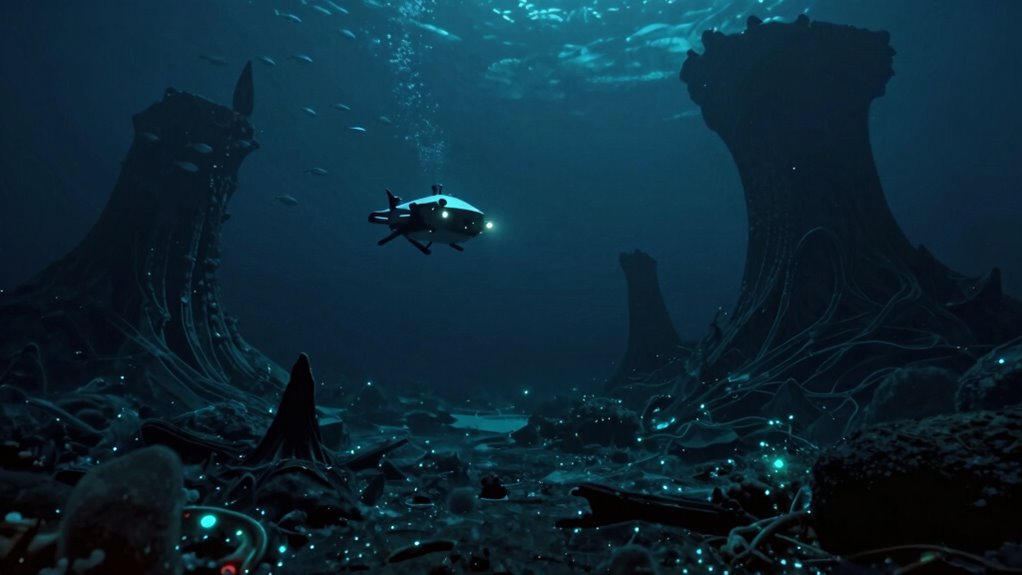

Exploring the deep ocean still feels like venturing onto another planet because much of its landscape remains uncharted and full of mysteries. You’re faced with extreme conditions, such as crushing pressures, freezing temperatures, and total darkness, unlike anything on land or near the surface. Using advanced technology like autonomous vehicles and sonar mapping, scientists uncover bizarre ecosystems and underwater features similar to distant worlds. Keep exploring, and you’ll discover how these remote environments are expanding our understanding of life and Earth’s hidden frontiers.

Get the latest gadgets delivered free with Prime
- Fast, free delivery on millions of items
- Prime Video, Amazon Music and more included
- Member-only deals all year
Key Takeaways
- The deep ocean’s vast, uncharted territory resembles distant planets due to limited exploration and understanding.
- Extreme environments and bizarre, luminescent creatures mirror alien landscapes and life forms.
- Advanced sonar and robotic technologies reveal terrain that looks like extraterrestrial surfaces.
- Many species and ecosystems remain undiscovered, akin to exploring unknown worlds.
- The ocean’s mysterious features and extreme conditions evoke the sense of exploring an alien planet.
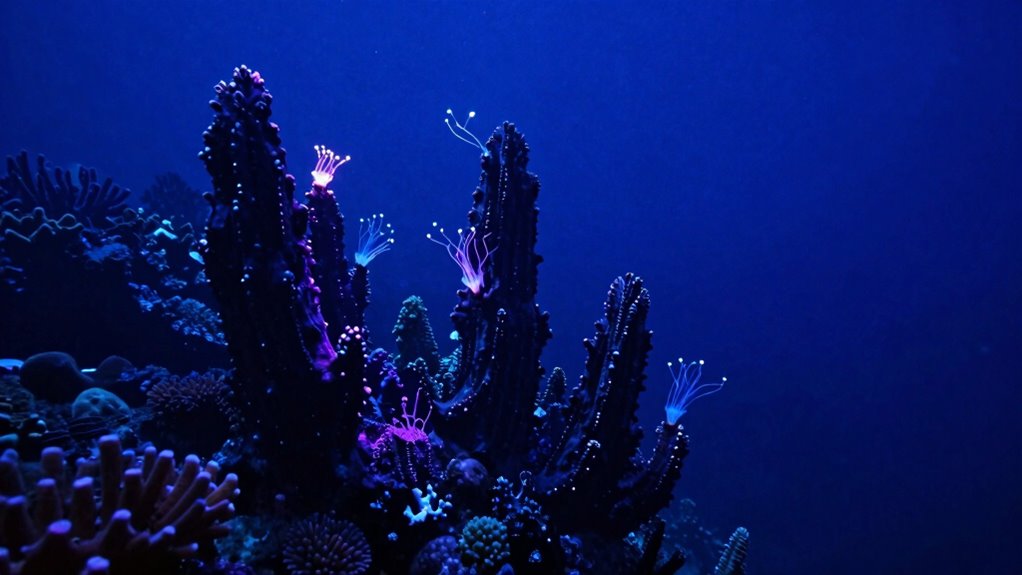
Have you ever wondered what lies beneath the world’s oceans? It’s a vast, mysterious domain that covers over 70% of the Earth’s surface, yet we’ve only scratched the surface of understanding it. Deep-ocean mapping is revealing just how little we know, and it still feels like exploring another planet. The deep sea is teeming with marine biodiversity, with countless species thriving in environments that push the limits of life. These ecosystems are unlike anything you’ve seen before, from bizarre, luminescent creatures to vast underwater mountain ranges and trenches. But revealing these secrets isn’t easy. The immense pressure, freezing temperatures, and darkness make the deep ocean a challenging environment for exploration. That’s where technological advancements come into play, dramatically transforming how we map and understand this alien world.
Thanks to innovative tools like autonomous underwater vehicles (AUVs) and remotely operated vehicles (ROVs), you can now venture into areas that were once inaccessible. These machines navigate the depths with precision, collecting high-resolution images and detailed data about the seafloor. Advanced sonar systems send out sound waves, creating detailed maps that reveal the topography of underwater landscapes. You might think of these as the ocean’s cartographers, charting terrains that resemble the surface of distant planets. Such technology has accelerated discoveries, unveiling underwater features like hydrothermal vents and deep-sea trenches that host unique ecosystems. These environments are so extreme that they challenge our understanding of where life can exist, highlighting the importance of continued exploration.
Despite these technological leaps, the deep ocean still feels like uncharted territory. You’re essentially venturing into a new world, one that’s filled with biological diversity that remains largely unexplored. Many species are yet to be discovered, and understanding their roles within these ecosystems could unlock answers to fundamental questions about life on Earth. The combination of marine biodiversity and cutting-edge tech keeps the mystery alive, making deep-ocean mapping a frontier of scientific discovery. Every new expedition pushes the boundaries further, revealing complex landscapes and fragile ecosystems that could be crucial to our planet’s health. As you look at the ongoing advancements, it’s clear that the deep ocean remains one of the last true frontiers—an alien world beneath the waves that continues to beckon explorers like you.
autonomous underwater vehicle for deep sea exploration
As an affiliate, we earn on qualifying purchases.
As an affiliate, we earn on qualifying purchases.
Frequently Asked Questions
How Deep Can Underwater Drones Currently Reach?
You’ll find that underwater drones can currently reach depths of around 6,000 meters, thanks to advanced remote sensing technology and autonomous navigation systems. These innovations allow you to explore the deep ocean with precision and safety, overcoming extreme pressure and darkness. As technology improves, your ability to map and understand the ocean’s depths continues to grow, making it feel as if you’re exploring another planet.
What Undiscovered Species Might Inhabit the Deep Ocean?
You might discover species like bioluminescent abyssal microfauna that glow in the dark depths, where over 80% of the ocean remains unexplored. These organisms thrive in bioluminescent ecosystems, creating a living light show. As you explore these uncharted territories, you could encounter strange, new creatures adapted to extreme pressure and darkness, revealing a hidden world teeming with life yet to be documented.
How Long Does It Take to Map a Single Deep-Sea Area?
Mapping a single deep-sea area can take months or even years, depending on its size and complexity. You rely on advanced marine geology techniques and detailed sonar surveys, which require careful planning. Ocean currents can influence data collection, making some areas harder to scan precisely. This slow process reflects the immense challenge of exploring the deep ocean, where every discovery feels like unearthing an entirely new world.
What Are the Biggest Technical Challenges in Deep-Ocean Mapping?
You face major technical challenges in deep-ocean mapping, especially in marine geology and steering ocean currents. Harsh conditions, immense pressure, and darkness make equipment vulnerable and data collection difficult. Ocean currents can distort survey paths, reducing accuracy and increasing time. Developing advanced, resilient mapping tools that withstand these elements is essential. Overcoming these hurdles helps reveal the ocean’s mysteries, similar to exploring a distant planet, and pushes the boundaries of marine science.
How Does Pressure Affect Underwater Exploration Equipment?
Did you know that pressure increases by about one atmosphere every ten meters underwater? This intense pressure affects your exploration equipment by testing its resilience; it can crush or damage devices if they’re not specially designed. To explore safely, you need equipment built to withstand these pressure effects, ensuring it functions correctly and remains intact under extreme conditions. Without this resilience, deep-ocean exploration would be nearly impossible.
high-resolution sonar mapping device
As an affiliate, we earn on qualifying purchases.
As an affiliate, we earn on qualifying purchases.
Conclusion
You might think ocean mapping is just about charts and sonar, but it’s really like exploring another planet. The deep ocean’s mysteries mirror distant worlds, with hidden landscapes waiting to be uncovered. As technology advances, you’ll see more detailed maps that reveal the unseen, transforming your understanding of Earth’s final frontier. So, keep imagining—you’re on the brink of discovering new worlds beneath the waves, just as if you were exploring distant planets.
ROV underwater remotely operated vehicle
As an affiliate, we earn on qualifying purchases.
As an affiliate, we earn on qualifying purchases.
deep ocean exploration equipment
As an affiliate, we earn on qualifying purchases.
As an affiliate, we earn on qualifying purchases.
Halloween Picks
halloween
As an affiliate, we earn on qualifying purchases.