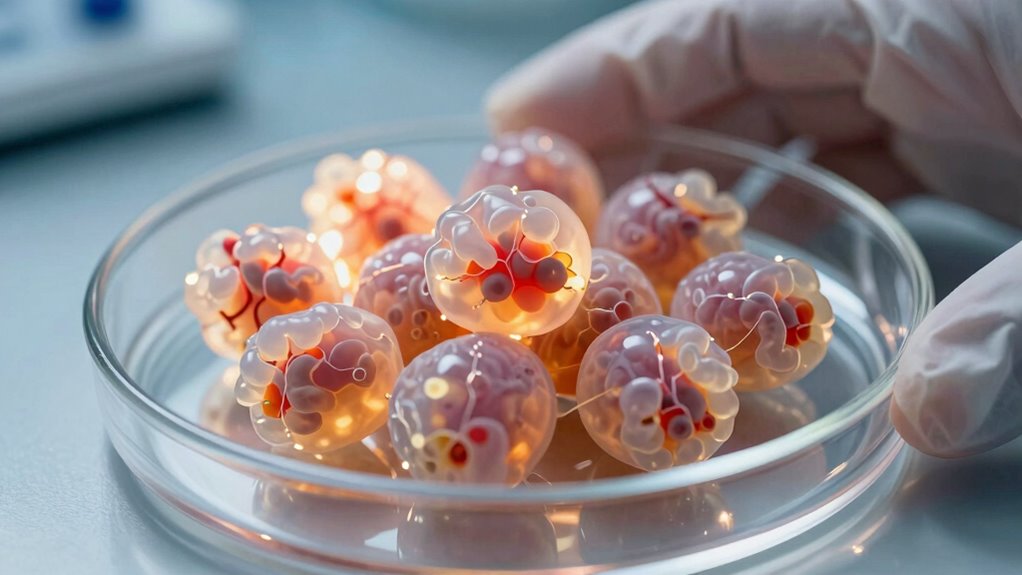

Lab-grown organoids are transforming medical research by giving you detailed, ethical models of human organs to study diseases, test drugs, and explore regenerative treatments. They allow scientists to observe complex biological processes in controlled environments without invasive procedures or animal testing. Advances in technology improve accuracy and consistency, making research more reliable. As you discover how these tiny organs are shaping future medicine, you’ll see just how impactful this innovative field truly is.

Get the latest gadgets delivered free with Prime
- Fast, free delivery on millions of items
- Prime Video, Amazon Music and more included
- Member-only deals all year
Key Takeaways
- Lab-grown organoids provide simplified, controllable models for studying organ development, disease mechanisms, and drug responses.
- They reduce reliance on invasive procedures and animal testing in medical research.
- Technological advancements improve reproducibility, accuracy, and standardization in organoid studies.
- Ethical considerations are prompting the development of guidelines to address moral questions surrounding complex organoids.
- Increased funding and innovation are accelerating the integration of organoids into personalized medicine and regenerative therapies.

Lab-grown organoids are revolutionizing medical research by providing miniature, simplified versions of organs that can be studied outside the human body. These tiny models allow you to observe complex biological processes in a controlled environment, reducing the need for invasive procedures and animal testing. As you explore their potential, you’ll notice that they offer invaluable insights into disease mechanisms, drug responses, and developmental processes. However, their use raises important ethical considerations. For instance, as organoids become more advanced and organ-like, questions arise about the moral status of these structures. You might wonder whether they deserve special protections or considerations, especially if they develop higher levels of complexity. Addressing these ethical dilemmas requires ongoing dialogue among scientists, ethicists, and policymakers to establish guidelines that respect both scientific progress and moral boundaries. The development of precise calibration techniques is also essential to improve the accuracy and reproducibility of organoid-based experiments. Additionally, advancements in neural interface technology could enhance our ability to manipulate and study brain organoids, opening new avenues for understanding neurological diseases. Researchers are also exploring ways to standardize protocols to reduce variability and improve comparability across studies. Moreover, public awareness of the ethical implications surrounding organoid research is crucial for fostering informed discussions and responsible innovation. As research continues, the importance of standardized protocols becomes evident to ensure consistency across different laboratories and studies. Furthermore, funding challenges play a significant role in shaping how quickly this promising field advances. Developing and maintaining lab-grown organoids demands substantial investment in cutting-edge technology, specialized training, and long-term research projects. You may find that securing consistent funding is difficult, especially when competing with other urgent healthcare priorities or traditional research methods. Limited resources can slow down innovation, restrict the scale of studies, and hinder the translation of findings into clinical practice. Despite these hurdles, many research institutions and government agencies recognize the transformative potential of organoids, which encourages ongoing grants and public support. As you follow the trajectory of lab-grown organoids in medical research, you’ll see that balancing ethical considerations with funding realities is vital. Researchers are challenged to innovate responsibly while steering moral questions about the nature of these organ-like structures. Simultaneously, funding bodies must prioritize investments that enable safe, ethical, and impactful research. This delicate balance influences how quickly organoid technology can be integrated into mainstream medicine, from personalized treatments to regenerative therapies. Ultimately, the progress you witness in this field depends on your collective efforts to address these ethical and financial challenges head-on, ensuring that the promising benefits of organoids are realized responsibly and sustainably.
As an affiliate, we earn on qualifying purchases.
Frequently Asked Questions
How Do Lab-Grown Organoids Compare to Actual Human Organs?
You’ll find that lab-grown organoids closely mimic real human organs in structure and function, making them excellent for organ simulation. They are made of synthetic tissues that replicate key features of actual organs, allowing you to study diseases and test treatments effectively. While not perfect duplicates, these organoids offer a practical, ethical alternative to studying full organs, advancing your understanding of human biology and improving medical research outcomes.
What Are the Main Ethical Considerations in Organoid Research?
You need to take into account stem cell ethics and consent protocols when researching organoids. Ethical concerns focus on donor consent for stem cell use and potential creation of complex, sentient-like structures. You should guarantee transparent consent processes, respecting donor rights, and carefully evaluate the moral implications of developing organoids with advanced neural features. Balancing scientific progress with ethical responsibility is vital to avoid misuse and public mistrust.
Can Organoids Fully Replace Animal Testing in Medical Research?
Organoids can greatly reduce reliance on animal testing by offering more human-relevant models for alternative testing. However, they can’t fully replace animal testing yet, mainly due to regulatory hurdles and the complexity of whole-organism interactions. You might see organoids used alongside traditional methods for now, helping to improve safety and efficacy assessments while working towards broader acceptance in regulatory frameworks.
How Long Does It Take to Develop a Functional Organoid?
Developing a functional organoid takes time, often spanning several weeks, as synthetic tissues undergo stem cell differentiation. During this process, your cells gently mature, transforming into specific tissue types, much like nurturing a delicate seed into a thriving plant. The exact timeline varies based on the organ type and complexity, but patience is crucial. This careful evolution ensures the organoid closely mimics real organs, advancing medical research and personalized medicine.
What Are the Biggest Challenges in Scaling up Organoid Production?
You face significant challenges in scaling up organoid production, mainly due to the complexity of maintaining consistency and quality. To overcome this, you need effective scaling techniques that guarantee uniformity across batches. Implementing production automation can streamline processes, reduce variability, and increase efficiency. However, integrating these technologies requires careful optimization and investment, making it a demanding but essential step toward large-scale, reliable organoid manufacturing for widespread research and medical applications.
neural interface technology for brain organoids
As an affiliate, we earn on qualifying purchases.
As an affiliate, we earn on qualifying purchases.
Conclusion
As you witness the rise of lab-grown organoids, you’re stepping into a new era of medicine where breakthroughs happen faster than a quill in a quak. These tiny, living models let you explore diseases and test treatments without risking lives — a true leap forward. Remember, just like the alchemists of old sought to turn lead into gold, today’s scientists aim to turn knowledge into cures. The future’s bright, and organoids are leading the charge.
standardized organoid research protocols
As an affiliate, we earn on qualifying purchases.
As an affiliate, we earn on qualifying purchases.
organoid imaging and analysis tools
As an affiliate, we earn on qualifying purchases.
As an affiliate, we earn on qualifying purchases.
Halloween Picks
halloween
As an affiliate, we earn on qualifying purchases.