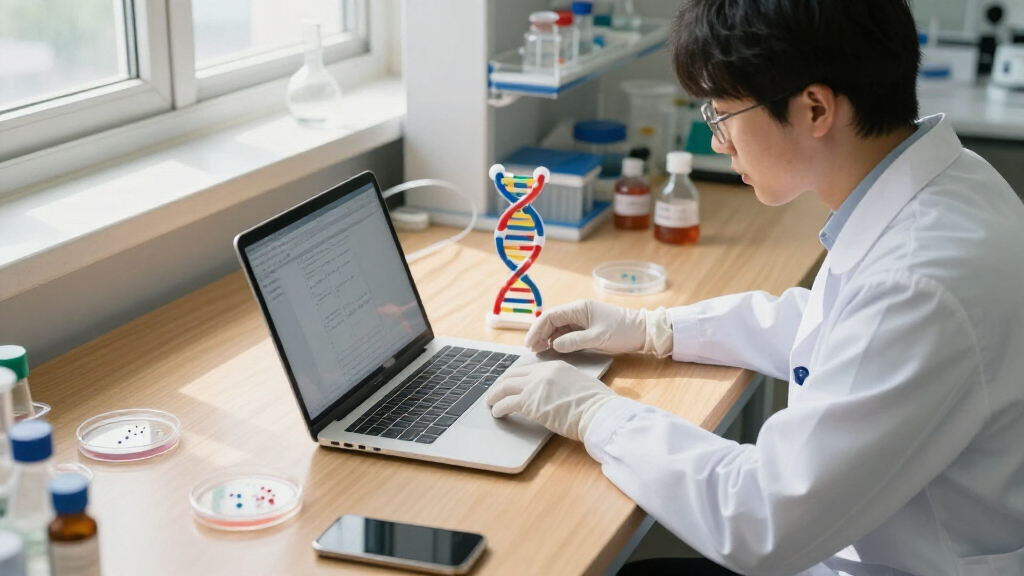

🔍 Read the full analysis: Revolutionizing Antimicrobial Research With Codex And ChatGPT AI Platforms on ThorstenMeyerAI.com

Get the latest gadgets delivered free with Prime
- Fast, free delivery on millions of items
- Prime Video, Amazon Music and more included
- Member-only deals all year
TL;DR
The University of Pennsylvania’s bioengineering lab uses AI platforms Codex and ChatGPT alongside deep-learning models to reduce antimicrobial candidate discovery from years to hours. This approach aims to address the growing threat of antimicrobial resistance, though candidates still face lengthy validation processes. For more on how AI is transforming antimicrobial research, see the original analysis. The development marks a significant shift in early drug discovery methods, as detailed in the original analysis.
The University of Pennsylvania’s bioengineering lab, led by César de la Fuente, has reported that its integration of AI tools such as ChatGPT and Codex with custom deep-learning models can now search genomes for antimicrobial candidates in a matter of hours, a process that traditionally takes years. This breakthrough significantly accelerates the initial phase of antimicrobial discovery, offering a potential new approach to combat rising antimicrobial resistance.
The lab’s approach treats biological systems as information networks, using deep-learning models trained to recognize patterns in DNA and protein sequences. By leveraging ChatGPT and Codex for hypothesis brainstorming, code development, and dataset analysis, and Codex for writing and refining computational workflows, the team has created an integrated pipeline that rapidly identifies promising antimicrobial peptides across vast genomic datasets.
According to the lab, this method can compress the early discovery phase from years to hours, dramatically reducing the time and cost associated with initial candidate screening. However, the report clarifies that this speedup applies only to the computational search stage; subsequent validation, testing for toxicity, resistance potential, and clinical trials remain lengthy and complex processes. No candidates discovered through this pipeline have yet entered clinical testing or received regulatory approval.
Impact of AI on Early Antibiotic Discovery
This development is significant because it offers a potential solution to the urgent global health crisis posed by antimicrobial resistance, which caused an estimated five million deaths in 2021 and is projected to double by 2050. Traditional discovery pipelines are slow, expensive, and largely reliant on modifying existing antibiotics, with no new classes introduced in nearly five decades. By rapidly narrowing down candidate molecules, AI could shift the focus of laboratory efforts toward the most promising options, potentially accelerating the development of new antibiotics.
Moreover, the use of general-purpose AI tools like ChatGPT and Codex demonstrates a broader trend: AI as a collaborative, cross-disciplinary partner that lowers barriers between biology, chemistry, and computer science. This integration could democratize and streamline early-stage drug discovery, enabling researchers from diverse backgrounds to contribute more effectively.
As an affiliate, we earn on qualifying purchases.
Background on AI-Driven Antimicrobial Research
Historically, antimicrobial discovery relied on isolating compounds from natural sources such as plants, microbes, and soil, followed by iterative testing—a process that could take years. The advent of digital genome databases has expanded the search to include organisms across the entire tree of life, including extinct species. Despite this, the bottleneck shifted from sample collection to signal detection—identifying meaningful antimicrobial signals within vast, complex datasets.
Previous research has shown that AI can identify promising peptides, but the scale and speed of this new pipeline represent a significant leap. De la Fuente’s lab emphasizes that the most promising discoveries often lie at the intersection of disciplines, where few researchers currently operate, making AI tools especially valuable in these uncharted territories.
“Antimicrobial resistance is one of the greatest existential threats to humanity. Our AI approach can drastically shorten the initial screening process, focusing lab work on the most promising candidates.”
— César de la Fuente
As an affiliate, we earn on qualifying purchases.
Unverified Claims and Developmental Limitations
The claim that candidate discovery has been compressed from years to hours is based solely on computational search times and has not yet translated into approved drugs. There are no published peer-reviewed results confirming the efficacy or safety of candidates identified through this pipeline. The report does not specify how many candidates have advanced to laboratory validation or clinical trials, and no molecules have been approved for use.
Additionally, the reliance on OpenAI’s promotional framing raises questions about potential bias. The actual impact of AI in subsequent validation, toxicity testing, and resistance management remains unverified and is likely to be the more challenging phase.
As an affiliate, we earn on qualifying purchases.
Next Steps for Validation and Clinical Development
The immediate next step involves laboratory validation of the AI-identified candidates to confirm antimicrobial activity and safety profiles. Researchers will need to test these molecules for toxicity, resistance development, and pharmacokinetics in vitro and in vivo. Successful candidates will then undergo the lengthy process of clinical trials, regulatory review, and manufacturing development.
The lab emphasizes that AI tools will continue to support each stage of this pipeline, but ground-truth experiments remain essential. Further peer-reviewed publications are anticipated to validate and refine this approach, and collaboration with regulatory agencies will be critical for translating these discoveries into approved therapies.
As an affiliate, we earn on qualifying purchases.
Key Questions
Can AI replace traditional antimicrobial discovery methods?
AI is expected to complement rather than replace traditional methods, primarily accelerating early-stage candidate identification. Validation and clinical testing will still require extensive laboratory work.
Are any of the AI-discovered candidates currently in clinical trials?
No, as of now, none of the candidates identified through this AI pipeline have entered clinical trials or received regulatory approval.
What are the limitations of this AI approach?
The main limitation is that the speedup applies only to the computational search stage. Subsequent validation, safety testing, and clinical development remain lengthy and complex processes.
How might this development impact global health?
If successfully translated into new antibiotics, this approach could significantly reduce the time and cost of bringing new drugs to market, helping address the rising threat of antimicrobial resistance.
Is this approach applicable to other drug discovery areas?
Yes, the principles of using AI for pattern recognition and rapid hypothesis generation can be extended to other areas such as antiviral, anticancer, or antifungal drug development.
Primary source: OpenAI · via ThorstenMeyerAI.com
Halloween Picks
halloween
As an affiliate, we earn on qualifying purchases.