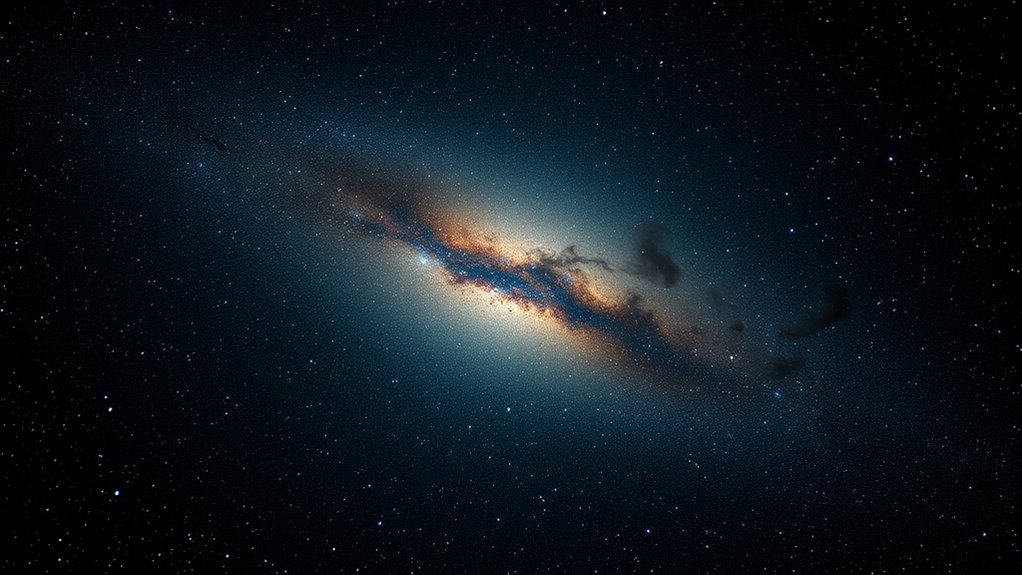

Scientists have detected a faint, mysterious glow coming from the Milky Way’s center, which might be linked to dark matter interactions. This diffuse emission isn’t caused by stars or gas clouds but suggests dark matter particles could be colliding or decaying. If true, this discovery could reveal new physics about dark matter’s nature and its role in galaxy formation. Keep exploring, and you’ll uncover more about what this glow could mean for our universe.
Key Takeaways
- Observations reveal a diffuse, unexplained glow near the Milky Way’s center, not caused by known stars or gas.
- The glow’s pattern suggests it may originate from dark matter particles interacting or decaying.
- Dark matter, comprising about 85% of the universe’s mass, could emit gamma rays detectable as this glow.
- Scientists are developing advanced instruments and simulations to confirm dark matter as the source.
- Confirming dark matter interactions would provide crucial insights into the universe’s unseen components and new physics.

Have you ever wondered about the mysterious light flickering across the Milky Way? It’s a phenomenon that has puzzled astronomers for years. Recently, scientists have observed an unusual glow emanating from the galaxy’s core, and it’s not easily explained by known sources like stars or gas clouds. Instead, this faint light might be linked to something even more elusive—dark matter. Dark matter makes up about 85% of the universe’s mass, yet it remains invisible, detectable only through its gravitational effects. Now, new research suggests that this strange glow could be a sign of dark matter particles interacting with each other or with normal matter in ways we haven’t fully understood before.
A mysterious glow near the galaxy’s core may reveal dark matter interactions, hinting at unseen cosmic forces.
This glow appears as a faint, diffuse emission that can’t be attributed to ordinary astrophysical objects. Researchers have used advanced telescopes and detectors to map the light’s distribution, noticing that it’s particularly concentrated around the galaxy’s center. The pattern hints at a process happening deep within the Milky Way’s dark matter halo—a vast, invisible sphere of mysterious particles surrounding the galaxy. The idea is that dark matter particles might occasionally collide or decay, releasing energy in the form of gamma rays or other particles that produce this faint glow. If true, it would offer a groundbreaking hint about the nature of dark matter, which remains one of the biggest mysteries in physics.
Scientists are developing new detection techniques to better understand these signals and distinguish them from other cosmic sources. Understanding dark matter interactions could reveal answers about how galaxies form and evolve. It could also reveal new physics beyond our current theories, possibly indicating particles that are unlike anything in the Standard Model. These interactions could be rare and subtle, making them hard to detect, but the persistent glow offers a potential window into these hidden processes. Scientists are now developing more sensitive instruments to differentiate this glow from other cosmic sources. They’re also running simulations to see if the signal matches predictions from dark matter theories, narrowing down the types of particles that could be responsible.
While alternative explanations like faint pulsars or unknown astrophysical phenomena are still considered, the idea that this glow signals dark matter interactions is compelling. It’s like a faint whisper from the universe’s most mysterious component. If future observations confirm this connection, it could revolutionize our understanding of the cosmos. You’d be witnessing a direct glimpse into the dark side of the universe—an invisible domain that shapes everything we see. As researchers continue to analyze the data, you can expect new insights to emerge, bringing us closer to unraveling one of the universe’s most profound secrets.
Top picks for "strange glow milky"
Open Amazon search results for this keyword.
As an affiliate, we earn on qualifying purchases.
Frequently Asked Questions
Could This Glow Indicate New Types of Particles?
Yes, this glow could indicate new types of particles. If dark matter interacts with itself or normal matter, it might produce signals like this faint glow. Scientists are exploring this possibility because discovering new particles would revolutionize our understanding of physics. You should keep an eye on ongoing research, as future observations and experiments could confirm these particles and reveal a whole new domain of fundamental particles beyond those currently known.
How Does This Discovery Impact Dark Matter Theories?
This discovery challenges existing dark matter theories by suggesting new interactions or particles that weren’t previously considered. You might need to rethink how dark matter interacts with itself or normal matter, possibly pointing to unknown properties. This could lead to developing more extensive models that explain the glow and expand your understanding of the universe’s unseen components. Stay tuned for further research that might reshape fundamental physics.
Can Similar Phenomena Be Observed in Other Galaxies?
Yes, you can observe similar phenomena in other galaxies, especially those with dense dark matter regions. Astronomers use advanced telescopes and detectors to scan for comparable glowing signals or anomalies. While these observations are challenging due to distance and noise, ongoing research aims to identify consistent patterns. Spotting such phenomena across galaxies would strengthen the dark matter interaction hypothesis and deepen your understanding of the universe’s hidden components.
What Tools Are Used to Detect Such Faint Signals?
Think of your telescopes as finely tuned listening devices, like a detective eavesdropping on whispers in a noisy room. You use space-based instruments such as the Fermi Gamma-ray Space Telescope and ground-based observatories like the Cherenkov Telescope Array. These tools detect faint signals across the electromagnetic spectrum—gamma rays, X-rays, and radio waves—allowing you to uncover hidden cosmic secrets and identify elusive phenomena like dark matter interactions.
Could This Glow Be Caused by Known Astrophysical Sources?
Yes, this glow could be caused by known astrophysical sources like pulsars, supernova remnants, or cosmic ray interactions with interstellar gas. These sources emit gamma rays and other signals that might resemble the observed glow. Scientists analyze the energy spectra and spatial distribution to differentiate between known sources and potential dark matter interactions. Ongoing research aims to determine if the glow’s origin is astrophysical or truly new physics.
Conclusion
As you gaze up at the night sky, that faint, mysterious glow in the Milky Way feels like a whisper from the universe’s deepest secrets. It’s as if shimmering shadows dance between the stars, hinting at dark matter’s elusive presence. This ghostly light beckons you to imagine unseen forces shaping the cosmos, urging you to explore the unknown. In that quiet glow, the universe’s hidden mysteries quietly invite your curiosity to shine brighter.