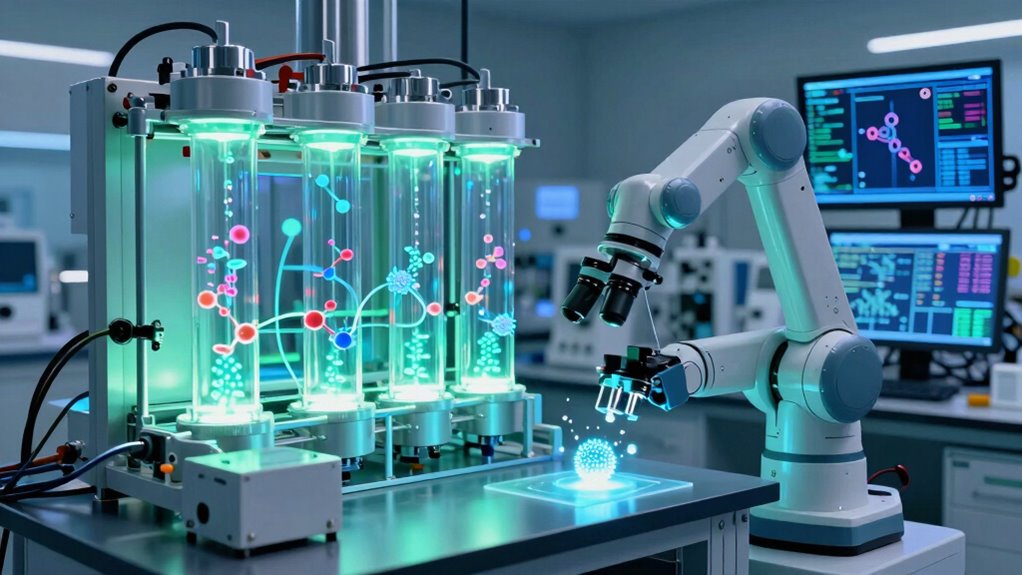

Synthetic biology is quickly advancing from a laboratory curiosity to an essential industrial tool by enabling you to engineer organisms precisely for sustainable manufacturing. It’s opening new possibilities for producing materials, chemicals, and pharmaceuticals at scale. As regulations evolve and ethical considerations grow, industry leaders are working closely with policymakers to guarantee safety and transparency. If you want to understand how this shift is transforming industries and impacting society, there’s more to explore ahead.
Key Takeaways
- Advances in precise organism engineering enable scalable industrial applications of synthetic biology.
- Increasing regulatory frameworks ensure safety and compliance for real-world deployment.
- Ethical considerations and societal engagement build public trust and responsible innovation.
- Development of international standards promotes harmonization and safe global adoption.
- Collaboration with policymakers facilitates the transition from laboratory research to commercial products.
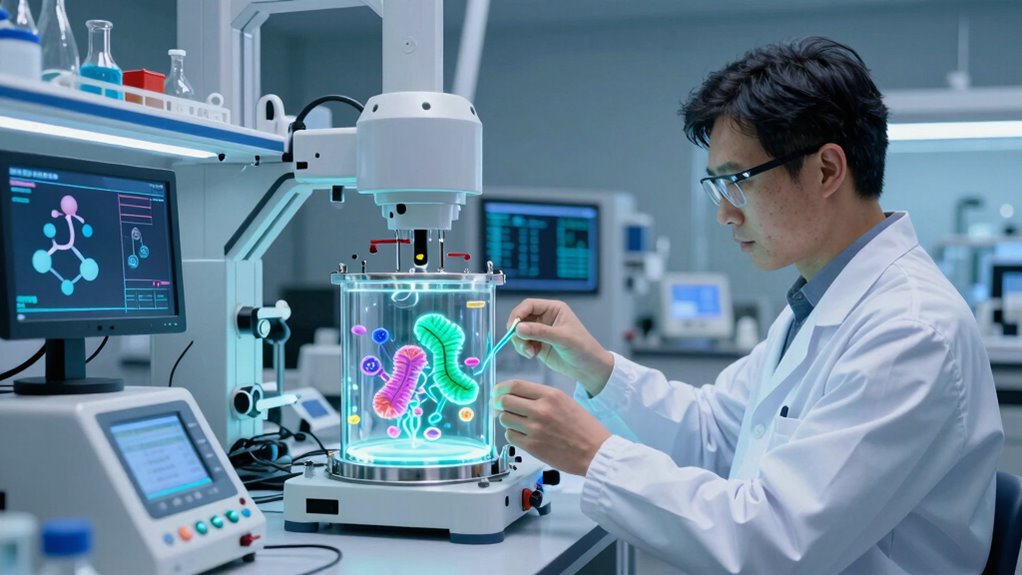
Synthetic biology has rapidly emerged as a powerful industrial tool, transforming how we design and produce materials, chemicals, and pharmaceuticals. This innovative field allows you to engineer organisms with precision, releasing new possibilities for sustainable manufacturing. However, as you move from laboratory experiments to real-world applications, you must confront important ethical considerations. The power to modify genetic material raises questions about safety, environmental impact, and the potential for misuse. You need to navigate these concerns carefully, guaranteeing that your work aligns with societal values and minimizes risks. Engaging with the public and stakeholders becomes essential in fostering trust and transparency, especially as synthetic biology starts to impact everyday life.
Synthetic biology’s power demands ethical care, transparency, and stakeholder engagement to ensure safe, responsible innovation.
Alongside ethical considerations, regulatory challenges present significant hurdles. Governments and international bodies are still developing frameworks to oversee synthetic biology’s growth. You might find yourself needing to comply with a patchwork of regulations, which can slow down innovation and increase costs. Assuring your products meet safety standards involves rigorous testing and documentation, adding layers of complexity to your development process. Regulatory agencies are also tasked with balancing innovation with public safety, which can lead to delays in approving new technologies. Staying ahead means keeping informed about evolving policies and actively participating in discussions around regulation to shape fair and effective guidelines. Additionally, understanding the regulatory landscape is crucial for navigating these complexities and ensuring compliance. Building awareness of global standards can help streamline your efforts and foster international cooperation. Recognizing the importance of public perception is essential for gaining acceptance and support for your innovations.
The shift from lab curiosity to industrial tool requires you to address these ethical and regulatory issues proactively. You must implement responsible research practices, such as risk assessments and containment strategies, to prevent unintended consequences. Building ethical frameworks into your development processes helps demonstrate your commitment to safety and societal benefit. Additionally, establishing international standards can facilitate smoother global adoption and foster collaboration across borders. This involves harmonizing regulations and sharing best practices to ensure consistent safety and ethical benchmarks worldwide. At the same time, collaborating with policymakers and regulatory bodies can smooth the path for commercial deployment. By working within existing frameworks and advocating for clear, science-based regulations, you help foster an environment where innovation can thrive without compromising safety or ethics.
Ultimately, your success in transforming synthetic biology into a mainstream industrial tool depends on how well you navigate these challenges. Embracing transparency, responsibility, and collaboration ensures that your advancements are sustainable and accepted by society. As the field matures, ongoing dialogue around ethical considerations and regulatory challenges will shape its trajectory. You play a pivotal role in shaping a future where synthetic biology’s potential is harnessed responsibly, benefiting industries, communities, and the environment alike. Moving forward, balancing innovation with ethical integrity and regulatory compliance will be key to harnessing the full promise of synthetic biology as a transformative industrial force.

DEXSUR 30 Pcs Advanced Dissection Kit Biology Lab Anatomy Dissecting Set for Medical Students and Veterinary with Stainless Steel Scalpel Knife Handle Blades
- Complete Dissection Kit: 30 pieces with carrying case
- Premium Stainless Steel: Durable and safe for professional use
- Designed for Versatility: Includes essential tools for various procedures
As an affiliate, we earn on qualifying purchases.
As an affiliate, we earn on qualifying purchases.
Frequently Asked Questions
How Cost-Effective Is Synthetic Biology for Large-Scale Production?
Synthetic biology can be cost-effective for large-scale production, but you need to address scalability challenges carefully. While initial costs may be high, advances in genetic engineering and automation improve cost efficiency over time. You’ll find that optimizing processes and reducing raw material expenses help make large-scale applications viable. However, ongoing research is essential to overcome hurdles in scaling up, ensuring that synthetic biology remains economically competitive for industrial use.
What Are the Main Ethical Concerns Surrounding Synthetic Biology?
You should be aware that bioethics debates and moral implications heavily influence synthetic biology. Concerns include unintended environmental impacts, biosecurity risks, and manipulating life forms, which raise questions about playing god. You might worry about the long-term consequences of creating new organisms, and whether such innovations respect natural boundaries. Addressing these ethical concerns is essential for responsible development, ensuring synthetic biology benefits society without compromising moral values.
How Does Synthetic Biology Compare to Traditional Manufacturing Methods?
You’ll find synthetic biology is a game-changer compared to traditional manufacturing, offering more precise control over biological systems. It often reduces waste and energy use, but you should also consider bioengineering ethics and ecological impacts. Unlike conventional methods, synthetic biology can create novel materials or medicines efficiently. However, it’s essential to weigh benefits against potential risks, ensuring responsible development and minimizing unintended environmental consequences.
What Regulatory Challenges Does Synthetic Biology Face Globally?
You face several regulatory challenges in synthetic biology, especially with international regulations that vary widely. Biosafety protocols are essential but often inconsistent across countries, creating hurdles for global collaboration and commercialization. Managing these complex legal landscapes requires staying updated on local and international rules, ensuring your projects meet safety standards, and advocating for harmonized regulations to accelerate responsible innovation while minimizing risks.
How Do Intellectual Property Rights Impact Synthetic Biology Innovation?
Think of intellectual patents as sturdy fences around your garden of ideas, protecting your innovations. They encourage you to plant seeds of creativity without fear of theft, fueling more breakthroughs. However, these fences can also block others from crossing and building on your work, possibly slowing overall innovation. Balancing intellectual patents with open collaboration guarantees you’re rewarded while still nurturing a fertile ground for synthetic biology’s growth.

Synthetic Biology: Tools for Engineering Biological Systems (Perspectives CSHL)
As an affiliate, we earn on qualifying purchases.
As an affiliate, we earn on qualifying purchases.
Conclusion
You’ve seen how synthetic biology is transforming industries, from sustainable manufacturing to medicine. With the global market projected to reach $20 billion by 2025, it’s clear this field is no longer just a lab curiosity. You’re part of an exciting era where engineered organisms could revolutionize how we produce everything from biofuels to pharmaceuticals. Embrace these innovations—synthetic biology is shaping a smarter, greener future, and you’re right at the forefront of it.

Advin Covid 19 at Home Test Kit, Rapid Results Under 10 mins, Easy to Use (1 case- 144 Pack – 288 Tests)
- Rapid Results: Results in under 10 minutes
- User-Friendly: Easy to use with simple instructions
- High Accuracy: Detects active COVID-19 antigens
As an affiliate, we earn on qualifying purchases.
As an affiliate, we earn on qualifying purchases.

The Biodynamic Farm: Developing a Holistic Organism
As an affiliate, we earn on qualifying purchases.
As an affiliate, we earn on qualifying purchases.