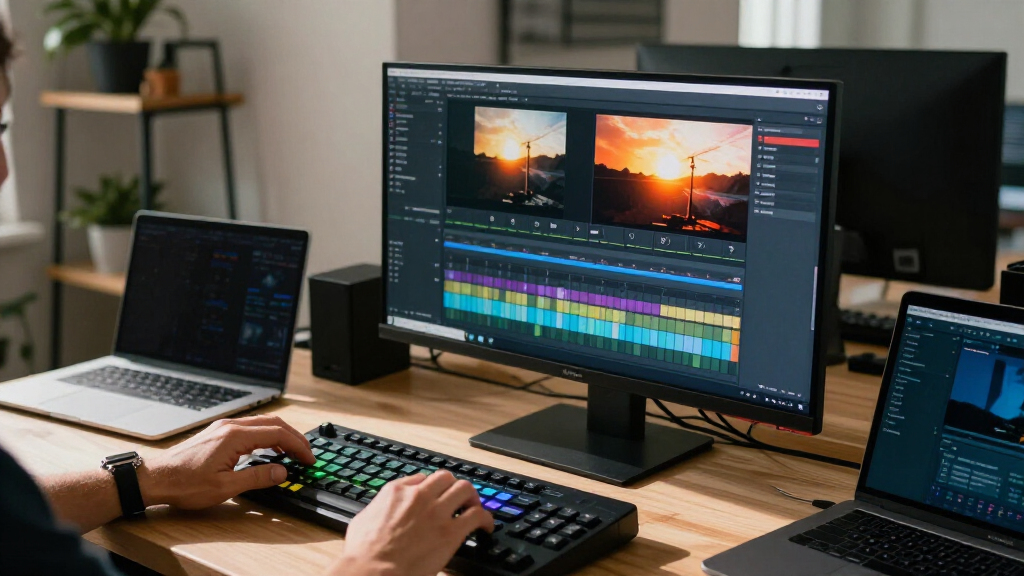

🔍 Read the full analysis: What Changes When Invideo Uses GPT‑6 Astra For Color Grading on ThorstenMeyerAI.com

Get the latest gadgets delivered free with Prime
- Fast, free delivery on millions of items
- Prime Video, Amazon Music and more included
- Member-only deals all year
TL;DR
OpenAI’s published customer story says video platform invideo improved color grading speed threefold using GPT-6 Astra. The customer result is attributed to invideo in OpenAI’s account; the available source material does not explain its measurement, baseline or test conditions.
OpenAI’s published customer story reports that video editing platform invideo improved color grading speed threefold with its GPT-6 Astra model, as detailed in the original analysis. OpenAI attributes the result to invideo, but the article body is not available in the source material, leaving the measurement and comparison behind the figure unverified.
OpenAI’s customer story identifies invideo as the customer and color grading as the workflow. Color grading involves adjusting a video’s color, contrast and tone to create a chosen look or maintain consistency across footage. The headline published by OpenAI attributes a threefold speed improvement to invideo’s use of GPT-6 Astra.
The available OpenAI material does not establish what the speed figure measures. It could refer to processing time, human review, the number of editing iterations, or a combination of steps. The baseline, workload and test conditions are also not stated, so the multiplier cannot be compared precisely with another editing process.
OpenAI’s available source does not describe the specific implementation. It does not say whether GPT-6 Astra directly changes grading settings, recommends adjustments to a separate tool, or assists a person who makes the final changes. It also provides no figures for cost, output quality, or the amount of human review required.
Potential Gains for Video Creators
If the improvement reported in OpenAI’s customer story applies to routine projects, faster grading could help marketing teams, social media producers and small businesses finish video work sooner. Color grading is a skilled post-production task, and reducing the time needed for it could make consistent visual treatment more accessible to creators without dedicated colorists. OpenAI’s published account does not show how broad that benefit is.
The case also gives OpenAI a named example of a model being used in a video production workflow. For invideo, a faster grading process could support its appeal to users who want to produce videos through a browser-based platform. Whether this creates a user-visible advantage over competing editing products remains unknown; OpenAI’s source includes no comparative performance data or user feedback.
For companies evaluating AI tools, the customer story is a signal of activity in multimodal video editing, rather than independent proof of a particular level of performance. OpenAI’s report describes a result attributed to its customer, but readers need its methods and comparison point to judge what the reported multiplier means for their own work.
Products Worth Considering

Amazon Kindle Scribe Colorsoft 64GB (1st Generation)

Bose QuietComfort True Wireless Earbuds with Active Noise Cancellation, Black

Samsung 27-inch Odyssey OLED G6 QD-OLED QHD Gaming Monitor
As an affiliate, we earn on qualifying purchases.
A Vendor Customer Story
OpenAI presents the result as a customer story about applying GPT-6 Astra to a production workflow. Such stories can show how a company says it uses a model, while also serving as vendor communications about customer adoption. In this case, OpenAI’s available source attributes the result to invideo but does not include the full account or an independent evaluation.
The source material describes GPT-6 Astra as a multimodal model. In principle, multimodal systems can take visual information and natural-language instructions into account, which could be relevant to requests such as matching a reference or changing a scene’s overall tone. That possible fit does not establish how invideo built its grading system: the product architecture and model’s specific role have not been disclosed in the material available here.
How the Speed Figure Was Measured
The principal unknown is what “threefold faster” means in practice. OpenAI’s available source does not specify whether invideo compared GPT-6 Astra with human colorists, its previous automated workflow, or another system. It gives no time window, sample size, footage types or description of how the result was recorded.
It is also unclear whether the reported result covers the full grading process or one step within it, and how much human correction remains necessary. The available material does not discuss performance on challenging footage, such as mixed lighting or scenes where accurate skin tones matter. No independent reproduction or third-party review is cited. These gaps do not disprove the customer claim, but they limit what readers can conclude from it.
Details Needed to Verify the Result
The next useful development would be access to the full OpenAI case study, including the baseline, measurement method and tested workload. Those details would clarify whether the speedup reflects faster processing, fewer editing cycles or a broader improvement in production throughput. Evidence about output quality and human review would help show whether time savings come with trade-offs.
Until those details are available, the threefold figure should be treated as a result attributed to invideo and published by OpenAI, rather than an independently verified benchmark. The available source material does not state a rollout schedule, wider availability change or further evaluation. Whether the claimed gain holds across different users and footage remains open.
Key Questions
What did OpenAI say invideo improved?
OpenAI’s customer story reports that invideo improved the speed of its color grading workflow threefold using GPT-6 Astra.
What does the threefold figure measure?
The available OpenAI source does not say. It gives no measurement method, baseline, workload or test conditions, so the figure’s precise comparison basis is unknown.
Has the result been independently verified?
No independent reproduction or third-party review is cited in the available material. The figure is presented as a customer result in an OpenAI publication.
How does GPT-6 Astra fit into invideo’s grading process?
The implementation has not been described in OpenAI’s available source. It is unclear whether the model adjusts grading directly, guides another system or assists a human reviewer.
Primary source: OpenAI · via ThorstenMeyerAI.com