
TL;DR
OpenAI said on November 18 that its models rewrote parts of AMD chip designs, with the best reported result reaching a 14% improvement across power, performance and area against heavily optimized baselines. The figure is an OpenAI claim; the company has not identified the blocks or provided an average, and no independent audit is public.
OpenAI said November 18 that its models rewrote portions of AMD chip designs, reporting best-case gains of up to 14% in power, performance and area (PPA) against heavily optimized baselines. OpenAI says some model-generated changes are in a design AMD has sent for manufacturing, but it has not disclosed which blocks produced the 14% result or published an independent assessment.

Get the latest gadgets delivered free with Prime
- Fast, free delivery on millions of items
- Prime Video, Amazon Music and more included
- Member-only deals all year
OpenAI described using its models to propose changes to SystemVerilog register-transfer-level (RTL) code, which specifies how chip circuits behave. According to the company’s account, reported by ANI and other outlets, Synopsys design tools checked whether rewritten code preserved the original behavior and evaluated changes to power, performance or area. The process measures candidate designs at a stage before later physical implementation and manufacturing.
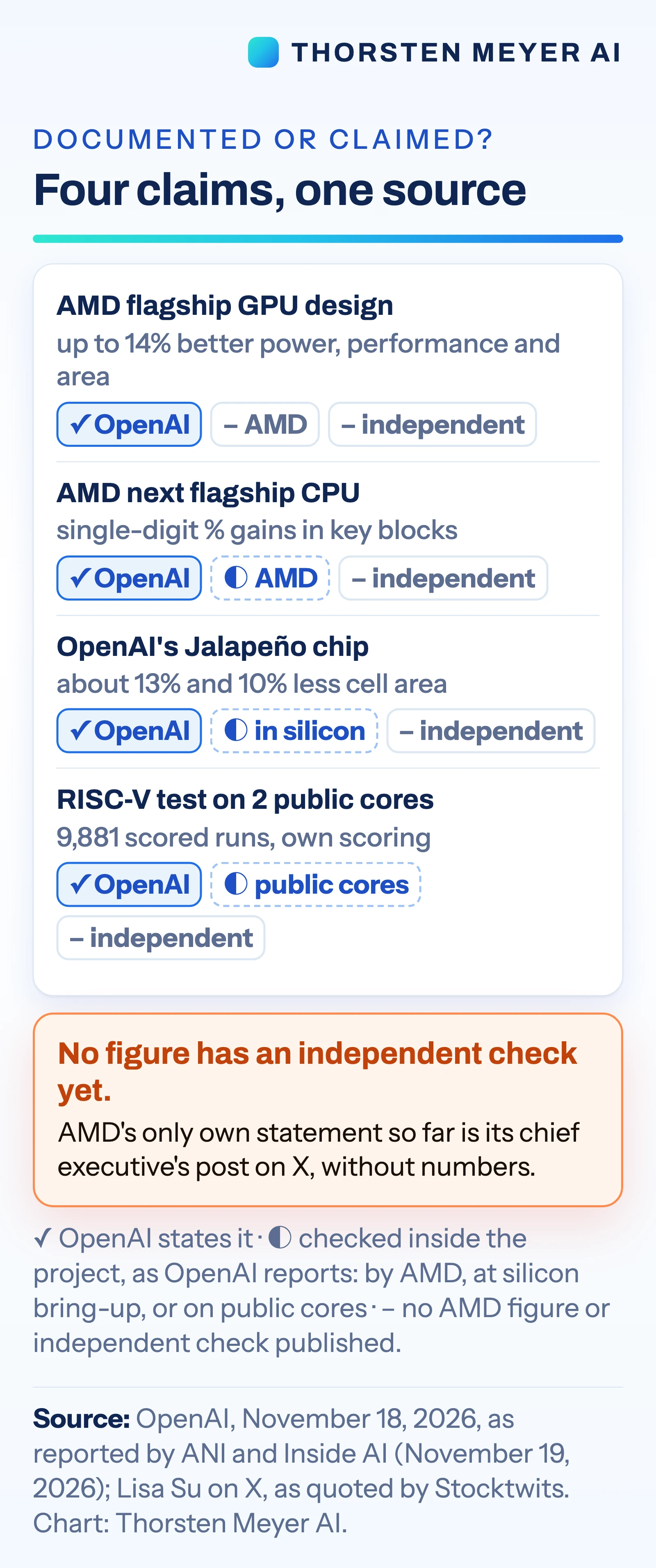
The AMD results cover more than one product and are not all reported at the same level of detail. OpenAI said the flagship GPU design had up to 14% better PPA than “heavily optimised baselines.” It did not name the affected blocks, give the average result across changes, or specify which of the three PPA measures improved by how much. OpenAI also said AMD had verified single-digit percentage PPA gains in key blocks of its next flagship CPU. The company said some changes were included in a recent design sent for manufacturing, while others entered AMD production design files for future versions.
OpenAI separately reported results on its own Jalapeño inference chip. It said model-proposed changes reduced standard-cell area by about 13% in one unit and 10% in another, with the changes validated after initial chips returned. Reports differ on the name of the first unit, describing it as a warp engine or vector unit. These figures concern specific blocks and area; they should not be read as whole-chip improvements or as the AMD GPU result.
AI Tools Enter Chip Design
The announcement describes AI models being used to change the hardware that runs AI systems. If the changes perform as OpenAI reports and persist through manufacturing, improving circuit area, speed or power use could affect the cost and capacity of future processors. A design already sent for manufacturing would indicate that at least some proposed changes have moved beyond a research exercise, though the company has not identified those changes or reported silicon measurements for AMD’s design.
The result also matters because AMD and OpenAI have a financial relationship. Under an agreement announced in October 2025, OpenAI holds a warrant for up to 160 million AMD shares, with vesting tied to AMD chip deployments. That relationship does not establish whether the reported engineering results are accurate, but it is relevant when weighing claims that have not yet been independently checked. The public record currently gives readers OpenAI’s summary rather than block-level data from AMD or an external audit.
Products Worth Considering

Bose Home Speaker 500 Smart Speaker with Alexa, Black

DJI Mini 4K Fly More Combo Drone with 4K Camera and 3 Batteries

Bose QuietComfort True Wireless Earbuds with Active Noise Cancellation, Bluetooth 5.3, USB-C Charging, IPX4, Black
As an affiliate, we earn on qualifying purchases.
From RTL Code to Chip Layout
RTL is an early design representation: engineers describe a circuit’s behavior in code, and synthesis tools translate that description into logic. Later stages determine how components are placed and connected on silicon. A rewritten RTL block can preserve the same function while using a different circuit structure, but gains reported at one stage do not by themselves establish the final performance, power consumption or area of a manufactured processor.
OpenAI’s announcement also described tests on two open-source RISC-V processor cores, PicoRV32 and Ibex. The company said it scored 9,881 model runs across the cores and that GPT-6.2 Astra, released November 17, had the highest score. These benchmark results are separate from the AMD product claims: they do not verify the reported 14% improvement or show that the same gains apply across chip designs.
The Missing Block-Level Evidence
The 14% figure is a maximum reported by OpenAI, not a disclosed average across the GPU design. The announcement, as summarized in the cited reports, does not identify the specific blocks, say whether 14% applies to power, performance or area individually or to a combined measure, or provide the comparison data needed to reproduce the calculation. OpenAI described the baselines as heavily optimized but did not publish their specifications.
It is also unclear which exact changes AMD sent for manufacturing, how those changes performed in final silicon, and whether AMD independently confirms the GPU figure. No independent audit of the results has been published. The Jalapeño unit naming differs across reports, and the available accounts do not resolve the discrepancy.
Manufacturing Results Still Ahead
The next useful evidence would be AMD’s own technical results identifying the affected blocks, baselines and measured PPA values, followed by results from manufactured silicon where available. OpenAI has said some changes are in a design sent for manufacturing, but has not provided a timetable for production or public measurement data. Until either company releases more detail, the gains remain company-reported results at the level described in the announcement.
Key Questions
What does the reported 14% improvement measure?
OpenAI reported up to 14% improvement in power, performance and area for parts of AMD’s flagship GPU design, compared with what it called heavily optimized baselines. It has not specified the individual metric values or named the blocks behind the best result.
Did AMD confirm the 14% figure?
The source material says AMD verified single-digit gains in key blocks of its next flagship CPU. It does not report AMD publishing its own figures for the GPU’s 14% result.
Were the changes used in a manufactured chip?
OpenAI said some model-generated changes were included in a design AMD sent for manufacturing. The public account does not identify those changes or report measurements from AMD silicon.
Has an independent party audited the results?
No independent audit of the chip-design results has been published in the source material. The headline figures are reported by OpenAI, with further technical details still unavailable.
Source: Thorsten Meyer AI