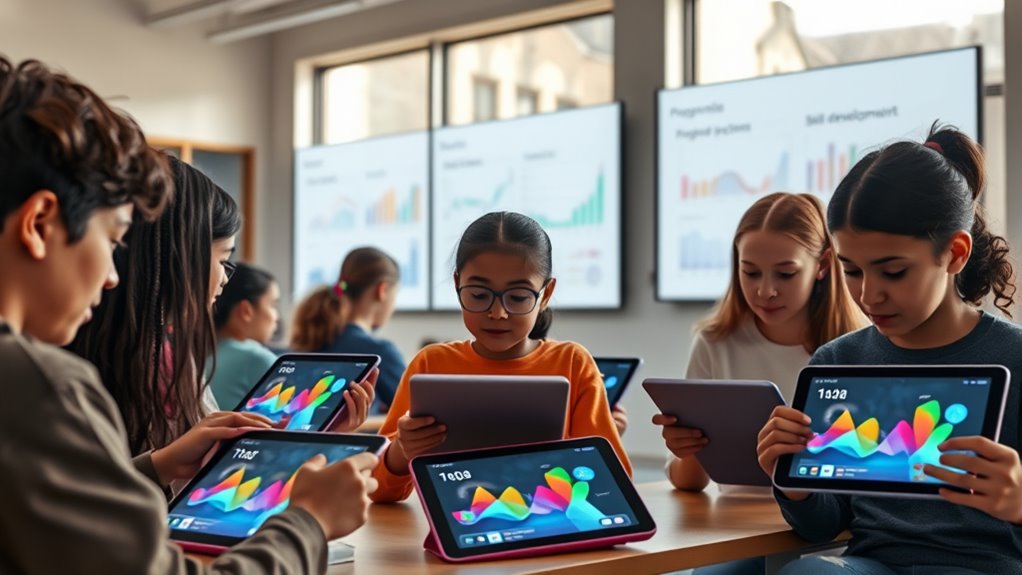

AI revolutionizes education by creating personalized learning experiences tailored to your needs and pace. It analyzes your strengths and weaknesses in real time, adjusting lessons to maximize understanding and retention. With instant feedback and progress tracking, you can refine your skills efficiently, while adaptive environments keep you motivated and challenged. Plus, AI helps educators by automating tasks and providing valuable insights for future planning. Keep exploring to discover how AI can open your full learning potential.
Key Takeaways
- AI personalizes lessons and activities based on individual learning styles, needs, and progress for more effective education.
- Provides real-time feedback and progress tracking to identify gaps and support mastery of skills.
- Automates administrative tasks like grading and attendance, allowing teachers to focus on personalized student support.
- Creates adaptive learning environments that adjust content and difficulty to maintain motivation and engagement.
- Uses data analytics to inform curriculum design, predict challenges, and enhance overall teaching strategies.
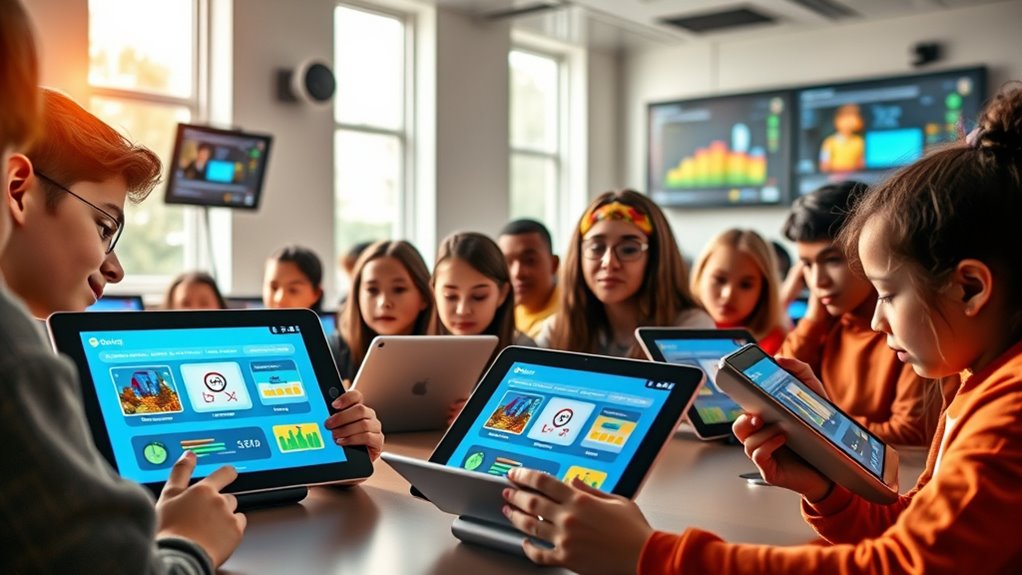
Artificial Intelligence is transforming education by providing personalized learning experiences and automating administrative tasks. You no longer need to follow a one-size-fits-all approach; AI tailors lessons and activities to fit your individual needs, pace, and learning style. When you interact with AI-powered platforms, they analyze your strengths, weaknesses, and progress in real time, adjusting content to keep you engaged and challenged just enough. This personalized approach helps you grasp concepts faster and retain information longer, making your learning journey more effective and enjoyable.
With AI, you get immediate feedback on your assignments or quizzes, enabling you to identify gaps in your understanding right away. Instead of waiting days for a teacher to grade papers, AI systems can assess your work instantly, providing detailed insights and suggestions for improvement. This continuous feedback loop allows you to focus on mastering skills rather than just completing tasks, fostering a growth mindset and boosting your confidence as you see tangible progress.
AI provides instant feedback on your work, helping you improve quickly and build confidence through continuous progress.
At the same time, AI automates many administrative duties that traditionally take up educators’ time. Tasks like grading, attendance tracking, and scheduling can be handled efficiently by AI systems, freeing up teachers to devote more time to personal interaction and mentorship. As a student, you benefit from this shift because your teachers can spend more quality time addressing your individual needs rather than being bogged down by paperwork. It creates a more engaging learning environment where you feel supported and motivated.
Moreover, AI facilitates adaptive learning environments that can evolve as you learn. If you’re struggling with a particular topic, AI can recommend additional resources, exercises, or tutorials tailored to your difficulty level. Conversely, if you’re excelling, it can introduce more advanced material to keep you challenged. This dynamic adjustment ensures that you stay motivated and avoid boredom or frustration, whether you’re excelling or facing hurdles.
AI-driven analytics also help educators understand your learning patterns and preferences better, enabling more tailored instruction. This insight allows them to design more effective curricula and interventions suited to your specific needs. As a result, you benefit from a more targeted and responsive educational experience. Over time, AI can even predict future learning challenges, helping you prepare for exams or new topics proactively. Additionally, understanding educational data can lead to more strategic improvements in teaching methods and curriculum design, ultimately enhancing the overall quality of education.
Frequently Asked Questions
How Does AI Adapt to Diverse Learning Styles?
AI adapts to your diverse learning styles by analyzing your interactions and progress. It identifies whether you learn best through visuals, hands-on activities, or reading, then tailors content accordingly. As you engage, AI adjusts the difficulty level and offers personalized resources to match your preferences. This continuous feedback loop guarantees your learning experience remains effective, engaging, and suited specifically to how you learn best.
What Are the Privacy Concerns With AI in Education?
Imagine your private data being as exposed as a floppy disk in a cyber age. Privacy concerns with AI in education include data breaches, unauthorized access, and misuse of personal information. You might worry about how your child’s learning data is stored and shared. To protect yourself, demand transparency from providers, use secure platforms, and stay informed about your rights, just like you’d safeguard your treasured vintage tech.
How Accessible Is AI Technology for Underserved Schools?
AI technology’s accessibility for underserved schools remains limited, but efforts are growing to bridge the gap. You might find that funding constraints, lack of infrastructure, and technical expertise act as barriers, making it harder for these schools to adopt AI tools. However, initiatives from governments and nonprofits aim to provide affordable solutions and training, so your school could benefit as these programs expand and become more widespread in the future.
Can AI Replace Human Teachers Entirely?
No, AI can’t replace human teachers entirely; think of AI as a helpful map, guiding students but lacking the warmth of a caring hand. While AI can personalize lessons and provide instant feedback, it misses the human touch—empathy, inspiration, and understanding—that only teachers bring. Your role as an educator remains irreplaceable, shaping minds and hearts in ways no machine can replicate.
What Skills Are Necessary for Educators to Implement AI Tools?
To implement AI tools effectively, you need strong technical skills, including understanding AI basics and data analysis. You should also develop digital literacy to navigate new platforms confidently. Critical thinking helps you evaluate AI outputs, while adaptability ensures you stay updated with evolving technologies. Communication skills are essential for explaining AI concepts to students. Finally, a collaborative mindset enables you to work with tech teams and colleagues to optimize AI integration in your teaching.
Conclusion
As you embrace AI in education, think of it as a guiding lighthouse illuminating each learner’s path. It personalizes your journey, helping you navigate skills development with clarity and confidence. With AI as your ally, you can unleash your full potential, transforming challenges into opportunities. Just like a lighthouse stands firm amidst stormy seas, AI stands ready to support your growth, ensuring your educational voyage is bright, focused, and full of promise.