
TL;DR
Mistral is betting on European digital sovereignty, offering open-weight models and full-stack control to regulated industries. Its strategy aims to reduce dependency on US giants, but the real test is whether this approach can match global AI benchmarks and infrastructure growth.
Europe faces a stark choice: chase the US giants or build its own AI fortress. Mistral’s recent summit laid bare a bold claim—it’s not just about better models, but about sovereignty, control, and independence. If you’re wondering whether this is a masterstroke or a desperate gamble, you’re not alone.
In this article, we’ll explore what Mistral is really doing—beyond the hype—and how its focus on open-weight models, full-stack control, and European infrastructure fits into a bigger picture of digital independence. Buckle up, because this isn’t just tech talk. It’s a geopolitical chess game.
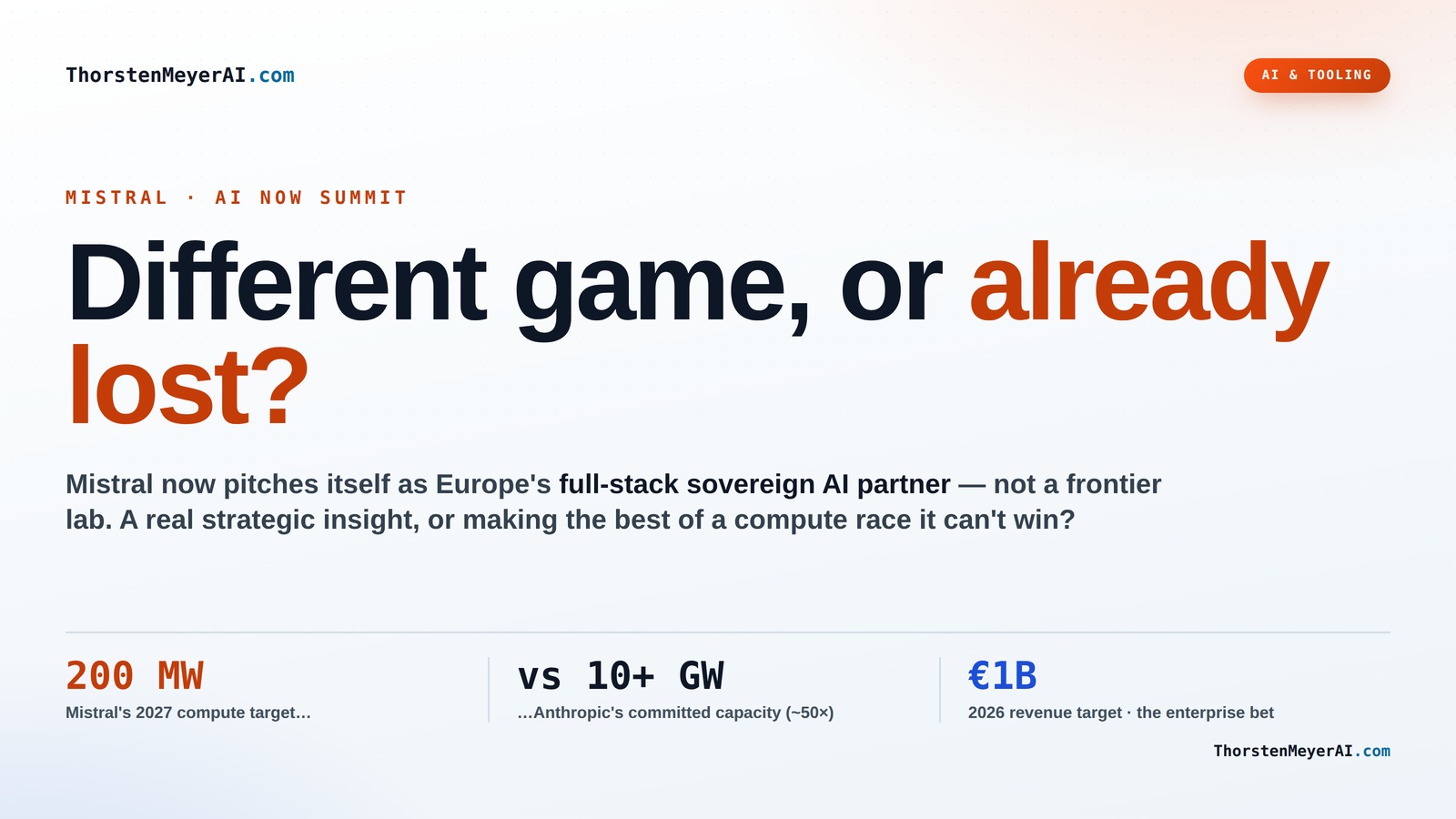
Different game, or already lost?
Mistral now pitches itself as Europe’s full-stack AI provider — compute, models, platform, consultancy — not a frontier-model lab. Is that a real strategic insight, or making the best of a race it can’t win? Both readings fit the same facts.
From model lab to full-stack provider
The clearest signal from the summit wasn’t a model — it was a posture. Heavy on enterprise logos and partnerships (ASML, BNP Paribas, Alexa+), light on new-model announcements. That absence is exactly what skeptics seized on.
Compute
40MW Paris DC + Sweden build · 200MW target by 2027
Models
Open & custom · efficient · you own and run them
Platform
Forge for custom models · Vibe for Work agent
Consultancy
Sales teams, integrators, EU provenance & support

Towards a Pan-European Telecommunication Service Infrastructure – IS&N '94: Second International Conference on Intelligence in Broadband Services and … (Lecture Notes in Computer Science, 851)
As an affiliate, we earn on qualifying purchases.
As an affiliate, we earn on qualifying purchases.
Small & focused, or large & general?
Mistral bets on specialized small models. The claim isn’t that they win a reasoning leaderboard — they don’t. It’s that on the metrics that matter in production agent systems, a purpose-built small model wins. Flip the metric to see the case reverse.
Small specialized vs large general — by what you measure
In token-heavy agentic apps making hundreds of calls, speed/energy/cost compound. Toggle the metric.

AI AND SMART APPLICATIONS WITH C# 14 AND .NET 10: Build Intelligent, Data-Driven, and Cloud-Ready Solutions Using Modern .NET Architecture
As an affiliate, we earn on qualifying purchases.
As an affiliate, we earn on qualifying purchases.
Narrow models doing real work
Each is one model doing one thing efficiently — the tangible version of the strategy. Strong on their own terms; the open question is whether the bundle beats a free Chinese open-weight download.
On-prem KYC compliance
Mistral models run inside the bank’s walls for know-your-customer checks. Sensitive financial data never leaves. (BNP was Mistral’s first customer, 2023.)
Voxtral multilingual voice
A focused voice model powering Alexa+ across Europe — speed and efficiency over raw size.
Robostral industrial robotics
Plus a “physics AI” push (via the Emmi acquisition) into aerospace, automotive & semiconductor design and simulation.
Document AI / OCR at scale
Large-scale text extraction — the unglamorous, high-volume enterprise work small models excel at.
Platform Engineering for Artificial Intelligence: Designing scalable infrastructure, data pipelines, and model lifecycle management for generative AI and agentic protocols (English Edition)
As an affiliate, we earn on qualifying purchases.
As an affiliate, we earn on qualifying purchases.
The strategy is downstream of the compute gap
Once you see the raw numbers, “why is Mistral behind?” answers itself — and the specialized-small-model strategy starts looking partly like a smart adaptation to a binding constraint, not a pure philosophical choice.
Compute & capital · Mistral vs a frontier leader, this same week
Not a knock — it’s the constraint that forces the efficiency-first, sovereignty-wedge strategy. Adapting intelligently to your position is what good strategy is.

NVIDIA Jetson AGX Orin 64GB Developer Kit with Ethernet, USB, Display Port
The NVIDIA Jetson AGX Orin 64GB Developer Kit makes it easy to get started with Jetson Orin. Compact…
As an affiliate, we earn on qualifying purchases.
As an affiliate, we earn on qualifying purchases.
“I want them to win, but I’m worried”
That ambivalence is the most accurate read of where Mistral sits. The enterprise pivot gets read two opposite ways — and both deserve airing.
On-prem, real sales teams, the Koyeb deployment acquisition, EU provenance — exactly what regulated enterprises want, and stickier than consumer mindshare. Targeting €1B revenue in 2026 with 1,000 staff, up from 15 people and one customer in 2023. US closed-API labs structurally can’t match the sovereignty axis.
“Software consultancy with a data center,” not a foundation-model moat. Enterprise B2B is where European startups go when they can’t win consumer or world-scale SaaS. Why pay Mistral on-prem when you could run Qwen free? One paying Le Chat Pro user said the quality gap with frontier labs is now hard to ignore.
Key Takeaways
- Mistral’s sovereignty focus is a strategic move to serve regulated European industries with control and compliance at its core.
- Open-weight models enable self-hosting, giving users full control but raising questions about performance versus US cloud giants.
- Small, purpose-built models can outperform large general-purpose ones in specific enterprise applications—speed, cost, control matter.
- Europe’s long-term AI independence depends not just on models but on investments in local infrastructure and policy support.
- Mistral’s game is about carving a niche in sovereignty—whether it’s a winning long-term strategy or a temporary pause in the AI race is still uncertain.
What Mistral’s Sovereignty Dream Really Means for Europe
Mistral’s sovereignty isn’t just a slogan; it’s a strategic blueprint. The company aims to empower European enterprises and governments with AI that they can own, control, and run locally. That means models you can download, fine-tune, and deploy on your own servers—no reliance on US cloud giants.
Imagine a French bank encrypting customer data with models hosted entirely in Europe, adhering to strict data laws. Or a government agency deploying AI that’s fully under its jurisdiction. That’s the core promise—control over data, infrastructure, and AI assets.
This approach isn’t just ideological. Recent policy shifts in Europe spotlight the need for digital sovereignty—less dependence on US and Chinese infrastructure, more local capacity. Mistral’s focus on this aligns perfectly with Europe’s broader industrial and security ambitions.
However, this pursuit of sovereignty involves significant tradeoffs. Maintaining local infrastructure and models requires substantial investment and technical expertise. It also risks fragmenting the AI ecosystem, making it harder for European entities to access the latest innovations without collaboration. The challenge is balancing independence with the need for a competitive, innovative ecosystem that can keep pace with global AI advancements.

Why Open-Weight Models Are the Heart of Mistral’s Strategy
Open-weight models are the backbone of Mistral’s pitch. Unlike OpenAI or Anthropic, which lock their models behind APIs, Mistral releases models that anyone can download, modify, and run internally. This approach is rooted in the belief that true sovereignty requires complete control—over the model, its training, and deployment environment.
Take Mistral’s latest models—designed to be lightweight, fast, and customizable. They’re tailored for enterprise needs where control and cost matter more than chasing the biggest AI benchmarks. For example, a European bank running Mistral models on-premises can ensure their data remains within their jurisdiction, complying with GDPR and local regulations. This reduces reliance on external cloud providers, which could be subject to foreign jurisdiction and data access risks.
However, this open approach also introduces challenges. Open-weight models often lag behind in raw performance compared to proprietary models from US giants, which benefit from massive training datasets and compute resources. The tradeoff is clear: sovereignty and control versus cutting-edge performance. For regulated industries, this tradeoff might be acceptable or even preferable, but for general-purpose applications aiming for state-of-the-art results, it’s a significant consideration. The decision to prioritize openness and control shapes not just Mistral’s strategy but also the broader debate about AI innovation versus sovereignty.

Building a European AI Ecosystem: Opportunities and Challenges
For Europe's AI ambitions to succeed, Mistral’s strategy must be integrated into a broader ecosystem that includes startups, academia, and industry players. Creating a vibrant, collaborative environment is essential for developing the talent, infrastructure, and innovation needed to compete globally.
One opportunity lies in fostering open-source initiatives and shared standards that can accelerate development while maintaining sovereignty. However, challenges such as funding, talent retention, and regulatory hurdles remain. Europe's regulatory landscape, while aimed at protecting privacy and security, can sometimes slow down innovation if not balanced carefully.
Moreover, the infrastructure gap—especially in cloud compute and data centers—poses a significant obstacle. Without local data centers and high-performance compute resources, even the most innovative models can’t reach their full potential. This requires long-term investment and policy support, emphasizing the importance of public-private partnerships and cross-border collaboration within Europe.
Ultimately, building this ecosystem is about more than just technology; it’s about creating a sustainable, resilient foundation that can adapt to rapid AI advancements and global competition. The tradeoff is whether Europe can prioritize sovereignty without sacrificing the speed of innovation that global players enjoy.
Frequently Asked Questions
What does ‘sovereign’ mean in Mistral’s context?
In Mistral’s case, sovereignty means enabling European clients to own, deploy, and run AI models locally—controlling data, infrastructure, and compliance without relying on US cloud providers.Is Mistral truly independent, or just less dependent?
Mistral aims for genuine independence through open-weight models and local compute, but whether this fully reduces reliance on global infrastructure remains to be seen—especially as performance gaps are still evident.Why do open-weight models matter?
Open-weight models give users the freedom to customize, control, and host their AI—crucial for regulated sectors and governments that need strict control over their data and AI assets.Can Mistral be deployed on-premises?
Yes. Mistral’s models are designed for local deployment, making them attractive for enterprise and government use where data privacy and control are priorities.Is Europe really at risk of dependence on US AI infrastructure?
Yes. Without significant investment in local compute, data centers, and talent, Europe risks falling behind in AI sovereignty, making companies like Mistral’s strategy vital for future independence.Conclusion
Europe’s sovereignty quest isn’t just a marketing line; it’s a real, tangible challenge. Mistral’s approach—powerful, open, and controlled—embodies that desire for independence. Whether it wins or not, it’s reshaping what AI sovereignty means in a world dominated by US giants.
Remember: the game isn’t just about model size or speed. It’s about control, infrastructure, and the will to build a different future. That’s a story worth watching—and maybe even joining.