

Gewerkton has entered beta with a voice-first platform designed to turn activity on construction sites into structured evidence, reports and coordinated project data. Born in the German market but built for global deployment, the platform combines construction documentation and defect management with support for 27 content languages, selectable regional AI providers and data-residency options.

Get the latest gadgets delivered free with Prime
- Fast, free delivery on millions of items
- Prime Video, Amazon Music and more included
- Member-only deals all year
Tech News · Gewerkton beta
From a spoken site event to structured project evidence
Gewerkton enters beta with one voice-first platform spanning field records, browser-based plans and models, and coordinated project data.
One platform · three connected product lines
Field
Voice-first capture for evidence, defects, daywork reports, takt and portal functions.
Studio
Browser workspace for plans and models — including creating a model where none exists.
Cloud
Operations and model or data coordination across Field, Studio and third parties.
German commercial depth
AI processing can include mainland China. Data can reside in an EU cloud or on the user’s own infrastructure.
The beta’s core proposition
“On site, what counts is what’s proven.”
The product is in beta now, with a public beta planned for fall 2026. That distinction matters: Gewerkton already has a defined three-part product structure and a broad set of capabilities, but it remains beta software rather than a finished public release.
The central idea is captured by the company’s marketing line: “On site, what counts is what’s proven.” Gewerkton applies that principle across voice capture, photos, original audio, plans, models, reports and operational coordination. The aim is to help site teams record what happened while keeping that information usable for the people managing the wider project.
voice-activated construction site documentation device
As an affiliate, we earn on qualifying purchases.
As an affiliate, we earn on qualifying purchases.
One platform, three connected product lines
The Gewerkton platform is organised as a single branded house with three product lines: Field, Studio and Cloud. Each covers a different part of the workflow, from the first spoken record on site to the coordination of models and data.
Gewerkton Field is the voice-first construction-site app. Its scope runs from dictation to evidence, defects and daywork reports, as well as takt and portal functions. In practice, it is the part of the platform closest to crews and events on site: the place where spoken input becomes a structured project record.
Gewerkton Studio is the browser workspace for plans and models. Where no model exists, the site team can create one directly in the browser. That gives the platform a route into projects that already have model-based workflows and those where the necessary model has not yet been prepared.
Gewerkton Cloud handles operations and model or data coordination between Field, Studio and third parties. It is the connecting layer for information captured on site, work carried out in the browser and data exchanged outside Gewerkton’s own product environment.
Together, the three lines address a familiar construction problem: evidence may begin as a voice note, photograph, instruction or signature, but it must remain connected to the project’s plans, models, deadlines and commercial processes. Gewerkton’s beta brings those functions under one brand while keeping the site app, browser workspace and coordination layer distinct.
construction defect management software
As an affiliate, we earn on qualifying purchases.
As an affiliate, we earn on qualifying purchases.
German commercial depth, global operating scope
Gewerkton’s strongest local integration is with German commercial construction workflows. The platform supports GAEB, REB, XRechnung and DATEV, giving it deep connections to the formats and systems used around quantities, billing, invoices and accounting in the German market.
That local foundation is paired with a broader international design. Gewerkton supports 27 content languages and is intended for teams working across the EU, US and APAC. Cross-border participants can work on the same project in their own languages while the evidence original remains unambiguous.
The multilingual approach extends from capture to reporting. On projects in Asia, for example, Chinese, Korean and Vietnamese crews can work across those stages without forcing the entire project into a single operating language. Gewerkton also makes the region used for AI processing selectable, including providers in the EU, US and Asia, with mainland China included.

multilingual construction project reporting tools
As an affiliate, we earn on qualifying purchases.
As an affiliate, we earn on qualifying purchases.
Bring-your-own AI and regional choice
The platform’s BYO-AI model supports 13 AI providers. Organisations bring their own keys and choose the region that matches the project, rather than being tied to one AI vendor. Provider options span the EU, US and Asia, including mainland China.
That choice sits alongside Gewerkton’s data-residency position: users can select an EU cloud or their own infrastructure. The combination of bring-your-own keys, selectable provider regions and infrastructure choice is intended to make the AI layer adaptable to projects operating in different territories.
Gewerkton itself was built by a solo founder directing a fleet of coding agents using Codex and Claude. In one night, that fleet shipped 21 software packages. The packages were verified with negative controls and mutation tests, an unusually concentrated development episode behind a platform that is still moving through beta.
construction site activity recording device
As an affiliate, we earn on qualifying purchases.
As an affiliate, we earn on qualifying purchases.
What the beta covers on site
The deployment fields are broad, but the common thread is the need to capture evidence across complex, fast-moving or geographically dispersed work.
Wind farms and renewables
Wind farms and renewable-energy projects often involve distributed sites and rotating crews. Gewerkton is positioned around field acceptance and offline capture in dead zones, allowing work to be recorded where connectivity is unavailable. Voice-first capture gives crews a way to document activity at the point where it happens rather than waiting to reconstruct events later.
Data centres and industrial plants
Data centres and industrial plants bring many trades together in parallel under tight deadlines. Gewerkton can turn decisions made in meetings into task lists sorted by trade. That creates a direct route from discussion to the teams responsible for carrying out the resulting work.
Housing and building construction
For housing and general building construction, the platform covers defects recorded with a photograph and deadline, dictated daywork reports and signatures collected on the device during handover. These are practical site records rather than separate administrative exercises, placing documentation and defect management alongside daywork and acceptance workflows.
Infrastructure and tunnels
Infrastructure and tunnel projects can run for long periods and generate many change orders. Here, Gewerkton’s stated use case centres on instructions backed by original audio. The spoken source remains attached to the record, giving project teams the evidence original behind the resulting instruction.
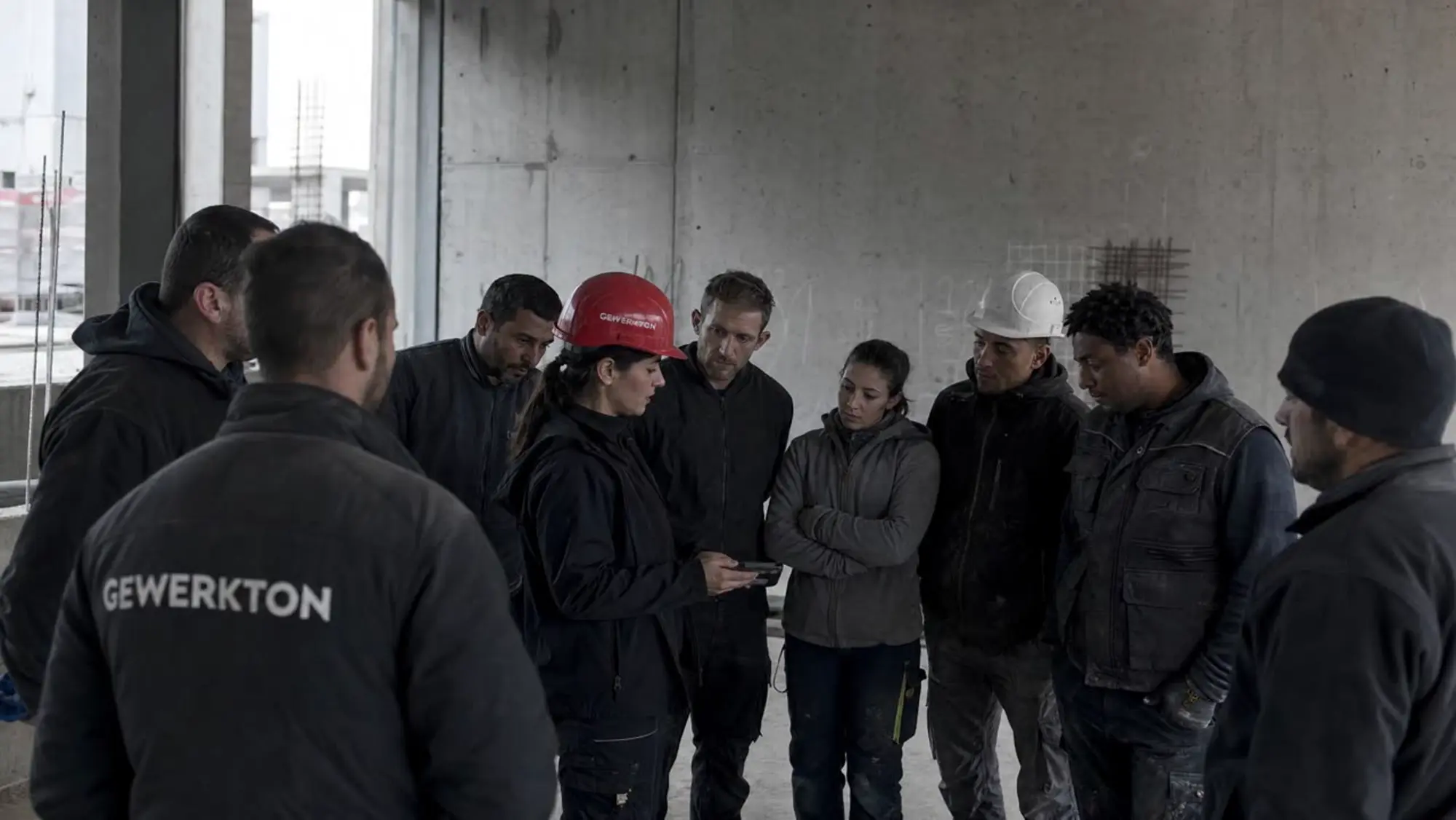
Cross-border and Asian projects
For teams distributed across the EU, US and APAC, language support is part of the operating model rather than an added translation step. Participants can work in their own language on a shared project while retaining an unambiguous evidence original. On Asian projects, multilingual capture and reporting can support Chinese, Korean and Vietnamese crews, with data residency chosen according to the project’s requirements.
A deliberately quiet marketing stack
The public-facing technology around the product follows a similarly controlled approach. Gewerkton’s marketing site is available in 27 languages and runs with zero trackers. It has no cookie banner and uses a fully egress-free architecture.
The company has also assembled a media bank containing more than 51 self-produced clips and posters. That material supports the presentation of a platform whose scope ranges from dictation and photographic evidence to browser-created models, commercial integrations and regional AI choice.
What ships now, and what remains beta
The current beta spans Field, Studio and Cloud. Field covers voice-led site capture, evidence, defects, daywork reports, takt and portal functions. Studio provides browser-based work with plans and models, including creating a model where none exists. Cloud coordinates operations and model or project data across the two products and third parties.
The beta also presents the platform’s wider operating framework: 27 content languages, 13 bring-your-own AI providers, selectable EU, US and Asian regions, support for mainland China, and a choice between an EU cloud and the user’s own infrastructure. German commercial integration covers GAEB, REB, XRechnung and DATEV.
What has not happened yet is the public beta. That is planned for fall 2026. Until then, Gewerkton should be read as an ambitious beta platform with a clearly defined product architecture, not as a completed general release.
Its proposition is straightforward: capture the original event on site, turn it into usable project information and keep that information connected across Field, Studio and Cloud. The range of target projects may stretch from housing handovers to wind farms, data centres and tunnels, but the underlying requirement remains consistent: construction records need to survive the distance between the work itself and the people coordinating what happens next.
Halloween Picks
halloween
As an affiliate, we earn on qualifying purchases.