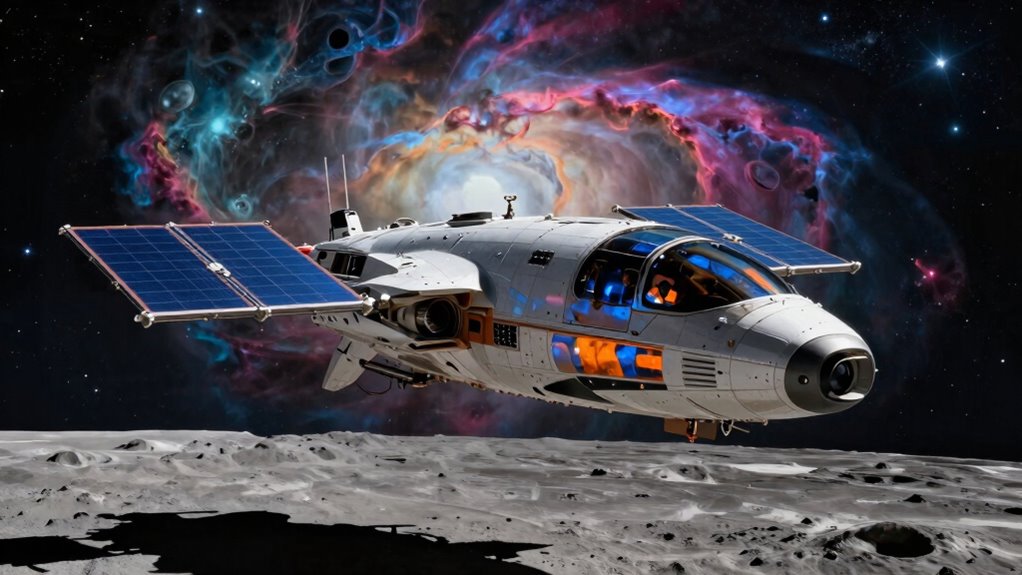

The new space race now focuses on commercial interests, private companies, and technological innovations, not just lunar exploration. You can see efforts shifting toward satellite technology, space tourism, and building space infrastructure. These advancements are making space more accessible and useful for everyone, from connecting remote areas to enabling new industries. If you want to understand how this evolving landscape impacts your world — from connectivity to economy — keep exploring what’s next in space.
Key Takeaways
- The new space race now focuses on commercial ventures, satellite technology, and space tourism, beyond just lunar exploration.
- Private sector involvement accelerates innovation in space transportation, infrastructure, and satellite deployment.
- Space tourism is transforming space into an accessible industry for private citizens, not just astronauts.
- Advancements in satellite tech support global connectivity, navigation, and disaster management, expanding space’s role in daily life.
- Evolving regulations and public-private partnerships are shaping a sustainable, multi-faceted future in space activities.

As nations and private companies gear up for a new era of exploration, the space race has shifted from government-led missions to a high-stakes competition driven by innovation and commercial interests. Today, you’re witnessing a dynamic landscape where satellite technology plays a pivotal role. These satellites aren’t just tools for communication or weather forecasting anymore; they now support everything from global internet coverage to advanced navigation systems. Companies are launching constellations of small satellites to ensure faster, cheaper, and more reliable connectivity worldwide. This revolution in satellite technology means you could soon experience seamless internet even in remote areas, fundamentally changing how you connect and communicate.
Satellite technology now powers global internet, navigation, and connectivity, transforming how we communicate and access information worldwide.
Alongside these advancements, space tourism is emerging as a major frontier, transforming the once-fantastical idea of space travel into a tangible industry. Instead of just government astronauts, now private citizens like you could travel to space for leisure. Companies are developing spacecraft capable of taking tourists on suborbital or even orbital journeys, offering a new perspective on Earth that was once reserved for astronauts. This shift isn’t just about adventure; it’s about democratizing access to space and igniting a new wave of interest and investment. You might find yourself booking a ticket to orbit, experiencing weightlessness, and viewing our planet from a vantage point that few have seen.
The push for space tourism also accelerates technological innovation. To make space travel safe and affordable for civilians, companies are refining rocket design, life support systems, and even in-flight entertainment. This progress benefits other sectors too, with advancements in satellite technology trickling down into everyday applications like GPS, weather prediction, and disaster management. As these technologies improve, you’ll see more precise navigation, better climate monitoring, and enhanced safety measures both on Earth and in space. Additionally, the integration of advanced satellite technology is helping to develop more reliable and resilient space transportation systems. A growing emphasis on space infrastructure is also crucial to support these new ventures. Furthermore, increased private sector involvement is driving competition and innovation, shaping the future landscape of space activities. The evolving regulatory environment will also play a key role in ensuring safe and sustainable exploration.
Furthermore, the commercial focus on space fuels competition and collaboration. You’re likely to see partnerships between governments and private firms, blending resourcefulness with regulatory support. This synergy pushes the boundaries of what’s possible, making space more accessible and opening new markets. As a consumer or investor, you can expect a future where space isn’t just the domain of scientists or astronauts but a realm of opportunity for entrepreneurs, travelers, and everyday users.
In this new space race, innovation isn’t just about reaching celestial bodies; it’s about transforming how we connect, explore, and expand our horizons. Satellite technology and space tourism are at the forefront, shaping a future where space becomes an integral part of your daily life. Additionally, the increasing role of commercial space activities highlights the growing importance of private sector involvement in shaping the future of space exploration.
As an affiliate, we earn on qualifying purchases.
Frequently Asked Questions
How Are Private Companies Funding Their Space Missions?
You see, private companies fund their space missions mainly through private funding and venture capital investments. They attract funds by offering innovative technology, promising commercial applications, and future profits. Venture capitalists see potential in space ventures and invest heavily, hoping for substantial returns. This approach allows companies to bypass traditional government funding, accelerating space exploration efforts and developing new markets like satellite services, space tourism, and resource mining.
What Are the Environmental Impacts of Increased Space Activity?
Imagine space as a fragile glass orb; increased activity risks shattering it. You might not see it, but space debris clouds our celestial neighborhood, threatening satellites and future missions. Plus, without strict planetary protection measures, Earth’s pristine environments could face contamination. As you push further into space, remember your actions echo back, impacting the universe’s delicate balance and Earth’s environment for generations to come.
How Does International Law Regulate Space Exploration?
International law regulates space exploration primarily through treaties like the Outer Space Treaty, which emphasizes space sovereignty and prohibits national claims on celestial bodies. You need to understand that legal jurisdiction depends on where activities occur; for example, a country’s laws govern spacecraft registered under its jurisdiction. These rules aim to prevent conflicts, ensure responsible exploration, and promote peaceful use, but enforcement remains a challenge as more nations participate.
What Technologies Are Emerging for Deep Space Travel?
You might be surprised to learn that emerging technologies like advanced propulsion system innovations are revolutionizing deep space travel. Astrobiology research fuels the excitement, as scientists explore life beyond Earth, pushing boundaries further than ever. These breakthroughs could make journeys to Mars or even distant exoplanets feasible, transforming what we thought was impossible into reality. As you watch space exploration evolve, remember these innovations are the essential to uncover our cosmic future.
How Will Space Resource Mining Affect Earth’s Economy?
You’ll see space resource mining boost Earth’s economy by providing rare materials and fuels, but it might also increase space debris and lead to orbital conflicts. As companies race for valuable resources, the risk of cluttering Earth’s orbit grows, complicating satellite operations and increasing collision chances. This could spark international disputes over space territory rights, ultimately impacting global markets and necessitating stricter regulations to balance economic gains with space sustainability.
As an affiliate, we earn on qualifying purchases.
Conclusion
As you watch this new space race unfold, remember it’s not just about reaching the moon anymore; it’s like a race across a cosmic highway, where every player speeds toward the next frontier. The stakes are higher, and the finish line keeps shifting. So, stay curious and alert—because in this race to the stars, the journey is just as thrilling as the destination. And who knows? You might be part of the next leap forward.
As an affiliate, we earn on qualifying purchases.
As an affiliate, we earn on qualifying purchases.