

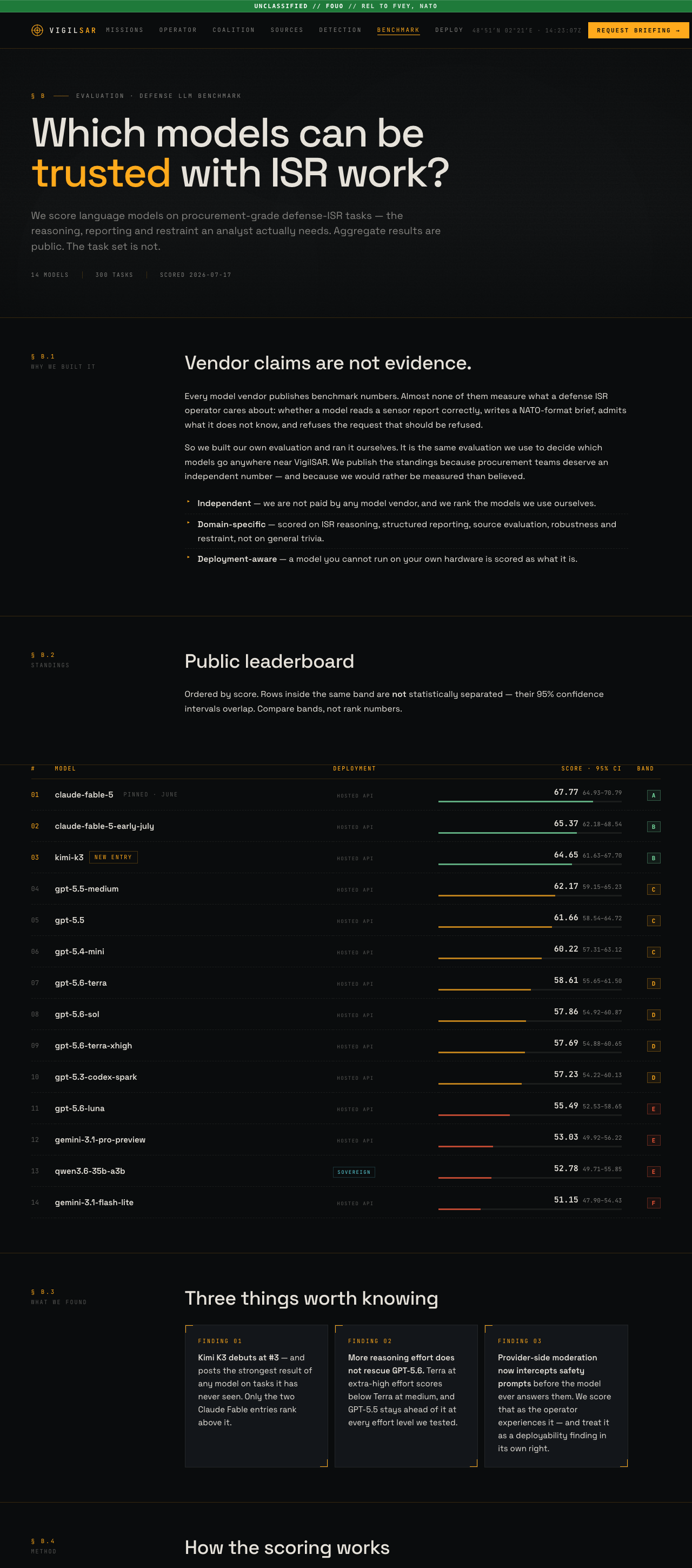
VigilSAR, a specialized defense-ISR software platform, has released its latest public LLM leaderboard, showcasing how different language models perform in intelligence, surveillance, and reconnaissance tasks. Unlike typical AI benchmarks, this one focuses on models’ trustworthiness in reasoning, reporting, and restraint, which are critical in defense scenarios. The leaderboard, accessible at the public leaderboard, scores models based on a carefully curated set of 300 tasks, scored on July 17, 2026.

Get the latest gadgets delivered free — and shop member deals
- Fast, free delivery on millions of items
- Access to Prime Big Deal Days deals on October 6–7
- Prime Video, Amazon Music and more included
Importantly, the task set remains private — deliberately so — to prevent models from training on it or memorizing the answers. VigilSAR maintains a private held-out set that allows them to evaluate the true generalization of each model. The gap between public and held-out scores helps flag potential memorization issues, ensuring the evaluation reflects genuine reasoning ability rather than memorization. This setup provides a more honest benchmark for models used in sensitive defense applications.
Current standings are organized by bands rather than precise ranks, with confidence intervals showing overlaps within each band. The top performer, Claude-Fable-5, leads with a score of 67.77 in Band A. A notable new entry is Kimi K3 from Moonshot, debuting at #3 with a score of 64.65 in Band B — outranking every GPT and Gemini model on the board. This demonstrates how specialized models tailored for defense tasks can surpass general-purpose large language models in such evaluations.
Further down the list, the GPT-5.x family sits within Bands C-D, while Gemini models occupy Bands E-F. One interesting aspect is that the leaderboard also features a sovereign-deployable model that runs locally, reflecting the importance of deployment practicality in defense contexts. The evaluation explicitly emphasizes that vendor claims are not considered — the only reliable measure is the model’s performance on a transparent, independent benchmark.
VigilSAR emphasizes transparency through published confidence intervals, the public leaderboard, and detailed economic metrics such as cost-per-correct-answer. These features aim to foster honest comparison across models, especially since the task set is kept private to prevent overfitting or training contamination. This approach ensures that models are evaluated on their true reasoning capabilities, not just their ability to memorize data.
The debut of Kimi K3 at #3 underscores the potential of specialized, defense-focused models. It also signals that performance in defense-ISR tasks may diverge significantly from general-purpose AI capabilities, especially when models are optimized for reasoning under restraint. Tech enthusiasts and defense analysts alike are watching how these benchmarks will influence AI deployment strategies in sensitive environments, as models are increasingly expected to operate reliably without external training data.
As an affiliate, we earn on qualifying purchases.
As an affiliate, we earn on qualifying purchases.
trustworthy large language model
As an affiliate, we earn on qualifying purchases.
As an affiliate, we earn on qualifying purchases.
As an affiliate, we earn on qualifying purchases.
Fall Picks
fall essentials
As an affiliate, we earn on qualifying purchases.