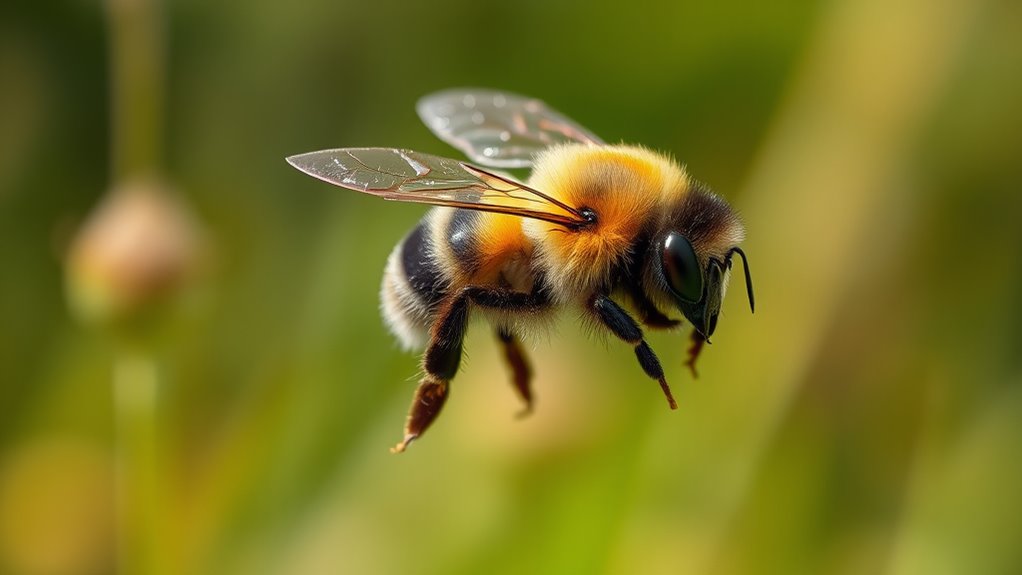

The hidden math behind bumblebee flight involves complex airflow patterns generated by rapid, precise wing movements, creating unsteady forces that produce lift and stability. Engineers analyze these aerodynamics using advanced fluid dynamics models to understand how bees manage flight through vortex creation and pressure changes. By mimicking these principles, they design agile drones capable of flying smoothly in turbulent environments. If you keep exploring, you’ll uncover how math and biology combine to inspire innovative flying machines.

Get the latest gadgets delivered free — and shop member deals
- Fast, free delivery on millions of items
- Access to Prime Big Deal Days deals on October 6–7
- Prime Video, Amazon Music and more included
Key Takeaways
- Bumblebee flight relies on unsteady aerodynamics, involving vortices and fluctuating pressure zones that generate lift.
- Engineers analyze detailed wing kinematics and airflow interactions to understand stability during rapid wingbeats.
- Mathematical models simulate unsteady forces, enabling precise control of wing motion for stable and agile flight.
- Bio-inspired algorithms replicate bee wing movements, guiding the design of drones with enhanced maneuverability and resilience.
- Decoding bee flight physics informs innovative engineering solutions for compact, stable, and responsive flying robots.
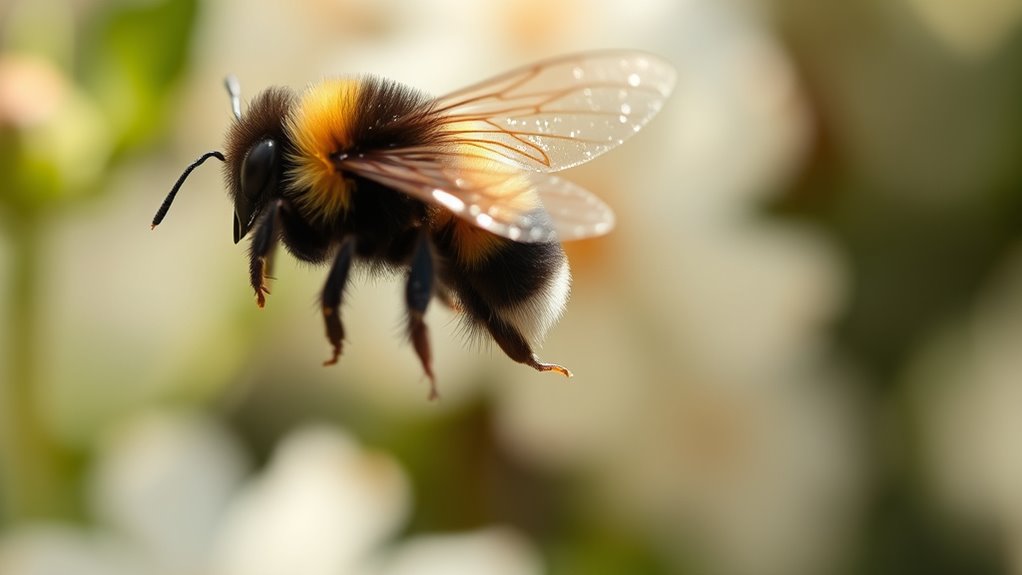
Many people are surprised to learn that there’s complex math behind how bumblebees manage to fly so efficiently. When you observe a bumblebee hovering or darting through the air, it might seem almost effortless, but beneath that grace lies intricate scientific principles. Bee wing aerodynamics play a vital role in their flight, involving the way their wings move and generate lift. Unlike fixed-wing aircraft, bumblebees flap their wings rapidly and in precise patterns, creating unsteady airflow that results in lift through a combination of vortices and fluctuating pressure zones. This dynamic motion allows them to stay aloft even in turbulent conditions, a feat achieved through a highly refined control of bumblebee flight stability.
Understanding how bumblebees maintain such stability involves delving into the mathematics of their wing kinematics and airflow interactions. Researchers have used advanced fluid dynamics models to analyze the forces at play during each wingbeat. They’ve discovered that the bee’s wing motion isn’t just about generating lift; it also actively manages stability. The bees adjust their wing angles, stroke amplitude, and timing to counteract disturbances and keep their flight steady. This precise coordination ensures they don’t spin out of control, especially when encountering gusts or carrying loads like pollen. Their ability to perform these adjustments in real-time is a marvel of biological engineering. Mathematical modeling helps scientists understand these complex interactions more clearly.
Engineers are now studying these principles to develop better flying robots and drones. By mimicking bee wing aerodynamics, they aim to create machines that can hover, maneuver, and stabilize themselves with the same efficiency. The secret lies in replicating the unsteady aerodynamic effects and control strategies that bumblebees employ naturally. For instance, micro-drones inspired by bee flight patterns can adapt quickly to changing conditions, thanks to algorithms based on the bees’ wing motion and stability mechanisms. This bio-inspired approach is opening new avenues in robotics, especially for navigating cluttered environments where stability and agility are crucial.
In essence, the math behind bumblebee flight isn’t just academic; it’s a blueprint for innovation. By decoding the complex interactions of wing aerodynamics and flight stability, scientists and engineers are unlocking new ways to design machines that move with the same finesse and resilience. As you look at a bumblebee buzzing from flower to flower, remember that behind its seemingly simple flight is a sophisticated dance of physics and mathematics, now inspiring the next generation of flying technology.
As an affiliate, we earn on qualifying purchases.
Frequently Asked Questions
How Do Bumblebees Avoid Wing Fatigue During Flight?
You might wonder how bumblebees avoid wing muscle fatigue during flight. They do this through energy conservation strategies, like modulating wingbeat frequency and amplitude, which helps reduce excessive strain. By optimizing muscle use and employing efficient flight patterns, they prevent wing fatigue and conserve energy. This natural adaptation allows them to fly longer, efficiently, and survive in their environment without overtaxing their wing muscles.
Can Bumblebee Flight Patterns Change With Weather Conditions?
You might notice bumblebee flight patterns change with weather. When wind speed increases or temperature fluctuates, they adapt by altering their wing beat and flight paths. These adjustments help maintain stability and conserve energy in varying conditions. So, yes, bumblebees modify their flight behaviors based on weather, ensuring they can forage and navigate efficiently despite environmental changes. Their flexibility is key to their survival.
What Role Does Wing Flexibility Play in Bumblebee Aerodynamics?
You might wonder how wing flexibility influences bumblebee flight. Wing deformation allows their wings to bend and twist, which enhances aerodynamic benefits like lift and maneuverability. This flexibility helps bumblebees adapt to different flight conditions, making their flight more efficient and stable. By understanding this, engineers can design flying robots that mimic these natural advantages, improving their performance in various environments.
Are There Variations in Flight Efficiency Among Different Bumblebee Species?
Did you know that species variation affects flight efficiency in bumblebees? Different species have unique wing sizes, shapes, and flight behaviors, which influence how efficiently they fly. These differences allow some bumblebees to conserve energy or navigate more effectively. So, if you’re curious about how nature optimizes flight, you’ll find that variations among species reveal fascinating adaptations that improve their flight performance and survival skills.
How Quickly Can Bumblebees Adapt Their Flight Techniques?
You might wonder how fast bumblebees adapt their flight techniques. They can quickly change their wingbeat frequency to adjust flight speed, often within seconds. This rapid adaptation helps them navigate different environments and optimize energy use. By tweaking wingbeat frequency, bumblebees efficiently modify their flight speed, allowing them to respond swiftly to obstacles or wind changes, showcasing their remarkable flight agility and adaptability in real-time.
As an affiliate, we earn on qualifying purchases.
Conclusion
Just like a masterful dancer moves effortlessly across the stage, bumblebees execute their flight with hidden mathematical precision. Engineers are now studying these secret steps, copying the dance to design better flying robots. By revealing the math behind their wing beats, you’re on the brink of transforming technology in ways that once seemed like magic. So, next time you see a bee, remember you’re witnessing a tiny miracle fueled by hidden numbers in motion.
As an affiliate, we earn on qualifying purchases.
As an affiliate, we earn on qualifying purchases.
Fall Picks
fall essentials
As an affiliate, we earn on qualifying purchases.