If you look at how scientists are searching for dark matter, you’ll see many have hit dead ends using traditional methods. They focus on finding tiny particles that don’t interact much, but these efforts haven’t given conclusive results. That’s why some think we might need new ideas, like tweaking our understanding of gravity or considering unknown forms of matter. If you’re curious, you’ll discover more about these exciting alternative theories and what could really explain dark matter.

Get the latest gadgets delivered free with Prime
- Fast, free delivery on millions of items
- Prime Video, Amazon Music and more included
- Member-only deals all year
Key Takeaways
- Persistent failure to detect dark matter particles suggests current models may be incomplete or incorrect.
- Observed gravitational effects could be explained by modified gravity laws, not unseen matter.
- The dominant presence of invisible dark matter indicates potential gaps in understanding fundamental physics.
- Alternative theories propose unknown forms of matter or energy beyond current scientific frameworks.
- Expanding detection methods and theories is necessary due to limitations of traditional particle-based approaches.
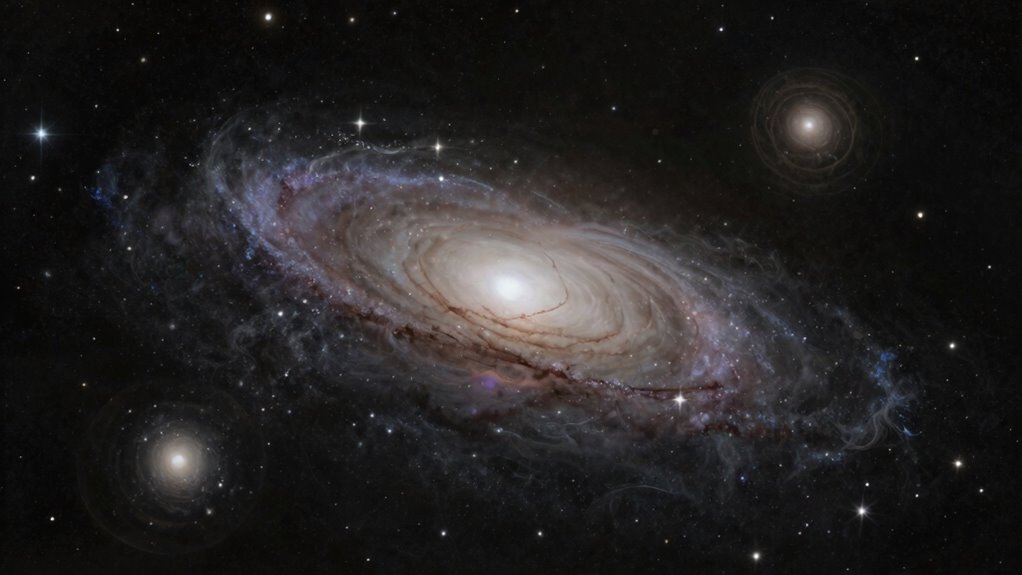
Have you ever wondered what makes up most of the universe’s mass? You might think it’s stars, planets, or even black holes, but the reality is that the vast majority of matter isn’t visible at all. It’s what scientists call dark matter—a mysterious substance that doesn’t emit, absorb, or reflect light. For years, the prevailing idea has been that dark matter consists of particles we haven’t yet detected, called particle candidates. These particles are thought to be weakly interacting, meaning they pass through ordinary matter almost unnoticed. But despite extensive searches, we haven’t definitively identified these particles yet. That’s why some scientists believe it’s time to reconsider our explanations for dark matter altogether.
Traditional detection methods focus on direct searches—looking for signs of particle interactions in sensitive detectors deep underground—or indirect detection, which involves observing cosmic rays or gamma rays that could result from dark matter particle annihilation. However, these methods have yet to produce conclusive evidence. This ongoing lack of success leads some researchers to argue that the assumed particle candidates might not be the right ones or that dark matter isn’t made of particles at all. Instead, they suggest alternative detection approaches that could reveal new physics or entirely different explanations for the gravitational effects we attribute to dark matter. This shift is driven by the possibility that the universe’s missing mass might stem from phenomena beyond standard particle physics.
Traditional searches for dark matter particles continue to fail, prompting scientists to explore new physics and alternative explanations for cosmic mysteries.
Some scientists propose that instead of particles, dark matter could be an effect of modified gravity—alterations to our understanding of how gravity works on cosmic scales. Others speculate that there could be unknown forms of matter or energy that don’t fit neatly into current models. These ideas challenge the traditional particle candidate approach, pushing researchers to explore other possibilities. The search for dark matter now involves a broader range of strategies, including astrophysical observations and experimental setups designed to test alternative detection methods. By expanding the scope, scientists hope to uncover clues that might point toward completely new types of matter or physics.
In the end, many believe that sticking to the idea of particle candidates alone might be limiting. The universe often surprises us, and the stubborn silence from detection experiments suggests we might need fresh perspectives. Whether it’s through alternative detection techniques, new theoretical frameworks, or rethinking gravity itself, the quest to understand dark matter remains one of the most exciting challenges in science today. You might not have all the answers yet, but the search continues, driven by curiosity and the desire to unlock the universe’s deepest secrets.
As an affiliate, we earn on qualifying purchases.
Frequently Asked Questions
Could Dark Matter Be Made of Unknown Particles?
Yes, dark matter could be made of unknown particles. You might consider that exotic particles, unlike anything we’ve detected before, could compose dark matter. These particles could interact through unknown forces, making them difficult to observe directly. Scientists are actively exploring these possibilities, searching for signs of these elusive entities, which may reveal new physics beyond our current understanding and explain the mysterious nature of dark matter in the universe.
How Does Dark Matter Affect Galaxy Formation?
You should know that dark matter plays a vital role in galaxy formation, accounting for about 85% of the universe’s mass. Its distribution creates gravitational wells that attract normal matter, leading to galaxy formation. Gravitational lensing reveals dark matter’s presence by bending light around galaxies, showing its influence on structure formation. Without dark matter, galaxies wouldn’t have the proper mass to form and evolve as we observe today.
Are There Alternative Theories to Dark Matter?
Yes, there are alternative theories to dark matter. You might explore modified gravity, which suggests that gravity behaves differently at galactic scales, or consider the quantum vacuum, where fluctuations could explain the observed phenomena without unseen matter. These ideas challenge traditional notions, proposing that changes in our understanding of gravity or the fabric of space might account for galaxy rotation curves and cosmic structure, providing fresh perspectives beyond dark matter.
What Experiments Are Ongoing to Detect Dark Matter?
Daring detectors plunge into dark matter detection, delving into particle physics with dedicated experiments. You’ll find underground labs like the Xenon1T, LUX-ZEPLIN, and PandaX testing tantalizing particles, hunting for hidden interactions. These experiments aim to catch elusive dark matter particles passing through, using sensitive sensors and sophisticated shielding. By studying these signals, scientists seek to reveal the universe’s unseen secrets, unveiling the mysterious matter that shapes cosmic structures.
Could Dark Matter Interact With Regular Matter?
Dark matter could interact with regular matter through weak forces or other unknown properties, although primarily, we observe its gravitational effects. Its properties might include minimal interactions, making detection tricky. You might find that scientists are exploring these possibilities to explain phenomena like galaxy rotation curves and gravitational lensing better. Understanding these interactions could reveal new physics beyond current theories, offering deeper insights into the universe’s fundamental composition.
modified gravity experiment tools
As an affiliate, we earn on qualifying purchases.
As an affiliate, we earn on qualifying purchases.
Conclusion
So, as you explore the mysteries of dark matter, remember that science is like a puzzle waiting to be solved. Sometimes, the pieces don’t quite fit, and new ideas are needed to see the full picture. Just as a lighthouse guides ships through fog, fresh explanations can illuminate the unseen universe. Keep questioning, because in the vast cosmic dance, discovering new answers might just be the key to revealing the universe’s deepest secrets.
cosmic ray detector for dark matter
As an affiliate, we earn on qualifying purchases.
As an affiliate, we earn on qualifying purchases.
As an affiliate, we earn on qualifying purchases.
Halloween Picks
halloween
As an affiliate, we earn on qualifying purchases.