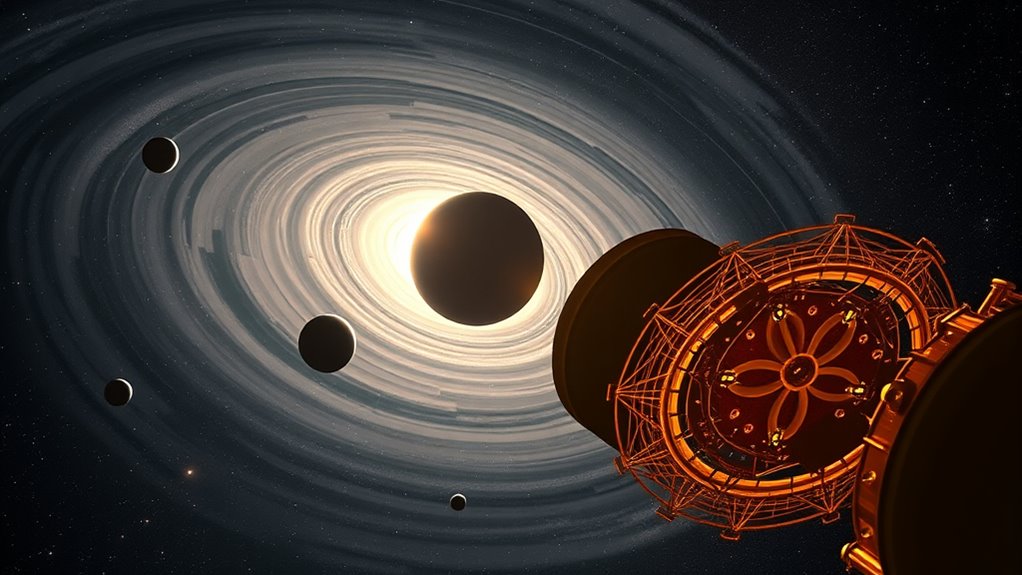

The James Webb Space Telescope is now focusing on detecting exomoons orbiting distant planets that could harbor life. Using advanced instruments, Webb analyzes light curves during planetary transits to find tiny brightness dips indicating these moons. It also examines atmospheres for water vapor and bio-signatures, helping assess their habitability. By studying their surface conditions and environment, Webb aims to identify moons that might support life. Keep exploring to uncover how Webb’s discoveries could change our understanding of habitable worlds.
Key Takeaways
- Webb targets distant exomoons orbiting exoplanets, analyzing light curves for subtle signals indicating their presence.
- Detection involves spectral analysis to identify atmospheres, water vapor, and bio-signature gases suggestive of habitability.
- Surface temperature and atmospheric composition assessments help determine if exomoons could support life.
- Focus is on moons with stable environments similar to Europa or Enceladus, potential habitats for life.
- Data will clarify how common habitable moons are and their capacity to sustain extraterrestrial life.
After successfully capturing stunning images of distant galaxies and exoplanets, the James Webb Space Telescope is now turning its focus to new targets that could reveal more about our universe’s origins. Among these, exomoons stand out as promising candidates in the search for extraterrestrial life. These moons orbit planets outside our solar system, and recent advancements make detecting them more feasible than ever. You might wonder how Webb can identify these elusive objects. Its advanced instruments enable precise exomoon detection by analyzing subtle signals in the light curves of exoplanets. When a planet transits its star, tiny dips in brightness can suggest the presence of a moon. Webb’s sensitivity allows it to detect these minute variations, helping scientists confirm the existence of exomoons around distant worlds.
Once an exomoon is detected, the next step involves habitability assessment. You’ll find this process vital because not all moons are suitable for life. The key factors include the moon’s size, composition, distance from its star, and the nature of its host planet. Webb can analyze the atmosphere of these moons—if they have one—by studying their spectral signatures. This data helps determine if conditions might support liquid water, a fundamental ingredient for life. For example, if an exomoon possesses an atmosphere rich in water vapor or other bio-signature gases, it becomes a prime candidate for further study. You’re essentially looking for moons that could have stable environments, similar to how Europa or Enceladus in our solar system are considered promising for habitability.
Furthermore, Webb’s ability to assess habitability extends beyond just detecting atmospheres. It can measure surface temperatures and examine the chemical makeup of the exomoon’s environment. This all-encompassing approach enables scientists to evaluate whether conditions on these distant moons could sustain life or if they’re merely inhospitable icy bodies. As Webb zeroes in on these targets, you can expect a significant leap in understanding how common potentially habitable moons are in the galaxy.
Frequently Asked Questions
How Does the JWST Detect Exomoons?
You might wonder how the JWST detects exomoons. It uses exomoon spectroscopy to analyze light passing through or reflecting off a planet’s atmosphere, revealing signs of moons. Additionally, gravitational microlensing helps spot exomoons by observing how their gravity bends light from distant stars, creating detectable signals. These methods enable you to identify potential moons that could harbor life, expanding our understanding of distant planetary systems.
What Criteria Determine a Promising Exomoon Target?
When selecting a promising exomoon target, you look for signs of planetary habitability and orbital stability. A good candidate orbits within the habitable zone, where conditions might support life. It also maintains a stable orbit around its planet, reducing risks of ejection or collision. These factors help you identify moons that could have the right environment and longevity to potentially harbor life, making them ideal for further study.
Can JWST Analyze Exomoon Atmospheres Directly?
You might wonder if JWST can analyze exomoon atmospheres directly. Currently, it doesn’t have the resolution to do so in detail. Instead, JWST studies atmospheric composition indirectly by observing transits, where it detects how the exomoon’s atmosphere affects starlight. Understanding exomoon formation helps identify promising targets, and analyzing atmospheric composition reveals clues about potential habitability, even if direct atmospheric analysis remains a challenge.
How Long Will It Take to Find Habitable Exomoons?
Finding habitable exomoons depends on your progress in understanding exomoon formation and conducting thorough habitability assessments. It could take years or decades because detecting these moons is challenging, requiring precise observations. As technology improves, you’ll get closer to identifying promising candidates. The more you study exomoon formation and analyze their atmospheres, the faster you’ll determine which exomoons might support life. Patience and advancements are key to this exciting discovery process.
Are There Any Known Exomoons With Signs of Life?
Right now, you won’t find any exomoons confirmed to have signs of life. Scientists analyze exomoon composition and habitability indicators like water presence, atmosphere, and temperature to assess potential life. You can stay hopeful, as upcoming telescope data may reveal exomoons with these signs. For now, though, evidence remains elusive, and research continues to understand which exomoons could truly support life.
Conclusion
Now, as you follow the James Webb Telescope’s journey, imagine the possibilities ahead. You’re witnessing the quest to find exomoons that might harbor life, revealing secrets of the universe. You’re dreaming of discovering new worlds, embracing hope, and fueling curiosity. You’re part of a story that stretches beyond the stars, pushing boundaries, challenging limits, and inspiring wonder. Together, you and the telescope step into the unknown, enthusiastic to uncover the mysteries waiting in the cosmos.