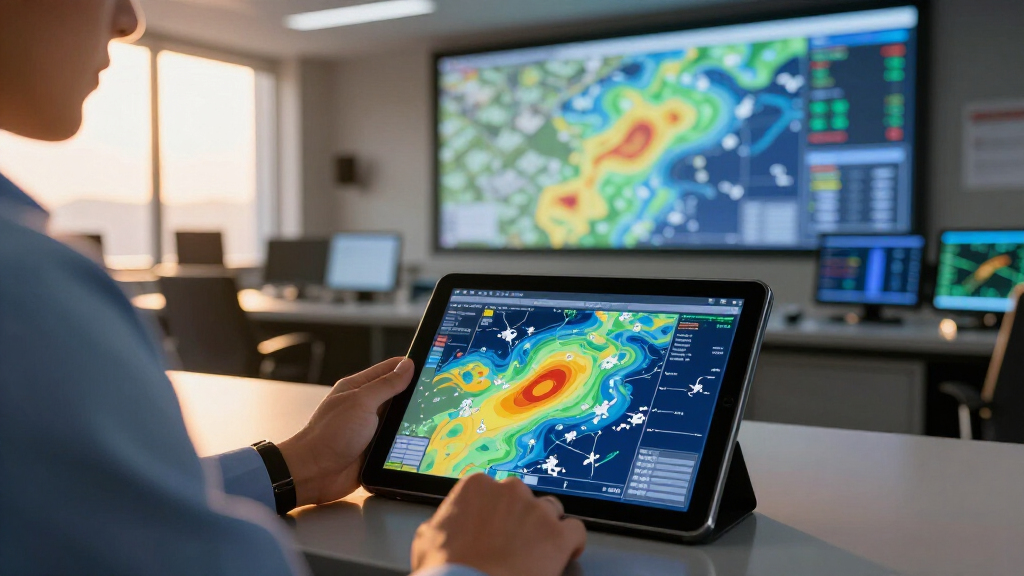

📊 Full opportunity report: Exploring How AI Is Reshaping Weather Forecasts In A Warming Planet on ThorstenMeyerAI.com — validation score, market gap, and execution plan.

Get the latest gadgets delivered free with Prime
- Fast, free delivery on millions of items
- Prime Video, Amazon Music and more included
- Member-only deals all year
TL;DR
A report attributed to Huawei Pangu suggests AI is significantly changing weather forecasting, potentially enabling faster warnings. However, no technical evidence or performance data has been provided. The development could impact disaster response, but its accuracy and operational readiness remain unconfirmed.
A report attributed to Huawei Pangu states that AI-based weather forecasting is transforming prediction capabilities, offering the potential for faster and more useful alerts amid rising climate-related extreme weather events. For a detailed analysis, see the original analysis. However, the report provides no technical data, model details, or validation metrics to substantiate these claims, leaving the actual impact uncertain.
The report highlights artificial intelligence as a major change in weather prediction, suggesting that rapid processing could help meteorological agencies identify dangerous conditions sooner. Learn more about AI’s role in weather forecasting on this site. It emphasizes the importance of faster warnings for public safety, emergency response, and infrastructure management, especially as climate change increases the frequency and severity of extreme weather events.
Despite these assertions, the report does not specify the AI system’s model version, training datasets, geographic scope, or benchmark results. For context, see the coverage of AI’s impact on weather prediction in this analysis. There are no published accuracy scores for temperature, precipitation, wind, or extreme event forecasts, making it impossible to verify whether AI truly improves prediction performance or speed. The claim remains an attribution without supporting evidence or independent validation.
Potential Impact of AI-Driven Weather Forecasting on Climate Risks
If AI systems can reliably produce faster and more accurate weather forecasts, they could significantly enhance early warning capabilities. This would allow communities, emergency services, and industries such as transportation and energy to better prepare for extreme weather, potentially reducing damage and saving lives. However, the actual operational benefits depend on proven accuracy, stable performance, and clear communication of forecast uncertainty, which are not yet demonstrated in the available report.
As an affiliate, we earn on qualifying purchases.
Current State of AI in Weather Prediction and Climate Challenges
AI has been increasingly integrated into weather prediction, often supplementing traditional physics-based models with pattern recognition from historical data. Conventional forecasting relies on complex simulations using physical equations supported by satellite, radar, and observational data. AI approaches can potentially reduce computational demands and enhance pattern detection, but their adoption in operational forecasting remains cautious and requires rigorous validation.
The recent report from Huawei Pangu does not specify whether the AI system is a new research development, a commercial product, or a pilot deployment. Historically, improvements in forecast accuracy and lead time have been incremental, with full operational integration demanding extensive testing across diverse regions and extreme weather scenarios.
“The claim that AI is revolutionizing weather prediction is intriguing, but without published benchmarks or validation, it remains speculative.”
— an anonymous researcher
As an affiliate, we earn on qualifying purchases.
Unverified Claims and Lack of Technical Validation
The report does not include technical details such as model version, training data, or benchmark results. It is unclear whether the AI system has been tested against established forecasting models or if it has demonstrated improved accuracy or lead time, especially for high-impact extreme weather events. The claimed benefits are based on attribution rather than validated evidence, leaving the actual performance and operational readiness uncertain.
As an affiliate, we earn on qualifying purchases.
Need for Independent Testing and Model Validation
Future steps include publishing detailed technical documentation, benchmark results, and independent evaluations of the AI system’s performance across various weather scenarios. Meteorological agencies and researchers will need to assess whether the AI system can reliably improve forecast accuracy and lead times, particularly for extreme events, before broader deployment. Continued transparency and validation are essential for establishing trust and operational value.
As an affiliate, we earn on qualifying purchases.
Key Questions
Does the report confirm that AI forecasts are more accurate than current models?
No. The report does not provide accuracy metrics, benchmark results, or direct comparisons with existing weather prediction systems. Its claims are unverified and remain at the attribution stage.
How could faster weather forecasts benefit communities?
Faster forecasts could give emergency services and the public more time to prepare for extreme weather, potentially reducing damage and saving lives. However, the benefit depends on the reliability and accuracy of the predictions, not speed alone.
What technical details are missing from the report?
The report lacks information about the specific AI model version, training datasets, geographic coverage, validation procedures, and benchmark results. Without these, it is impossible to verify the claims of improved forecasting performance.
When can we expect more concrete evidence of AI’s impact on weather prediction?
Next steps include publishing detailed technical documentation, independent validation studies, and operational testing results. These are needed before confirming any substantial advances in AI-based weather forecasting.
Source: ThorstenMeyerAI.com
Fall Picks
fall essentials
As an affiliate, we earn on qualifying purchases.