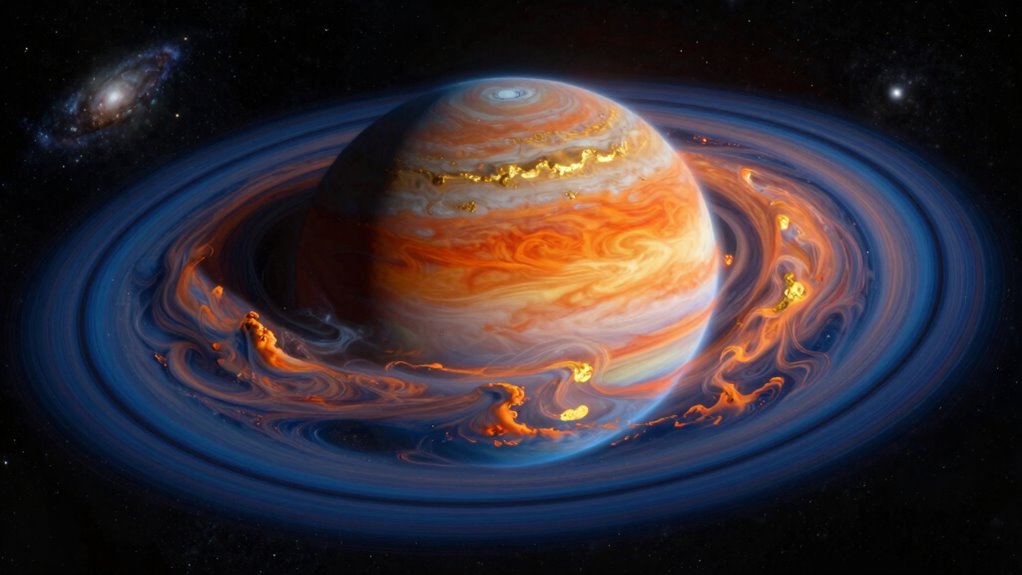

Exoplanet atmospheres reveal the gases present, their interactions, and clues about habitability. By detecting key molecules like water vapor, oxygen, and methane, you can identify potential signs of life from afar. Advances in spectroscopy allow you to analyze atmospheric changes over time and understand planetary processes. This shifts the search from simply finding planets to discovering those that might support life. Keep exploring to discover how these discoveries could change your view of the universe.

Get the latest gadgets delivered free with Prime
- Fast, free delivery on millions of items
- Prime Video, Amazon Music and more included
- Member-only deals all year
Key Takeaways
- Analyzing atmospheric composition reveals potential biosignatures, indicating possible biological activity on exoplanets.
- Advanced spectroscopic techniques enable precise detection of key molecules like water vapor and oxygen.
- Understanding atmospheric features helps assess planetary habitability and surface conditions.
- Identifying signs of life in atmospheres shifts focus from mere discovery to finding life-supporting worlds.
- Studying atmospheric evolution enhances our knowledge of planetary processes and the universe’s habitability potential.

Since the discovery of the first exoplanets, scientists have been enthusiastic to understand their atmospheres, as these layers hold vital clues about the planet’s potential to support life. The atmospheric composition reveals what gases are present, their relative abundances, and how they interact with each other. This information helps you assess whether a planet’s environment could sustain life or if it’s too hostile. When examining atmospheres, you look for specific molecules that might indicate biological activity, known as biosignatures. Detecting such signs could revolutionize the search for extraterrestrial life, turning distant worlds into promising candidates.
Understanding exoplanet atmospheres reveals clues about habitability and the potential signs of extraterrestrial life.
You realize that studying atmospheric composition involves analyzing light from a star that filters through or reflects off a planet’s atmosphere. By examining this light, you identify absorption features corresponding to various gases. For example, the presence of oxygen and methane together could suggest biological processes, since these gases tend to react and should not coexist in large amounts unless replenished by living organisms. This makes biosignature detection a vital aspect of your investigation, as it points to potential signs of life even from millions of miles away.
The ability to decode atmospheric composition opens new pathways to understanding exoplanets’ habitability. Instead of just discovering new worlds, you’re now pinpointing those with environments that might support life. You realize that the detection of water vapor, carbon dioxide, or other key molecules offers insights into climate, surface conditions, and the planet’s overall potential. As your tools improve, including space telescopes equipped with advanced spectrometers, your capacity to identify these essential molecules grows more precise.
Furthermore, atmospheric analysis isn’t only about finding life’s chemical fingerprints. It also helps you understand planetary processes, such as volcanic activity or atmospheric escape, which influence habitability. These factors shape the environment and determine whether life could arise or persist. By analyzing atmospheric composition over time, you can even track changes that might signal biological activity or planetary evolution. Advances in spectroscopic techniques are enabling more detailed and accurate measurements, further enhancing your understanding.
In essence, the detailed study of exoplanet atmospheres transforms the search from mere discovery to a more targeted quest for life indicators. As your understanding deepens, you become better equipped to identify worlds worth exploring further, making the search for extraterrestrial life more efficient and promising. The potential to detect biosignatures in exoplanet atmospheres doesn’t just expand your knowledge—it could fundamentally reshape how humanity views its place in the universe.
As an affiliate, we earn on qualifying purchases.
Frequently Asked Questions
How Do Scientists Detect Atmospheres on Distant Exoplanets?
You detect atmospheres on distant exoplanets using spectroscopic techniques. When a planet passes in front of its star, starlight filters through its atmosphere, revealing atmospheric signatures. By analyzing the absorbed wavelengths, you identify gases like oxygen or methane. These atmospheric signatures help you determine if a planet might be habitable or host life, making spectroscopic observations essential in the search for extraterrestrial life.
Can Exoplanet Atmospheres Reveal Signs of Advanced Civilizations?
You might find it fascinating that about 10% of exoplanets show atmospheric features hinting at alien biosignatures. Atmospheres could indeed reveal signs of advanced civilizations through technosignature detection, like unusual chemical patterns or artificial pollutants. These clues help scientists identify potential signs of intelligent life. By studying exoplanet atmospheres, you’re part of a groundbreaking quest to uncover evidence of alien civilizations beyond our planet.
What Are the Limitations of Current Atmospheric Detection Methods?
You face several limitations with current atmospheric detection methods. Spectroscopic challenges make it difficult to distinguish exoplanet signals from the star’s light, reducing accuracy. Atmospheric interference from Earth’s environment can distort measurements, complicating data collection. These factors hinder precise characterization of exoplanet atmospheres, limiting your ability to identify potential signs of life or advanced civilizations. Overcoming these hurdles requires improved instruments and techniques for more reliable, clearer observations.
How Do Exoplanet Atmospheres Evolve Over Time?
You see, exoplanet atmospheres evolve over time through interactions with stellar radiation, volcanic activity, and atmospheric escape, which alter their composition. As these processes occur, they influence climate stability, making the atmosphere more or less hospitable. Over billions of years, these changes can lead to significant shifts in surface conditions, affecting the potential for life. Tracking these atmospheric evolutions helps you understand a planet’s habitability timeline.
Could Artificial Atmospheres Be Created on Exoplanets?
It’s possible that artificial atmospheres could be created on exoplanets through advanced atmospheric engineering and terraforming potential. You might harness technologies to modify a planet’s atmosphere, making it habitable or suitable for human life. Coincidentally, breakthroughs in these fields could allow you to design environments tailored to your needs, transforming distant worlds into new homes or scientific laboratories, ultimately broadening humanity’s reach across the cosmos.
As an affiliate, we earn on qualifying purchases.
Conclusion
By studying exoplanet atmospheres, you open the door to discovering potential signs of life beyond Earth. Imagine detecting oxygen on a distant planet, much like discovering a hidden oasis in a vast desert—it’s a clue that life might thrive there. As technology advances, your chances of finding such signs increase, transforming your search for extraterrestrial life from mere hope to scientific possibility. The next discovery could be just a breath away.
As an affiliate, we earn on qualifying purchases.
As an affiliate, we earn on qualifying purchases.
Halloween Picks
halloween
As an affiliate, we earn on qualifying purchases.