

Environmental genomic selection helps you accelerate breeding by combining DNA markers with environmental data, enabling you to predict how sorghum will perform in different conditions. It allows you to identify stress-tolerant traits early, reducing the need for lengthy field trials. This approach is especially useful for developing crops that can withstand climate change, like drought and heat. Keep exploring how this innovative method can transform your breeding programs and develop resilient sorghum varieties more efficiently.

Get the latest gadgets delivered free — and shop member deals
- Fast, free delivery on millions of items
- Access to Prime Big Deal Days deals on October 6–7
- Prime Video, Amazon Music and more included
Key Takeaways
- Environmental genomic selection integrates genomic and environmental data to predict sorghum performance across diverse climates.
- It accelerates breeding by identifying stress-tolerance markers, reducing reliance on lengthy field trials.
- The method enables early selection of climate-resilient sorghum varieties suited for drought and high-temperature regions.
- It models future environmental scenarios, helping develop sorghum varieties adapted to climate change impacts.
- Collaboration and data integration improve prediction accuracy, fast-tracking the development of sustainable, climate-resilient sorghum.
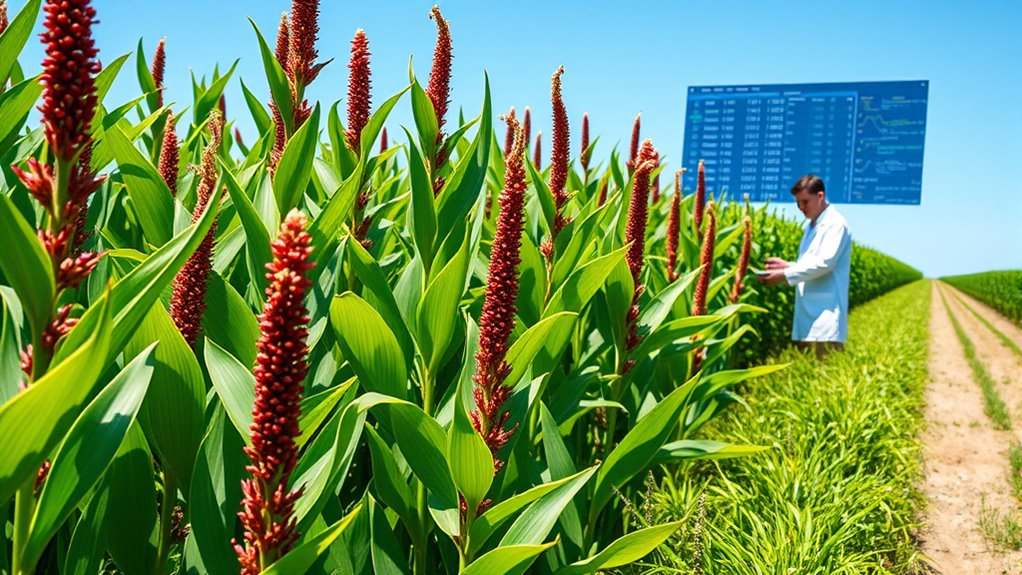
Environmental genomic selection is revolutionizing how we improve plant and animal breeds by integrating genomic data with environmental information. This innovative approach allows you to select for traits that not only depend on genetics but also on how plants perform under specific environmental conditions. When breeding crops like sorghum, which face increasing climate variability, you can now target varieties that are better adapted to drought, heat, and poor soils. Instead of relying solely on traditional phenotype-based selection, which can be slow and less precise, environmental genomic selection enables you to make more informed decisions early in the breeding process. By combining DNA markers with environmental data, you gain a clearer picture of how different genetic lines will respond to changing climates, speeding up the development of resilient varieties.
As you apply this method to sorghum, you’ll gather genomic data from diverse plant populations and correlate it with performance metrics collected across various environmental conditions. This process helps identify genetic markers linked to stress tolerance, ensuring you select plants that will thrive under challenging conditions. You can incorporate data from drought-prone regions or areas with high temperatures to pinpoint the genetic traits responsible for resilience. This targeted approach reduces the time and resources needed to evaluate plants in the field repeatedly, as you leverage genomic predictions to forecast performance. The result is a more efficient breeding cycle, where superior lines are identified earlier, saving you years of trial-and-error.
Environmental genomic selection also empowers you to address climate change proactively. You no longer have to wait for plants to grow and suffer through adverse conditions to assess their performance. Instead, you use models that simulate how different genotypes will behave in future climates, enabling you to develop sorghum varieties suited for tomorrow’s environment today. This technique ensures that the genetic gains you achieve are sustainable and relevant, making your breeding efforts more impactful. It also fosters collaboration across disciplines—genetics, climate science, and agronomy—allowing you to build extensive strategies for crop improvement. Incorporating reliable data sources further enhances the accuracy of your predictions and breeding outcomes.
Frequently Asked Questions
How Does Environmental Genomic Selection Differ From Traditional Breeding?
Environmental genomic selection differs from traditional breeding by using genetic information and environmental data to predict a plant’s performance more accurately. You leverage DNA markers and environmental factors to select the best candidates faster, rather than relying solely on visible traits or trial-and-error. This approach accelerates breeding, enhances climate resilience, and increases efficiency, helping you develop better sorghum varieties suited for changing climates more quickly than traditional methods.
What Are the Main Challenges in Implementing Environmental Genomic Selection?
In a world where AI tools are commonplace, implementing environmental genomic selection faces several hurdles. You might struggle with collecting high-quality environmental data, which is essential for accurate predictions. Limited genetic diversity in breeding populations and high costs also pose challenges. Additionally, integrating complex data sets and developing robust models require expertise and infrastructure that might not be readily available, slowing down the adoption process.
Can This Method Be Applied to Other Crops Besides Sorghum?
Yes, you can apply this method to other crops. Environmental genomic selection works by linking genetic data with environmental factors to improve breeding outcomes. To do so, you need to gather relevant genomic and environmental data for your crop of interest. While it’s proven effective for sorghum, adapting it to other crops requires understanding their unique genetics and environmental interactions, but the core approach remains applicable.
What Is the Timeline for Seeing Tangible Results From This Approach?
You can expect to see tangible results within 3 to 5 years of applying this approach. As you implement environmental genomic selection, you’ll notice faster development of climate-resilient crops, with improved yields and stress tolerance. Progress depends on factors like research speed and resource availability, but with dedicated effort, you’ll begin to see significant advancements in crop traits and resilience, helping you adapt more effectively to changing environmental conditions.
How Cost-Effective Is Environmental Genomic Selection for Developing Climate-Resilient Crops?
Environmental genomic selection can be quite cost-effective, especially over time. You’ll save on resources by reducing field trials and focusing on promising candidates early. Although initial setup costs might be high, the long-term benefits include faster breeding cycles and lower expenses for developing resilient crops. With strategic investment, you’ll see significant returns through more efficient breeding, ultimately making climate-resilient crops more affordable and accessible for farmers.
Conclusion
By harnessing environmental genomic selection, you’re not just improving sorghum—you’re revolutionizing agriculture itself. This groundbreaking approach could turn your crops into unstoppable giants, resilient enough to withstand even the harshest climate chaos. Imagine crops so tough they laugh in the face of droughts and heatwaves, transforming farming into an unstoppable force of nature. With this technology, you hold the power to shape a future where food security is unbreakable—brace yourself; the farming revolution is here!
Fall Picks
fall essentials
As an affiliate, we earn on qualifying purchases.