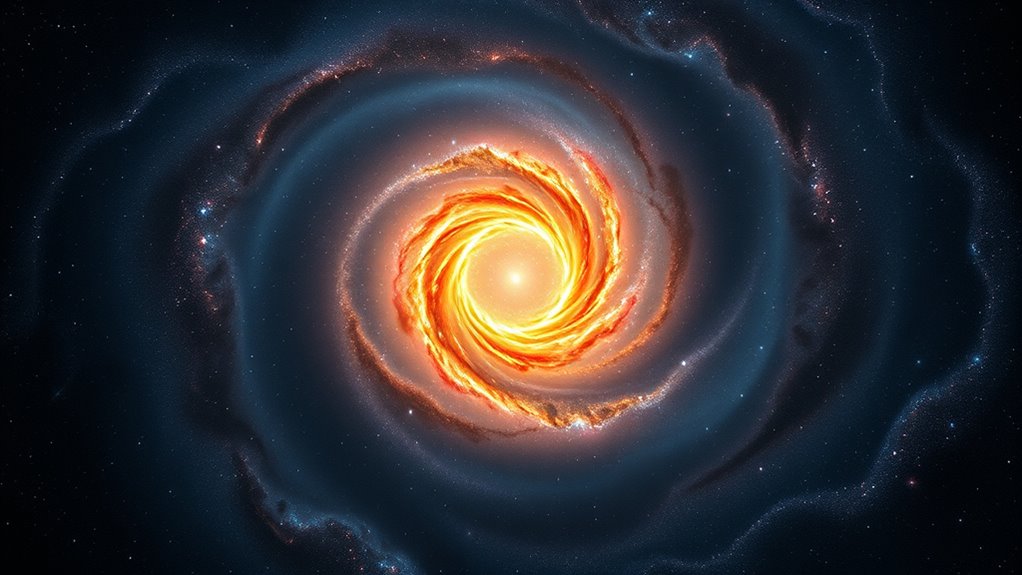

Hubble has captured a stunning glowing ring in a distant spiral galaxy, revealing a dramatic structure shaped by recent cosmic interactions. This fiery ring is made of bright, young stars and glowing gas, indicating active star formation caused by a gravitational disturbance, such as a collision or close encounter. The discovery offers clues about the galaxy’s past and its ongoing evolution. If you keep exploring, you’ll uncover even more about this fascinating cosmic feature.
Key Takeaways
- Hubble Telescope identified a luminous, fiery ring structure in a distant galaxy.
- The ring forms from a collision or gravitational interaction, triggering active star formation.
- Bright stars and glowing gas create a striking contrast with the galaxy’s darker spiral arms.
- The ring provides insights into the galaxy’s recent interaction history and evolutionary processes.
- Such features exemplify the dynamic, evolving nature of galaxies influenced by cosmic events.
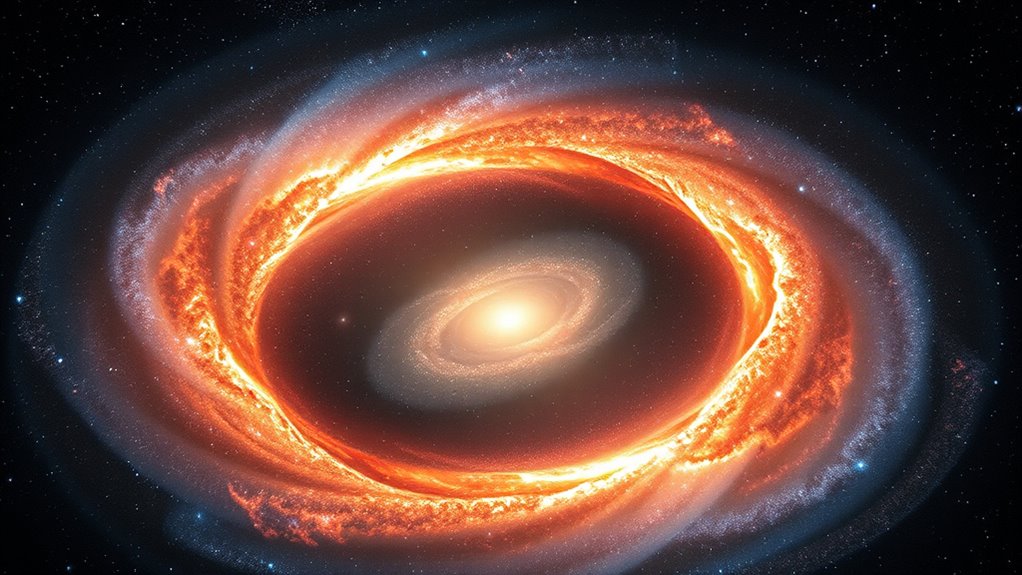
Scientists using the Hubble Space Telescope have discovered a striking ring structure in a distant galaxy, offering new insights into galactic formation and evolution. When you look at this galaxy, what immediately catches your eye is a luminous, glowing ring that seems to shimmer with fiery intensity. This isn’t just a visual curiosity; it’s a clue to complex processes that shape galaxies over billions of years. The ring is composed of bright, young stars and glowing gas, which emit a vivid light that makes it stand out against the darker backdrop of the galaxy’s spiral arms. As you observe this structure, you realize that it’s likely the result of a dynamic event—perhaps a collision or gravitational interaction—that triggered a burst of star formation in this specific region.
This glowing ring isn’t just an aesthetic feature; it’s a window into the galaxy’s history. The intense brightness suggests that a significant amount of star formation is happening right now, or occurred relatively recently in cosmic terms. You might wonder what caused this ring to form. Scientists believe that such rings often result from gravitational disturbances—either from a smaller galaxy passing through the main galaxy or a close encounter with another massive object. This interaction compresses the gas and dust, igniting a wave of star birth that creates the radiant ring you see. Its shape and size can tell astronomers a lot about the galaxy’s past interactions, including the speed and angle of the collision. Additionally, the distribution of gas and dust within the ring can influence future star formation processes, shaping the galaxy’s evolution over time.
A luminous ring reveals the galaxy’s recent gravitational encounters and star formation history.
This discovery challenges previous ideas about how galaxies grow and change over time. Instead of a smooth, gradual process, this galaxy shows signs of dramatic events that leave behind spectacular features. The ring’s composition also provides clues about the galaxy’s environment, such as the density of gas and the distribution of star-forming material. By analyzing the light from the ring, astronomers can determine the ages of the stars within it, revealing how quickly this galaxy is evolving and how recent these starburst events are. These insights contribute to our broader understanding of galactic evolution and the dynamic forces that drive it.
Seeing this glowing ring through Hubble’s advanced instruments reminds you of how much there is still to learn about our universe. It highlights the dynamic nature of galaxies, which are constantly shaped by interactions and internal processes. As you consider the implications, you realize that such discoveries help piece together the grand story of cosmic evolution. Every new detail, like this fiery ring, adds depth to our understanding of how galaxies develop, collide, and ultimately give rise to the diverse universe we observe today.
Frequently Asked Questions
What Is the Chemical Composition of the Glowing Ring?
You find that the glowing ring mainly consists of ionized hydrogen gas, which emits a bright red glow when energized. It may also contain traces of helium, oxygen, and nitrogen that contribute to its vivid appearance. These elements get ionized by nearby stars’ radiation, causing them to emit light at specific wavelengths. This chemical composition helps astronomers understand the star formation processes happening within the galaxy.
How Old Is the Galaxy With the Ring?
You’re looking at an ancient galaxy, likely over 10 billion years old, based on its structure and star populations. Its glowing ring indicates active star formation, which typically occurs in mature galaxies. The galaxy’s age is estimated through observations of its stellar content and redshift data, helping astronomers determine how long it’s been evolving. So, this galaxy has been around for a significant part of cosmic history.
Could This Ring Be a Sign of an Impending Supernova?
Yes, that glowing ring could be a sign of an impending supernova. Such rings often indicate a star nearing the end of its life, especially massive stars that can explode dramatically. When these stars run out of fuel, they collapse and release intense energy, creating bright, ring-shaped remnants. Keep an eye on this galaxy, as it might soon host a spectacular supernova event, illuminating the cosmos.
What Tools Did Hubble Use to Capture This Image?
Hubble used its advanced suite of instruments, primarily the Wide Field Camera 3 and the Advanced Camera for Surveys, to capture this stunning image. These tools allow you to observe distant celestial phenomena in multiple wavelengths, revealing intricate details like the glowing ring. By combining images from these cameras, Hubble creates detailed, high-resolution views that help you investigate cosmic mysteries, including whether such rings signal supernova activity.
Are Similar Rings Common in Other Galaxies?
Yes, similar rings are fairly common in other galaxies, especially around active galactic nuclei or star-forming regions. These rings often form from interactions between gas, dust, and gravitational forces, creating stunning structures. You might see them in images captured by various telescopes, not just Hubble. While not every galaxy has a glowing ring, they’re a fascinating feature that astronomers frequently observe in the universe, revealing dynamic cosmic processes.
Conclusion
Just like the legendary Phoenix rising from the ashes, this glowing ring reveals the galaxy’s ongoing transformation. Hubble’s discovery invites you to imagine the cosmic forces at play, shaping distant worlds beyond your reach. As you gaze up at the night sky, remember that each shimmering ring is a story of creation and renewal—reminding us that even in the vast darkness, light and change persist, echoing the timeless saga of the universe’s endless rebirth.