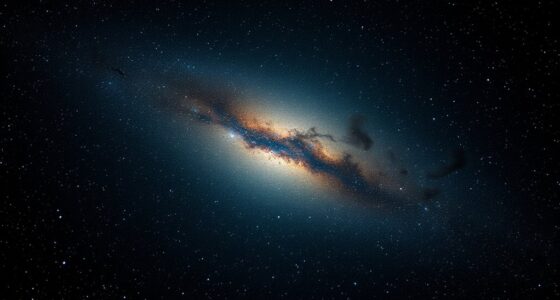
The Webb Space Telescope has uncovered a hidden, active disk beyond our solar system that’s creating moons rapidly. You’ll discover it surrounds a young star, containing dust, ice, and rocky debris that are clumping together through accretion. This process suggests moons are forming independently and faster than we expected. It may mean moons are far more common in the galaxy than previously thought, and exploring more could reveal even bigger surprises about our universe.

Get the latest gadgets delivered free with Prime
- Fast, free delivery on millions of items
- Prime Video, Amazon Music and more included
- Member-only deals all year
Key Takeaways
- Webb Telescope detected a dense, dusty disk around a young star actively forming moons.
- The process involves rapid accretion of particles into larger moon-sized bodies outside our solar system.
- This discovery reveals a new, faster moon formation mechanism distinct from planet formation.
- The moon factory suggests such disks may be common, increasing potential moon populations around stars.
- Findings expand understanding of planetary system development and potential habitats beyond planets.

The James Webb Space Telescope has uncovered a surprising discovery—a hidden moon factory located beyond our solar system. As you follow the data streaming in from this distant region, you’re struck by how this discovery challenges your understanding of planetary formation. This isn’t just about finding a new moon; it’s about revealing an entire process that creates moons at an extraordinary rate, all hidden in the vastness of space. Webb’s advanced instruments have detected a dense, dusty disk around a young star, something previously unseen with older telescopes. This disk appears to be teeming with material that’s actively forming moons, almost like a celestial assembly line. You realize that, unlike our solar system’s formation, this process happens in a region where conditions are more dynamic and chaotic, allowing for rapid moon creation.
As you explore more deeply into the observations, you notice that the disk contains a wealth of small particles, ice, and rocky debris. Webb’s infrared capabilities allow it to see through the thick dust, revealing the raw ingredients for moon formation. The data indicates that these particles are clumping together into larger bodies, a process known as accretion. You comprehend that this is similar to how planets form, but on a smaller scale. In this case, these clumps will eventually become moons, orbiting their parent star in a bustling environment. The discovery suggests that moon formation isn’t just a byproduct of planet formation but can occur independently and at an accelerated pace under the right conditions. Planetary formation is a complex process that can vary significantly depending on the environment.
What excites you most about this find is how it opens up new questions. Could this moon factory be a common phenomenon in the galaxy? If so, it means moons might be far more numerous than we previously thought, existing around stars that we’ve yet to study thoroughly. It also hints at the possibility that such moon-forming disks could host environments suitable for life, or at least for complex chemistry, adding another layer of intrigue to the search for extraterrestrial life. You realize that Webb’s ability to peer into these distant, dusty regions is revolutionizing how we understand planetary systems. Every discovery like this pushes the boundaries of what we know, showing you that the universe is still full of surprises waiting to be uncovered.
As an affiliate, we earn on qualifying purchases.
Frequently Asked Questions
How Does the Webb Telescope Detect Moons Around Distant Stars?
You can see moons around distant stars by observing tiny dips in the star’s brightness as a moon passes in front. The Webb Telescope detects these subtle light changes with its powerful instruments, capturing high-resolution images and spectra. By analyzing these signals, you can identify the presence of exomoons, determine their size, and even learn about their composition, expanding your understanding of planetary systems beyond our own.
What Materials Are Used to Create Moon-Like Bodies in Other Star Systems?
You find that moon-like bodies in other star systems form from materials like ice, rock, and metal. These materials come from protoplanetary disks surrounding young stars, where dust and gas collide and stick together. Over time, they coalesce into larger objects, creating moons or planetesimals. The Webb Telescope detects these bodies by observing their effects on nearby stars and the light they reflect or block, revealing their presence even at great distances.
Could These Moons Support Life or Habitable Conditions?
Think of these moons as potential islands in a vast cosmic ocean. They could support life if they have water, a stable atmosphere, and energy sources, but many conditions need to align. You might find subsurface oceans or atmospheres rich in gases, making habitability possible. However, without the right ingredients, these moons remain distant, icy worlds—beautiful but unlikely to host life as we understand it.
How Does This Discovery Impact Our Understanding of Planet Formation?
This discovery reshapes your understanding of planet formation by revealing that moons can form in complex, unseen environments beyond our solar system. It suggests that moon formation isn’t limited to planets we see close by, but can occur far out in space, driven by hidden processes. This broadens your perspective on how planetary systems develop, indicating that the universe is even more dynamic and full of surprises than you previously thought.
Are There Other Similar Moon Factories in the Universe?
Think of the universe as a vast orchard, and these moon factories as hidden seeds waiting to sprout. Yes, there are likely other similar moon factories scattered across the cosmos, forming in regions rich with dust and gas. Your curiosity drives exploration, and each discovery like this reveals new layers of our universe’s complexity. As we find more, you’ll understand that these celestial nurseries are common, shaping worlds beyond our current imagination.
As an affiliate, we earn on qualifying purchases.
Conclusion
As you gaze into the depths of this discovery, remember that even in the vast darkness, there’s a spark of creation waiting to be uncovered. This hidden moon factory symbolizes the universe’s endless capacity for wonder, reminding you that every mystery holds the promise of new worlds. Keep your eyes open; the cosmos is whispering secrets, inviting you to explore beyond what’s visible, fueling your curiosity and inspiring you to chase the unseen.
As an affiliate, we earn on qualifying purchases.
As an affiliate, we earn on qualifying purchases.
Halloween Picks
halloween
As an affiliate, we earn on qualifying purchases.