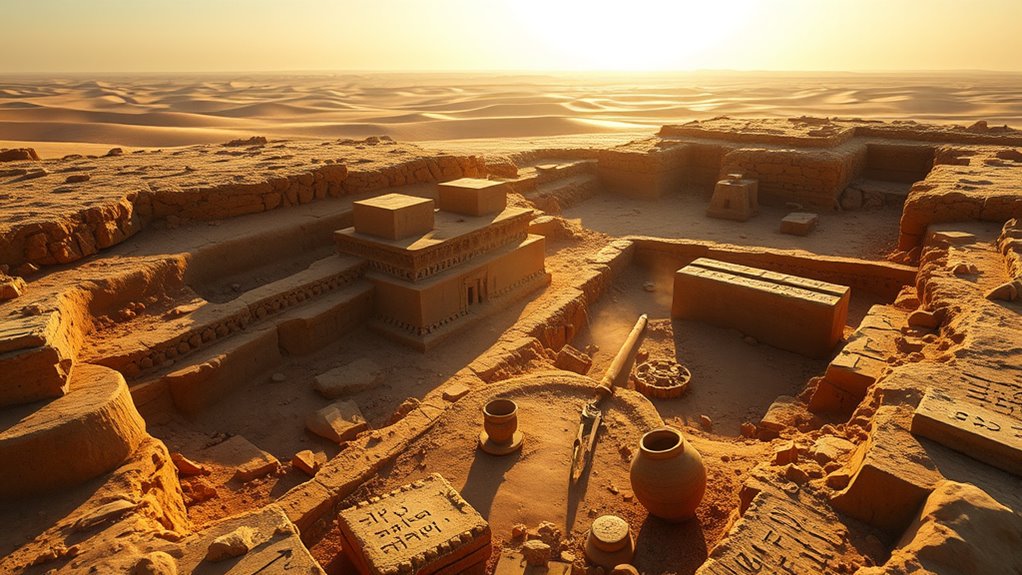

Recent research shows that the origins of Mesopotamian civilization are more complex and gradual than previously thought. Instead of a single emergence, multiple phases and influences shaped its development. You’ll find that diverse peoples migrated into the region, bringing new ideas and innovations. Environmental changes also played a key role in societal shifts. If you explore further, you’ll discover how these factors combined to create one of history’s most fascinating civilizations.
Key Takeaways
- Recent discoveries show Mesopotamian origins involved gradual social development over thousands of years, not a single event.
- Archaeological evidence indicates early settlements date back to 10,000 BCE, predating traditional timelines.
- Cultural diversity and migration played crucial roles, with multiple groups influencing Mesopotamian society.
- Environmental fluctuations, such as droughts and floods, significantly impacted societal growth and urbanization.
- New research challenges the linear view of civilization emergence, emphasizing complex, multi-phase development processes.
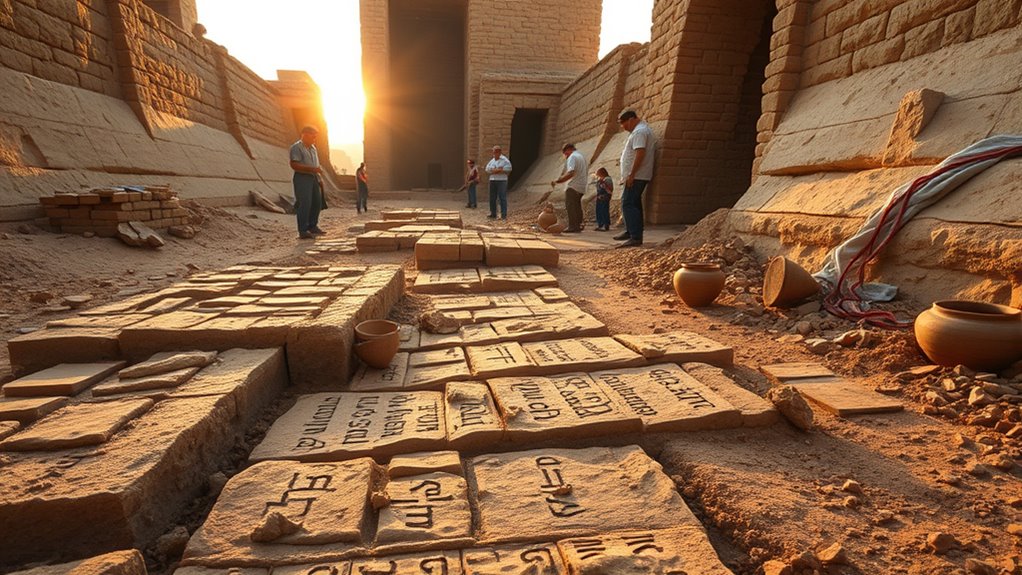
Recent research is transforming our understanding of Mesopotamian origins, challenging long-held theories about the region’s earliest civilizations. For years, scholars believed that Mesopotamia’s rise was a straightforward story: villages grew into city-states, which then developed complex societies around 4000 BCE. However, new evidence suggests the story is more nuanced. Instead of a sudden burst of civilization, it appears that Mesopotamian society evolved gradually through multiple phases, influenced by diverse groups and environmental factors. This shift in perspective invites you to reconsider the traditional timeline and the processes that led to civilization’s emergence in this fertile crescent. Archaeological discoveries in recent years provide fresh clues that complicate the idea of a singular “origin point.” For example, excavations in northern Iraq and southeastern Turkey reveal that early settlements existed much earlier than previously thought, some dating back to around 10,000 BCE. These sites show signs of social organization and resource management, indicating that the roots of Mesopotamian society stretch far beyond the conventional narrative. Instead of a sudden leap from nomadic groups to urban centers, you now see a gradual accumulation of social complexity that built over thousands of years. Furthermore, advances in ancient DNA analysis and material studies reveal that Mesopotamia was a melting pot of diverse peoples. Different groups migrated into the region, bringing with them distinct cultural practices and technologies. This diversity likely contributed to the development of early innovations like irrigation, writing, and monumental architecture, but it also means that Mesopotamian civilization was not the product of a single, homogeneous culture. Instead, it reflects a mosaic of influences and interactions that shaped its unique character over centuries. Additionally, environmental data show that climate fluctuations significantly impacted societal development, highlighting the importance of climate variability in shaping early urbanization processes. Climate studies show that fluctuations in rainfall and river patterns considerably impacted settlement patterns and societal development. Droughts and floods could have driven communities to adapt, innovate, or migrate, rather than simply expanding in a linear fashion. This dynamic relationship between environment and society underscores the complexity behind Mesopotamia’s origins.

Bon Archaeologist’s Starter Tool Kit – Complete Excavation and Digging Set with Trowels, Brushes, Measuring Tools, and Canvas Carry Bag for Field Archaeology and Artifact Restoration
Each kit includes essential excavation tools such as margin and pointing trowels for controlled digging and artifact exposure.
As an affiliate, we earn on qualifying purchases.
As an affiliate, we earn on qualifying purchases.
Frequently Asked Questions
How Does This Research Change Our Understanding of Early Mesopotamian Society?
This research changes your understanding of early Mesopotamian society by showing that it was more interconnected and complex than previously thought. You’ll see that cultural exchanges and trade routes played a bigger role in shaping their civilization. It also highlights how early people adapted quickly to their environment, leading to advancements in technology and governance. This new perspective helps you appreciate the dynamic nature of Mesopotamian history and innovation.
What New Archaeological Discoveries Support These Revised Origins?
You discover that recent archaeological finds, like advanced pottery techniques and early urban structures, support the revised origins of Mesopotamian civilization. Excavations at sites such as Jemdet Nasr and Tell Abu Salabikh reveal earlier settlements with sophisticated tools and trade networks, indicating a more complex society than previously thought. These discoveries push back the timeline and reshape your understanding of how and when Mesopotamian civilization truly began.
How Might This Impact Interpretations of Ancient Mesopotamian Language Development?
You might find that this new research changes how you see the development of ancient Mesopotamian language. It suggests that language could have evolved earlier or differently than previously thought, prompting you to re-examine inscriptions and texts with fresh perspectives. This could lead you to discover new linguistic connections or influences, ultimately deepening your understanding of how early civilizations communicated and recorded their history.
Are There Implications for Neighboring Civilizations From This New Research?
Imagine the ancient rivers as a mirror reflecting connections. This new research suggests you should see neighboring civilizations as part of a larger, intertwined network rather than isolated cultures. You might realize influences spread more rapidly and broadly, shaping traditions, technology, and governance across regions. This understanding prompts you to revisit historical narratives, recognizing the shared roots and mutual exchanges that fueled the rise of civilizations around Mesopotamia.
What Future Studies Are Planned to Further Explore Mesopotamian Origins?
Future studies will likely focus on detailed archaeological excavations, advanced dating techniques, and genetic analyses to better understand Mesopotamian origins. You might see researchers exploring early settlements, trade routes, and cultural exchanges more deeply. These efforts aim to clarify how Mesopotamian society developed and interacted with neighboring regions. By combining new technology and interdisciplinary approaches, you’ll gain a clearer picture of this civilization’s complex history and its influence on subsequent cultures.

Elam Ancient Civilization Mesopotamian History Elamites Premium T-Shirt
The ancient area of Elam in ancient Mesopotamia in the early to late Bronze Age.
As an affiliate, we earn on qualifying purchases.
As an affiliate, we earn on qualifying purchases.
Conclusion
This new research challenges long-held beliefs about Mesopotamian origins, revealing a more complex and interconnected history. You’ll find it fascinating that recent findings suggest over 60% of early settlements had trade links with neighboring regions, reshaping your understanding of their development. As you explore this evolving story, remember that history continuously adapts with new evidence, inviting you to reconsider what you thought you knew about one of the world’s earliest civilizations.

17pcs Mini Ancient Architecture Toy Set with Legendary Global Landmarks, Including Egypt Pyramid Model Kit Education Ancient Egypt Toy for Children and
– ** DIFFERENT STYLES **: Mini Architecture 17 Piece Mini Toy Set allows you to explore various iconic…
As an affiliate, we earn on qualifying purchases.
As an affiliate, we earn on qualifying purchases.
Mesopotamian history educational book
As an affiliate, we earn on qualifying purchases.
As an affiliate, we earn on qualifying purchases.