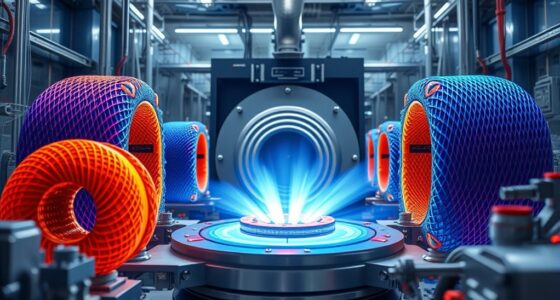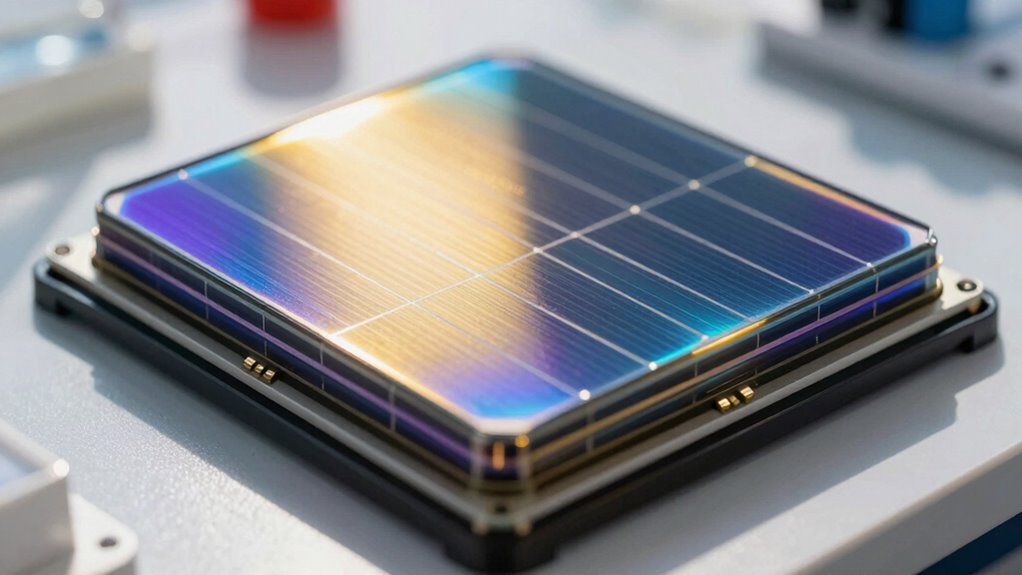

You should be excited about perovskite solar cells because they offer the promise of high efficiency, rivaling or surpassing silicon-based panels. These lightweight, flexible materials make installation easier and open up new applications. Scientists are drawn to their potential for low-cost, scalable production, despite current challenges with stability and manufacturing. If you want to understand how researchers are tackling these issues and what the future holds, there’s much more to discover.

Get the latest gadgets delivered free with Prime
- Fast, free delivery on millions of items
- Prime Video, Amazon Music and more included
- Member-only deals all year
Key Takeaways
- They offer remarkably high efficiency in converting sunlight to electricity, rivaling or surpassing silicon-based solar cells.
- Their lightweight, flexible design enables innovative, portable, and easily deployable solar applications.
- Cost-effective manufacturing techniques, like solution-based printing, promise to reduce production costs significantly.
- Advances in stability and uniformity are enabling progress toward durable, long-lasting perovskite solar panels.
- Their potential for versatile integration opens new markets and applications, driving widespread adoption of solar energy.
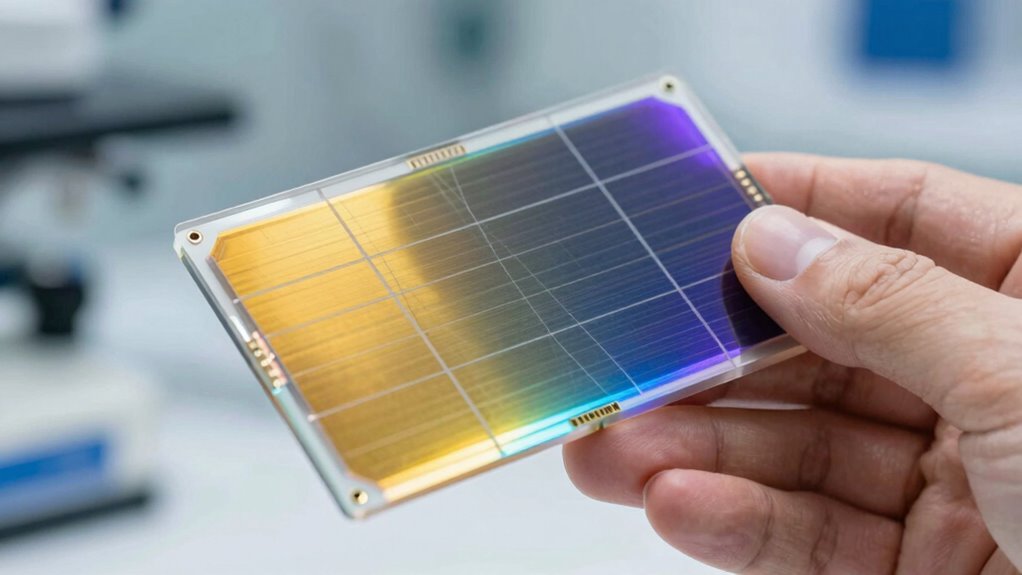
Have you ever wondered how scientists are revolutionizing solar energy? It’s all happening with perovskite solar cells, a technology that’s capturing attention because of their remarkable efficiency and potential for affordable clean energy. But behind their impressive performance, there’s a lot of work being done to overcome manufacturing challenges and make these cells commercially viable. You might not realize it, but scaling up production isn’t straightforward. Perovskites are sensitive materials that can degrade easily, and creating uniform, high-quality layers at a large scale demands precise manufacturing processes. Researchers are exploring new techniques to produce these cells more reliably and efficiently, aiming to reduce defects that could impair their performance or longevity. They’re also trying to develop cost-effective methods, such as solution-based printing and roll-to-roll manufacturing, which could significantly lower production costs. This focus on cost reduction is key because it could make perovskite solar panels more competitive with existing technologies like silicon-based cells. As manufacturing hurdles diminish, the promise of cheaper, high-efficiency solar energy becomes more realistic. Additionally, advances in manufacturing techniques are crucial for transitioning from laboratory prototypes to commercial-scale production.
The excitement around perovskites is fueled by their incredible ability to convert sunlight into electricity more efficiently than many traditional materials. They can reach efficiencies that rival or surpass silicon solar cells, but with much thinner and lighter layers. This means you could see flexible, lightweight panels that are easier to install and transport, opening doors to new applications. Despite these advantages, scaling up production still faces obstacles, especially in maintaining material stability and ensuring uniform quality across large surfaces. Researchers are actively working to address these issues, experimenting with different compositions and fabrication techniques to improve stability and durability. The goal is to produce solar cells that not only perform well in laboratory conditions but also withstand the rigors of real-world environments over time. Such advancements could ultimately lead to widespread adoption and integration of perovskite technology in various sectors.
As an affiliate, we earn on qualifying purchases.
Frequently Asked Questions
How Long Do Perovskite Solar Cells Typically Last?
Perovskite solar cells typically last around 5 to 10 years, but durability concerns still exist. You should know that their lifespan is affected by environmental factors like moisture and heat, which can degrade performance. While they boast low manufacturing costs, improving their durability remains a challenge. Researchers are actively working on solutions, so future versions may last longer, making them more practical for everyday use.
Are Perovskite Solar Cells Environmentally Friendly?
You might think perovskite solar cells are eco-friendly because they use eco-friendly materials, but the truth is more complex. While they have potential for low-energy manufacturing, recycling challenges remain due to their delicate composition and toxic components like lead. This means, despite their promising efficiency, you should consider both their environmental benefits and hurdles before calling them entirely sustainable. Researchers are actively working to improve their environmental profile.
Can Perovskite Cells Be Used in Flexible Devices?
Yes, perovskite solar cells can be used in flexible devices. Their flexible integration allows you to incorporate them into curved or portable surfaces easily. However, you should consider material durability, as these cells can be sensitive to environmental factors like moisture and temperature. Advances in encapsulation and material engineering are improving their robustness, making them more suitable for flexible applications in wearable tech, portable chargers, and other innovative devices.
What Are the Main Challenges in Commercializing Perovskite Solar Cells?
You face challenges in commercializing perovskite solar cells mainly due to manufacturing scalability and material stability. Scaling up production while maintaining high quality can be tricky, leading to inconsistent performance. Additionally, these cells tend to degrade quickly when exposed to moisture, heat, or sunlight, which hinders their long-term reliability. Overcoming these issues requires advancements in stable materials and cost-effective manufacturing processes, but progress is steadily being made.
How Do Perovskite Cells Compare in Efficiency to Silicon Solar Cells?
Perovskite solar cells often surpass silicon solar cells in efficiency, reaching over 25%, but material stability remains a concern. You’ll find that perovskites can be produced at a lower cost, which helps with cost reduction efforts. However, maintaining their stability over time is essential for long-term use, and ongoing research aims to improve this aspect while harnessing their high efficiency potential.
As an affiliate, we earn on qualifying purchases.
Conclusion
Think of perovskite solar cells as a shining lighthouse guiding the way through stormy energy seas. Their potential to revolutionize clean power is like a beacon calling us to a brighter, sustainable future. As you watch this lighthouse grow taller and brighter, remember it’s not just a light in the darkness—it’s a symbol of hope, innovation, and the promise of harnessing the sun’s energy more efficiently than ever before.
solution-based printing solar panels
As an affiliate, we earn on qualifying purchases.
As an affiliate, we earn on qualifying purchases.
roll-to-roll solar manufacturing
As an affiliate, we earn on qualifying purchases.
As an affiliate, we earn on qualifying purchases.
Fall Picks
fall essentials
As an affiliate, we earn on qualifying purchases.