
🔍 Read the full analysis: Using NVIDIA Warp And MjWarp To Improve Robotics Simulation Workflows on ThorstenMeyerAI.com
TL;DR
Hugging Face’s second article in its State of Simulation for Physical AI series demonstrates migrating an SO-101 follower arm from a standard MuJoCo workflow to MuJoCo Warp (MJWarp), running up to 2,048 parallel GPU environments. The tutorial covers environment preparation and scaling only — it trains no policy and reports no measured speedup.
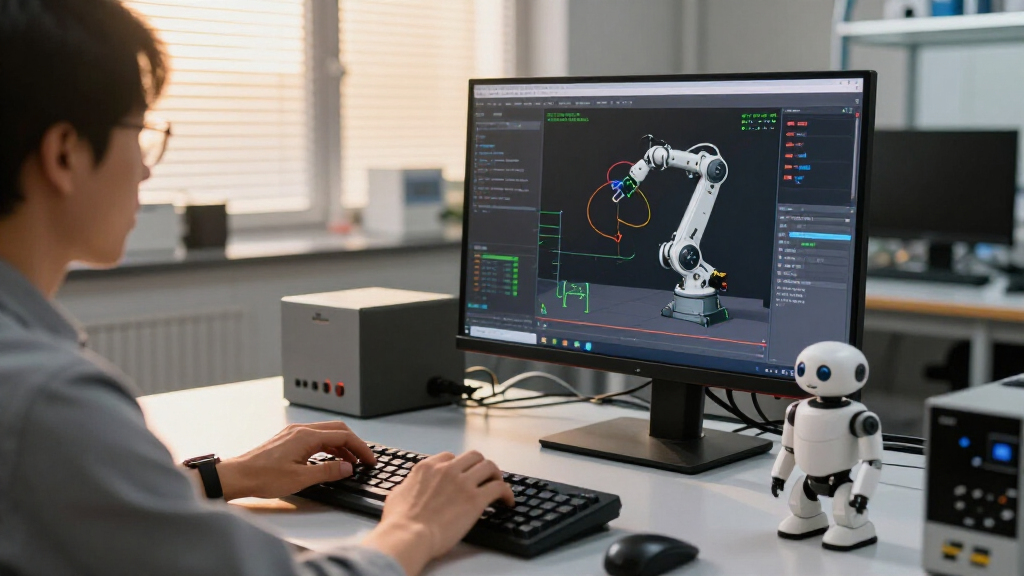
Hugging Face has published the second article in its State of Simulation for Physical AI series, demonstrating how to move an SO-101 follower arm from a standard MuJoCo workflow into MuJoCo Warp (MJWarp), scaling to as many as 2,048 parallel simulation environments on NVIDIA GPUs. The tutorial covers preparing and scaling the simulation only — it does not train a robot policy and reports no measured speedup. According to Hugging Face, the walkthrough “prepares and scales the simulation environment; we do not train a policy.”
The article describes a division of labor between two components. MuJoCo loads and compiles the MJCF robot model, while MJWarp implements compatible MuJoCo physics using Warp kernels compiled for NVIDIA GPUs. In the tutorial’s stack, Warp supplies the kernel language and device execution, MJWarp supplies MuJoCo physics, and Menagerie or Robot Studio assets provide the SO-101 model and task geometry.
NVIDIA Warp is a Python framework for writing GPU or CPU kernels. Its Python code specifies parallel work while Warp compiles kernels for execution; the first launch builds and caches a native module, and later launches reuse that cache. The article also explains a practical data-management constraint: copying a CUDA array to NumPy synchronizes and transfers data to the CPU, so keeping data on the device requires Warp’s framework adapters or DLPack-compatible sharing.
Running many copies of a scene in batches can suit learning workloads that need experience from varied starting states, the article explains. However, it presents the 2,048-environment figure as a demonstrated scale rather than a throughput benchmark — no frame rate, hardware configuration, or comparison baseline is provided.
Why GPU Environment Scaling Matters for Robot Learning
Robot-learning workloads often need to evaluate many candidate actions or starting conditions at once. A single simulation that runs quickly may still limit how much experience can be generated simultaneously. MJWarp’s batched GPU approach addresses that scaling question by advancing multiple compatible worlds while keeping simulation data near the accelerator.
The article offers practical guidance on tool selection: it recommends familiar CPU MuJoCo for single-robot model-predictive control or teleoperation, MJWarp or mjlab for raw MuJoCo physics throughput, and MuJoCo Playground or MJX with the Warp implementation for JAX-oriented training recipes. Teams seeking a broader multi-solver API and Isaac Lab integration are pointed toward Newton, which Hugging Face says will be covered in a later installment.
The tutorial’s value is an implementation path and a scale demonstration, not proof that every robot task will run faster. As the source material notes, the number of environments alone does not establish frame rate, hardware cost, model compatibility, or training quality.
Top picks for "nvidia warp mjwarp"
As an affiliate, we earn on qualifying purchases.
Where This Fits in Hugging Face’s Simulation Series
The tutorial is the second entry in Hugging Face’s series on simulation for physical AI. The first installment provided an overview of robot simulation; this article bridges that overview and later installments on Newton and Isaac Lab, which are intended to cover additional integration layers such as multi-solver APIs, USD, sensors, managers, and training loops.
MuJoCo itself is widely used for robot simulation and control, including workloads that parallelize sampling across CPU cores. MJWarp extends that ecosystem by building on NVIDIA Warp to execute compatible MuJoCo physics in batched GPU environments. Warp features such as differentiable kernels and deterministic execution are discussed in the article as framework capabilities — the source cautions these do not make an entire MJWarp rollout differentiable or deterministic by default.
“Here, we prepare and scale the simulation environment; we do not train a policy.”
— Hugging Face, describing the article’s scope
Missing Benchmarks and Compatibility Questions
The source material does not state the GPU model, measured simulation rate, workload settings, or comparison baseline behind the 2,048-environment figure. It is not clear how performance changes across different robot scenes, contact conditions, or hardware.
The article describes compatible MuJoCo models rather than claiming universal compatibility, and it does not specify which models may require changes before working with MJWarp. It also provides no policy-training results, task success rates, or evidence that a GPU setup improves learning outcomes. Warp’s autodifferentiation and deterministic modes are described as available capabilities, but the source explicitly cautions they do not apply to an entire MJWarp rollout by default. No publication date or detailed hardware configuration is given in the supplied material.
Newton, Isaac Lab, and the Evidence Still Needed
Hugging Face says later articles in the series will cover Newton and Isaac Lab, extending the discussion to multi-solver APIs, USD support, sensors, managers, and training loops. Those installments would show how a prepared MJWarp scene connects with larger robotics and learning systems.
For readers assessing whether to adopt the workflow, the next useful evidence would be reproducible throughput measurements with hardware and task details, model compatibility guidance, and results from an actual policy-training run — none of which are included in the current article.
Key Questions
Does the article claim MJWarp makes simulation faster?
No. The 2,048-environment figure is a demonstrated scale, not a reported speed benchmark. The article gives no measured simulation rate, comparison baseline, or hardware configuration.
Does the tutorial train a robot policy?
No. Hugging Face states the article’s scope explicitly: “Here, we prepare and scale the simulation environment; we do not train a policy.” Policy training is left to later work.
How do MuJoCo and NVIDIA Warp divide the work?
MuJoCo loads and compiles the MJCF robot model, while MJWarp implements compatible MuJoCo physics using Warp kernels compiled for NVIDIA GPUs. Warp provides the kernel language and device execution.
Will any MuJoCo model work with MJWarp?
That is unclear. The article describes compatible models, not universal compatibility, and does not specify which models may need modification.
When should teams still use CPU MuJoCo instead?
The article recommends CPU MuJoCo for single-robot model-predictive control or teleoperation, reserving MJWarp or mjlab for raw physics throughput and MJX/Playground for JAX-oriented training recipes.
Primary source: Hugging Face · via ThorstenMeyerAI.com