🔍 Read the full analysis: Using RoboTrack For Point Tracking In Real-World Robotic Tasks on ThorstenMeyerAI.com

Get the latest gadgets delivered free with Prime
- Fast, free delivery on millions of items
- Prime Video, Amazon Music and more included
- Member-only deals all year
TL;DR
Researchers introduced RoboTrack, a benchmark and training-data suite for testing point tracking in real-world robotic manipulation. They report that leading trackers scored lower on its 307 videos than on another real-video robotics benchmark, and that synthetic RoboTrack-15M data improved tracking on real manipulation footage.
Researchers have introduced RoboTrack, a benchmark and training suite for testing whether computer vision models can follow points on objects and robot grippers during real-world manipulation. The team reports that existing trackers score lower on its 307 annotated videos than on another real-video robotics benchmark, and that training with synthetic data improved performance on real manipulation footage.
RoboTrack-Bench contains 2,522 human-verified point tracks drawn from 307 videos sourced from DROID, Ego-Exo4D, MolmoAct 2 and EgoVerse. The clips show cluttered scenes, robot grippers and human hands from first- and third-person viewpoints. A subset of 33 synchronized video pairs follows the same physical points from two camera views. According to the project description, annotators focused on points that move or become hidden during an interaction, and labeled whether each track belonged to a robot or human body, a manipulated object or a static object. A second group checked every track frame by frame.
The researchers evaluated CoTracker3, BootsTAPNext, AllTracker and CoWTracker across RoboTrack-Bench and four other benchmarks, including RoboTAP, a real-world tabletop robotics test. They used Average Jaccard, or AJ, a measure that combines tracking accuracy with visibility prediction; higher scores indicate better performance. The team says the evaluated trackers scored 3.0 to 6.6 AJ points lower on RoboTrack-Bench than on RoboTAP. For example, CoWTracker scored 70.5 AJ on RoboTAP and 63.9 on RoboTrack-Bench.
The release also includes RoboTrack-15M, a synthetic dataset of manipulation point tracks created by extending the MolmoSpaces simulation ecosystem. The researchers released RoboTracker, fine-tuned from AllTracker, and RoboTracker-Warp, trained from CoWTracker, as well as a technical report, code and project materials. The project summary says RoboTrack-15M improved an existing tracker on real manipulation videos and that both released models raised average AJ across three robotics benchmarks compared with their respective baselines.
The team also reports that RoboTracker-Warp achieved state-of-the-art performance on four of five evaluated benchmarks. The supplied summary does not identify all five tests or provide the model’s full scores, so that claim cannot be examined in detail from the release information alone.
RoboTrack: Point Tracking For Real-world Robotic Manipulation
RoboTrack tests whether vision models can follow objects and grippers through real manipulation scenes. Its results show that strong scores on existing benchmarks may not carry over to clutter and occlusion.
Built around difficult interactions
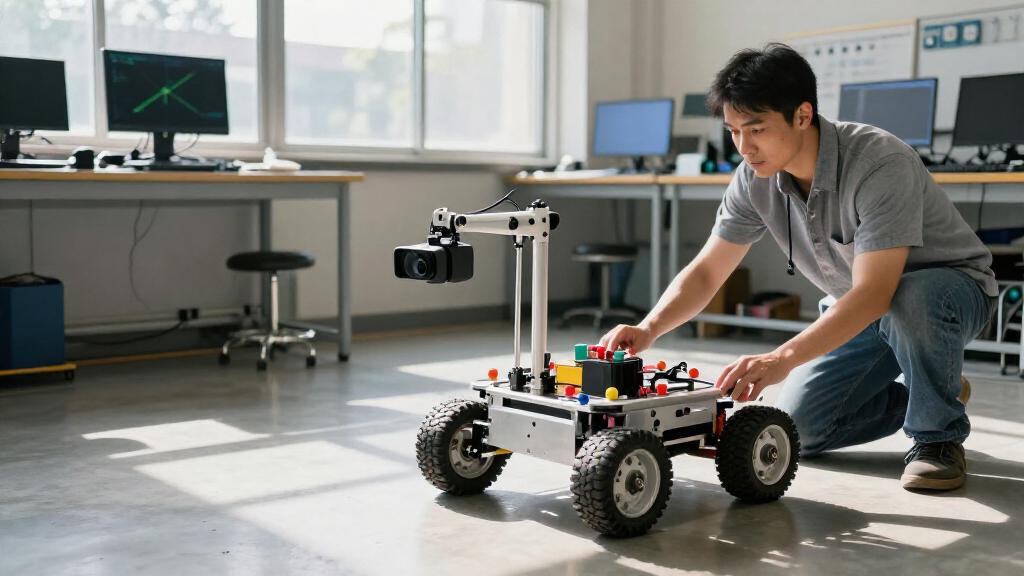
The clips include clutter, robot grippers, human hands, and first- and third-person views.
Follow points as they disappear
Tracks prioritize points that move or become hidden during an interaction.
Connect two camera views
A subset of 33 synchronized video pairs follows the same physical points from two views.
Benchmark results vary by scene
Higher Average Jaccard (AJ) means better tracking accuracy and visibility prediction.
From data to tracking models
The release pairs real evaluation footage with synthetic training data and two models.
Researchers compiled verified point tracks from DROID, Ego-Exo4D, MolmoAct 2, and EgoVerse.
RoboTrack-15M provides synthetic manipulation point tracks.
RoboTracker and RoboTracker-Warp build on AllTracker and CoWTracker, respectively.
What the results establish
The release reports tracking gains, but does not establish more reliable robot task execution.
- RoboTrack-15M improved tracking on real manipulation footage.
- RoboTracker-Warp reached state-of-the-art performance on four of five evaluated benchmarks.
- Exact new-model scores and full evaluation details.
- How gains transfer across robots, objects, and camera setups.
- Whether tracking gains improve task success.
Why Manipulation Trackers Need Harder Tests
Point tracking lets a system estimate where a chosen location moves through a video, including when it is temporarily hidden. In a manipulation task, that location might be the point where a gripper contacts an object. Tracking can inform learning from demonstrations, movement planning and feedback while a robot carries out a task. A gripper blocking the view, a small object or a changing camera angle can all make that tracking difficult.
The reported gap between RoboTAP and RoboTrack-Bench suggests that a strong score on an established robotics benchmark may not carry over to scenes with different viewpoints, clutter and occlusion. That matters for researchers comparing models and for teams considering them for robot systems. However, benchmark performance is not proof that a robot will complete tasks more reliably: the reported scores measure tracking, not end-to-end task success.
The project describes a real-robot example involving pipette handling in a wet-lab task, where a tracker was used to guide the robot. The supplied material does not give success rates or compare that demonstration with other control methods. It therefore illustrates a possible application, rather than establishing a measured improvement in robot performance.
Products Worth Considering

Apple Watch SE 3 GPS 40mm Smartwatch

Apple MacBook Air 13-inch Laptop with M5 Chip, 16GB Memory, 512GB SSD, and 12MP Center Stage Camera – Midnight

Sonos One (Gen 2) Voice-Controlled Smart Speaker, White
As an affiliate, we earn on qualifying purchases.
How RoboTrack Measures Moving Points
Point tracking begins with a location in one video frame and estimates where the same physical point appears in later frames. The task includes predicting visibility when an object or gripper blocks the view and locating the point if it reappears. In robotics, this can help connect what a camera sees with how objects and the robot move during an interaction.
The RoboTrack team tested four existing trackers on several kinds of video, including real tabletop manipulation, simulated stacking and general video benchmarks such as DAVIS and Kinetics. RoboTrack adds clips selected to include moving points and occlusions in real manipulation scenes. The researchers say adding synthetic RoboTrack-15M data improved an existing tracker on real manipulation videos and also produced gains on other tracking benchmarks. The project summary does not provide full results tables or a detailed account of the evaluation protocol.
““We wanted to see whether those results hold up across the varied scenes, viewpoints, and object interactions robots encounter in practice.””
— RoboTrack research team
What the Release Summary Leaves Open
The supplied project summary does not include full benchmark tables, uncertainty estimates or detailed protocols. That limits independent assessment of the size and consistency of the reported training gains. Apart from the CoWTracker comparison of 70.5 AJ on RoboTAP and 63.9 on RoboTrack-Bench, exact scores for the new models are not provided. The summary also does not identify all five benchmarks behind the RoboTracker-Warp result.
It is not clear how well the models transfer to robots, camera setups, tasks or environments outside the datasets. The pipette-handling example is described as a use case, but no task completion results, success rates or comparison with other robot-control approaches are supplied. The source summary also gives no release date or direct links to the project materials.
Reproducing Results on Real Robots
Researchers can examine the technical report, data and code described by the project, reproduce the benchmark comparisons and test the models on their own manipulation footage. Further trials could show whether the reported gains hold across new objects, camera angles and patterns of occlusion, and whether better point tracking improves task completion on real robots.
The supplied material gives no schedule for additional robot trials or other upcoming milestone. Until those results are reported, RoboTrack’s benchmark scores and the pipette example should be treated as evidence about tracking evaluation and a described application—not as a general measure of robot capability.
Key Questions
What is RoboTrack?
RoboTrack is a benchmark and training suite for evaluating point tracking in robotic manipulation. Its benchmark includes 307 annotated videos and 2,522 human-verified point tracks.
What did the researchers find on RoboTrack-Bench?
The researchers report that the tested trackers scored 3.0 to 6.6 Average Jaccard points lower on RoboTrack-Bench than on RoboTAP. For CoWTracker, the reported scores were 63.9 on RoboTrack-Bench and 70.5 on RoboTAP.
What is RoboTrack-15M?
RoboTrack-15M is a synthetic dataset of manipulation point tracks. The team says training with this data improved an existing tracker on real manipulation videos, though the supplied summary does not include full results tables.
Does RoboTrack show that robots perform tasks better?
Not by itself. The reported benchmark scores measure point tracking, not overall task success. The project describes a robot pipette-handling example but does not provide success rates or comparisons with other control methods.
What remains to be tested?
Further evaluation is needed to establish how the models perform on new robots, camera setups, objects and manipulation tasks. The supplied project summary does not give a timeline for those tests.
Primary source: Hugging Face · via ThorstenMeyerAI.com