
Understanding how calibration and environmental factors influence your thermal monoculars can greatly extend their detection range and improve night vision. When you properly calibrate your device and account for conditions like humidity and temperature, you allow it to detect subtle heat differences more effectively. This means you’ll see farther and more clearly in the dark. Keep these points in mind, and you’ll reveal even greater performance—there’s more to discover about optimizing your thermal experience.
Key Takeaways
- Understanding detection range helps optimize thermal monocular settings for clearer night viewing.
- Proper calibration extends the effective distance at which objects can be detected.
- Environmental factors like humidity and temperature impact the sensor’s ability to distinguish heat signatures.
- Knowledge of thermal technology allows users to interpret images more accurately in darkness.
- Regular calibration maintains device performance, enhancing night vision capabilities over time.

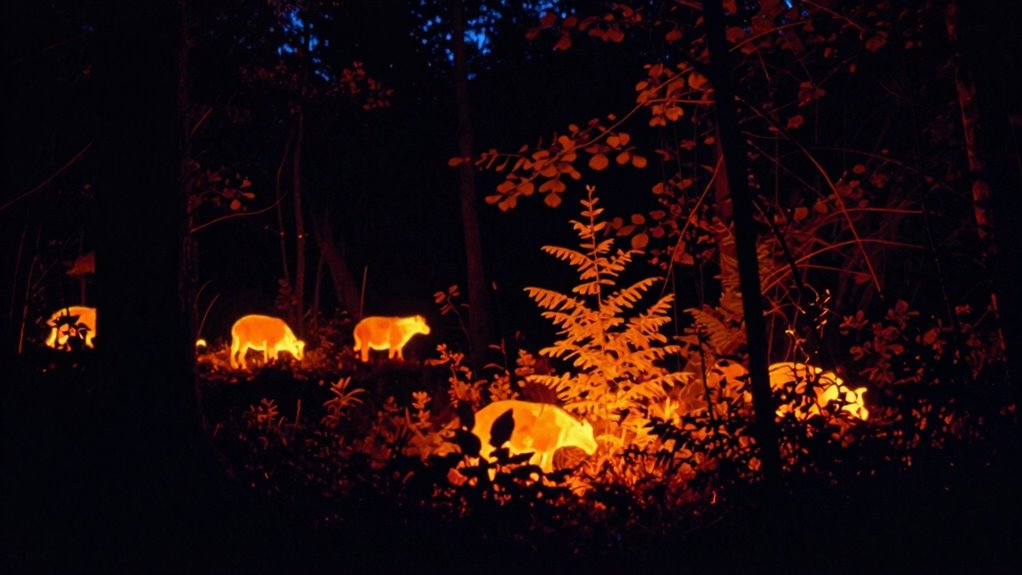
Ever wondered how thermal monoculars can detect objects at surprisingly long distances? The secret lies in advanced infrared technology and precise thermal sensor calibration. These devices don’t rely on visible light; instead, they detect heat emitted by objects, allowing you to see in total darkness or through obstructions like fog or foliage. Infrared technology captures the thermal radiation emitted by warm objects, converting it into an image you can interpret. This process is what makes thermal monoculars such powerful tools for night viewing, surveillance, or outdoor adventures.
Thermal monoculars detect heat emissions, enabling clear vision in darkness and through obstacles like fog or foliage.
The effectiveness of a thermal monocular’s detection range hinges on how well its thermal sensor is calibrated. Thermal sensor calibration ensures that the device accurately interprets temperature differences in its environment. When a monocular is properly calibrated, it can distinguish subtle heat variations, which enhances its ability to detect objects at longer distances. Calibration involves adjusting the sensor to account for environmental factors like ambient temperature and humidity, which can otherwise distort thermal readings. Regular calibration is essential to maintain optimal detection performance, especially if you’ve been using the device in varying conditions. Additionally, sensor calibration often requires specific procedures recommended by the manufacturer to ensure accuracy. Proper calibration not only improves detection range but also reduces the likelihood of false positives, which can interfere with effective night viewing. Recognizing the thermal sensor sensitivity can help you make better use of your device’s capabilities. Understanding the importance of infrared technology at work can help you appreciate how these devices achieve such impressive detection distances. Moreover, awareness of environmental factors can assist in optimizing the device’s performance in different conditions.

TOPDON TS004 Thermal Imaging Monocular, 320 x 240 TISR 256 x 192 IR Resolution, Supported Wireless Connection, 13mm 50Hz Thermal Night Vision with 11h Battery Life, IP67 Monocular for Hunting
UNMATCHED CLARITY: With a high IR resolution of 256×192 and a smooth 50Hz refresh rate, the thermal monocular…
As an affiliate, we earn on qualifying purchases.
As an affiliate, we earn on qualifying purchases.
Frequently Asked Questions
How Do Thermal Monoculars Differ From Traditional Night Vision Devices?
Thermal monoculars differ from traditional night vision devices because they use thermal imaging technology to detect heat signatures, not ambient light. This means you can see in complete darkness, through fog or smoke, without relying on external light sources. Traditional night vision amplifies available light, which can be less effective in harsh conditions. With thermal technology, you gain a clearer, more reliable view regardless of lighting or weather.
What Factors Influence the Detection Range of Thermal Monoculars?
Your detection range depends on factors like thermal sensor calibration and battery life management. Proper calibration guarantees accurate temperature detection, extending your effective viewing distance. Managing battery life prevents power loss during vital moments, maintaining ideal performance. Environmental conditions, such as temperature contrast and weather, also influence detection range. By keeping your thermal sensor calibrated and batteries well-managed, you maximize your night vision capabilities and improve overall detection distance.
Are Thermal Monoculars Effective in All Weather Conditions?
Thermal monoculars are generally effective in various weather conditions, thanks to their weather resilience, allowing you to see through fog, rain, or snow. However, heavy weather like thick fog or precipitation can still reduce their effectiveness. Keep in mind, cost considerations play a role, as high-quality models with better weather resilience tend to be pricier. Still, investing in a durable thermal monocular guarantees reliable night viewing across different environments.
How Does Target Size Affect Detection Distance?
Target size directly affects detection distance; larger targets are easier to spot from farther away. When using thermal monoculars, a bigger object emits more heat, making it stand out against the background. Smaller targets emit less heat, reducing detection distance. So, if you’re trying to see distant objects, larger targets will be more visible, while smaller ones may require closer proximity. Understanding this helps optimize your night viewing effectiveness.
What Maintenance Is Required for Optimal Thermal Monocular Performance?
Like a well-tuned instrument, your thermal monocular needs regular care. You should regularly check the battery life and replace batteries as needed to guarantee uninterrupted use. Keep the lens clean by gently wiping it with a soft, lint-free cloth to maintain clarity. Avoid harsh chemicals that could damage the lens coating. Proper maintenance guarantees sharp images and reliable performance, making your night viewing experience as clear as a moonlit night.
TOPDON TS004 Thermal Imaging Monocular, 320 x 240 TISR 256 x 192 IR Resolution, Supported Wireless Connection, 13mm 50Hz Thermal Night Vision with 11h Battery Life, IP67 Monocular for Hunting
UNMATCHED CLARITY: With a high IR resolution of 256×192 and a smooth 50Hz refresh rate, the thermal monocular…
As an affiliate, we earn on qualifying purchases.
As an affiliate, we earn on qualifying purchases.
Conclusion
Once you grasp the concept of detection range, thermal monoculars become your reliable night-time companions, revealing what’s hidden in the darkness. Think of them as your own personal lighthouse, piercing through the night fog. With this understanding, you’ll see the night not as a barrier, but as an open book waiting to be read. Embrace the power of thermal vision, and turn darkness into an advantage—like a tool revealing secrets others can’t see.

Goldeep 2 in 1 Thermal Imaging Camera, 240 x 240 TISR Resolution, 96×96 IR Resolution with 25000 Counts Multimeter, Professional Digital Multimeter with IR Camera, -4℉-1022℉ Temperature Range (Black)
2-in-1 thermal imaging multimeter (Goldeep Ti-1) featuring 240×240 thermal resolution, 50°×50° field of view, and 25Hz refresh rate….
As an affiliate, we earn on qualifying purchases.
As an affiliate, we earn on qualifying purchases.
TOPDON TS004 Thermal Imaging Monocular, 320 x 240 TISR 256 x 192 IR Resolution, Supported Wireless Connection, 13mm 50Hz Thermal Night Vision with 11h Battery Life, IP67 Monocular for Hunting
UNMATCHED CLARITY: With a high IR resolution of 256×192 and a smooth 50Hz refresh rate, the thermal monocular…
As an affiliate, we earn on qualifying purchases.
As an affiliate, we earn on qualifying purchases.