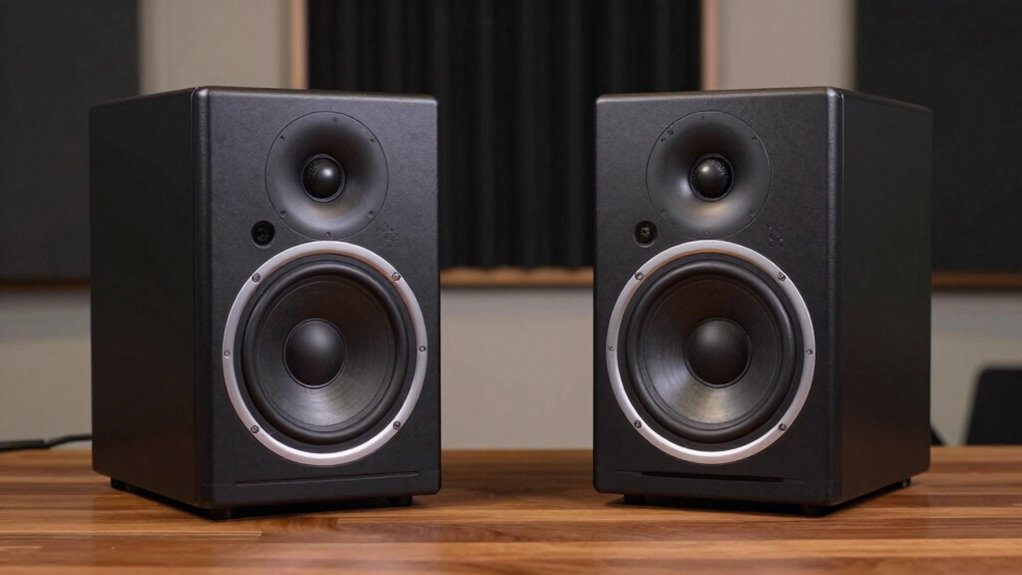

Studio monitor speakers aren’t like regular consumer speakers because they deliver a flat, uncolored sound that reveals every detail in your audio. They’re designed for accuracy, not bass-heavy or boosted tones, helping you spot tonal imbalances and issues during production. Their precise construction minimizes distortions and resonances, ensuring a true sound picture. If you want to understand what makes these speakers essential for professional-quality audio, keep exploring the details behind their design and purpose.

Get the latest gadgets delivered free with Prime
- Fast, free delivery on millions of items
- Prime Video, Amazon Music and more included
- Member-only deals all year
Key Takeaways
- Studio monitors provide a flat frequency response for accurate audio reproduction, unlike regular speakers which often enhance certain frequencies.
- They are designed for critical listening, enabling precise detection of tonal imbalances during mixing and mastering.
- Studio monitors reduce acoustic coloring and distortion, ensuring true audio representation without coloration or exaggeration.
- Their construction minimizes vibrations and resonances, maintaining clarity and fidelity essential for professional audio work.
- Regular speakers prioritize aesthetics and bass enhancement, whereas studio monitors focus solely on sound accuracy and neutrality.
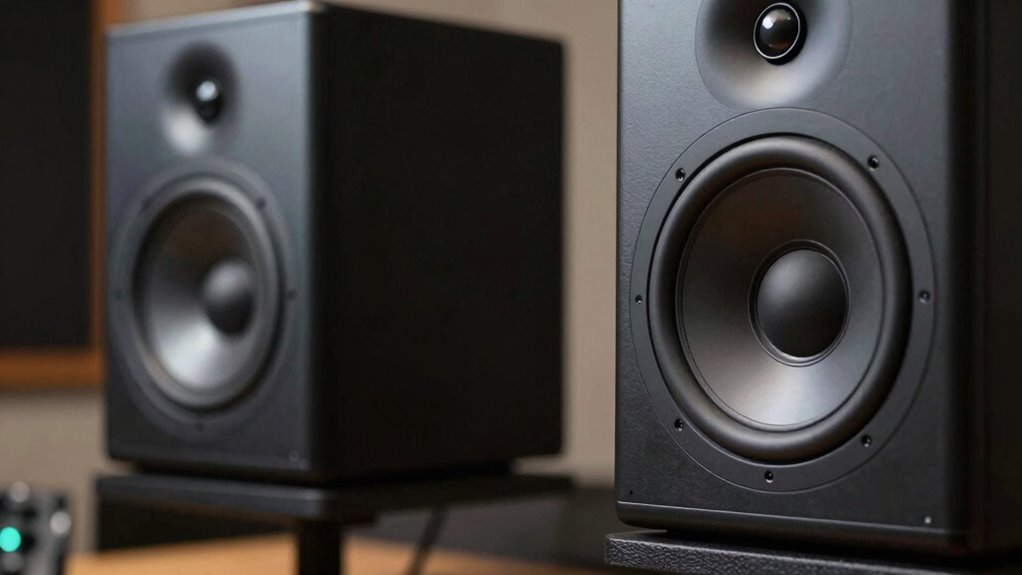
When it comes to producing accurate sound, studio monitor speakers stand out from regular speakers because they’re designed specifically for critical listening. Unlike typical consumer speakers, which often enhance certain frequencies to make music sound more appealing, studio monitors deliver a flat, uncolored sound. This means you hear the audio exactly as it was recorded, without any added bass, treble, or midrange boost. This precision is essential for mixing and mastering, where even the slightest tonal imbalance can affect the final product.
Studio monitors provide a flat, uncolored sound for precise, honest audio reproduction essential in professional mixing and mastering.
One of the key reasons studio monitors excel is their focus on sound frequency. These speakers are engineered to reproduce the full spectrum of sound frequencies accurately, from deep bass to shimmering highs. They don’t exaggerate or suppress specific ranges; instead, they aim for neutrality. When you listen through a monitor, you get a true representation of the audio, which helps you make informed decisions during production. This isn’t just about hearing more detail but about hearing the sound as it truly exists, without distortion caused by the speaker’s design. Achieving acoustic neutrality often involves meticulous design choices that prioritize sound fidelity over aesthetic or bass-heavy appeal.
The acoustic design of studio monitors also plays a vital role in their superiority. These speakers are built with meticulous attention to how sound waves behave within the environment. They often feature near-field designs, meaning you sit close to the speakers, minimizing the influence of room acoustics. Their cabinets are carefully constructed to reduce unwanted resonances and vibrations that could color the sound. This design ensures that the monitor’s output remains clear and precise, giving you a reliable reference point. In contrast, regular speakers often prioritize aesthetic appeal or bass output over acoustic neutrality, which can lead to skewed perceptions of your audio. Additionally, sound fidelity is a core focus in the engineering process of studio monitors, ensuring they deliver consistent performance across different listening environments.
Furthermore, studio monitors are designed with smooth, extended frequency responses and minimal distortion. This ensures that every detail in the sound is maintained without harshness or muddiness. The goal isn’t to make the sound more exciting but to reproduce it exactly as it is captured in the studio. This level of accuracy is crucial when mixing, as it allows you to identify issues like muddiness, harshness, or imbalance that might go unnoticed with consumer-grade speakers. Achieving accurate sound reproduction is a fundamental aspect that distinguishes studio monitors from regular speakers.
In essence, your ability to produce professional-quality audio hinges on understanding the true sound. Studio monitor speakers aren’t just louder or more stylish—they’re purpose-built tools that provide an honest, transparent window into your recordings. Their precise sound frequency reproduction and thoughtful acoustic design make them indispensable for anyone serious about audio production.
studio monitor speakers for mixing
As an affiliate, we earn on qualifying purchases.
As an affiliate, we earn on qualifying purchases.
Frequently Asked Questions
Can Studio Monitor Speakers Be Used for Casual Listening?
Yes, you can use studio monitor speakers for casual listening, but keep in mind they prioritize sound clarity over bass or warmth. You’ll notice a more accurate, uncolored sound, which is great for critical listening but might feel flat for relaxed, casual enjoyment. If you prefer warm, rich sound for casual listening, you may want to pair them with a subwoofer or consider different speakers designed for everyday use.
How Do Studio Monitors Affect Mixing Accuracy?
Think of studio monitors as your musical crystal ball, revealing every detail with clarity. They enhance mixing accuracy by providing a flat frequency response, so you hear sound transparency without coloring the audio. This honesty allows you to make precise adjustments, ensuring your mix translates well across all systems. Without monitors, you’re steering blindfolded; with them, you gain a clear, uncolored window into your music’s true sonic landscape.
Are Studio Monitors More Expensive Than Regular Speakers?
Yes, studio monitors are generally more expensive than regular speakers because they prioritize color accuracy and precise sound reproduction, which requires higher-quality components. They also handle more power to deliver clear, consistent audio at various volumes without distortion. This investment guarantees you get accurate mixes, making studio monitors essential for professional audio work, unlike regular speakers that often focus on aesthetics or bass response.
Do Studio Monitors Require Special Placement?
Think of your studio as a nurturing garden; proper placement of your monitors is crucial for growth. Yes, studio monitors require special placement, considering room acoustics and speaker calibration. You need to position them at ear level, away from walls, and in an ideal triangle to guarantee true sound reproduction. This careful setup helps your mixes translate well across different systems, making your creative efforts bloom naturally.
Can Studio Monitors Improve Overall Sound Quality in a Home Setup?
Yes, studio monitors can improve your overall sound quality in a home setup. They provide accurate sound reproduction, thanks to their flat frequency response, allowing you to hear every detail. Proper sound isolation helps prevent external noise from affecting your listening, ensuring clearer mixes. This combination helps you make better mixing decisions, ultimately enhancing your audio experience and producing professional-sounding results right in your home environment.
As an affiliate, we earn on qualifying purchases.
Conclusion
So, don’t think of studio monitor speakers as just fancy home audio gear. They’re designed to give you a pure, accurate sound—perfect for mixing and creating. Sure, they might seem like overkill for casual listening, but once you experience the clarity and detail, you’ll realize they’re worth it. Plus, with the right setup, you might just find yourself enjoying music even more than before—no fancy headphones needed!
professional audio studio monitors
As an affiliate, we earn on qualifying purchases.
As an affiliate, we earn on qualifying purchases.
near-field studio monitor speakers
As an affiliate, we earn on qualifying purchases.
As an affiliate, we earn on qualifying purchases.
Halloween Picks
halloween
As an affiliate, we earn on qualifying purchases.