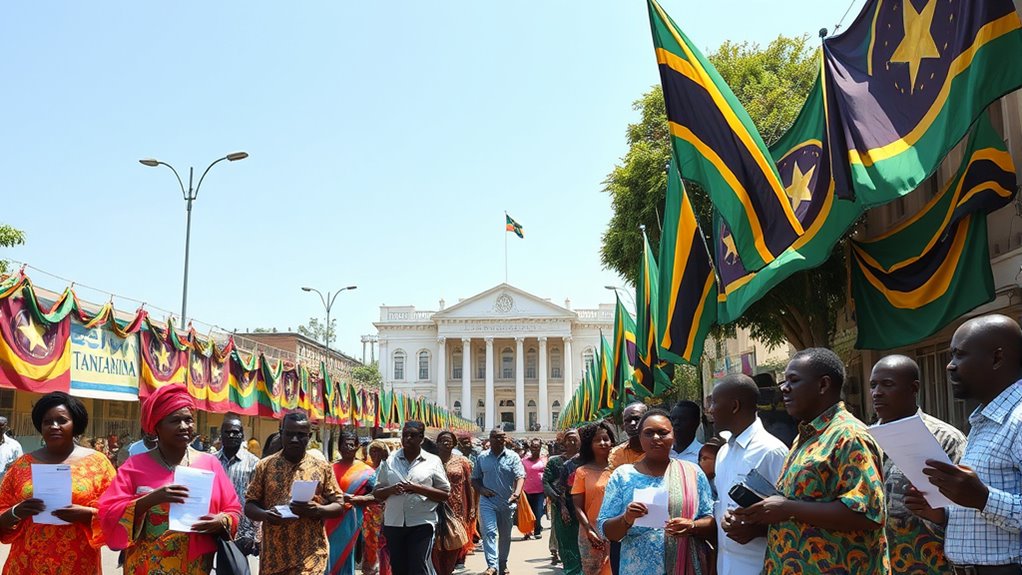

Tanzania’s 2025 elections are shaping up as a major political contest, with the ruling CCM facing growing opposition and a shifting voter base. You’ll see candidates focus on economic growth, social justice, and governance, using social media and rallies to influence voters. The elections also include key legislative races that could change parliamentary power. If you want to understand how these developments will shape Tanzania’s future, keep exploring what’s at stake.
Key Takeaways
- The 2025 elections feature a competitive presidential race with contrasting visions for Tanzania’s future.
- Opposition parties are gaining ground, challenging CCM’s long-standing dominance in both presidential and legislative races.
- Campaign strategies focus on social media, rallies, and voter engagement, emphasizing economic and governance issues.
- Electoral integrity and transparency are key concerns, with civil society and observers emphasizing fair voting processes.
- The outcome will shape Tanzania’s political landscape, influencing governance, policy implementation, and democratic development.
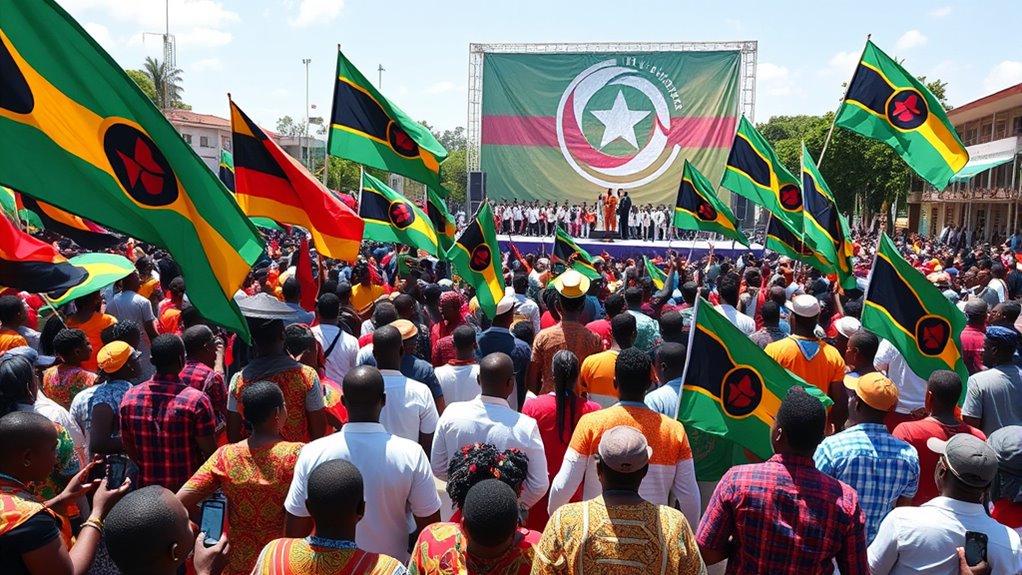
As Tanzania gears up for its 2025 elections, the political landscape is becoming increasingly dynamic and competitive. You’ll notice that the race for the presidency is attracting more attention than ever before, with several key figures positioning themselves to lead the nation. The ruling Chama Cha Mapinduzi (CCM) remains a dominant force, but opposition parties are mobilizing more effectively, aiming to challenge its long-standing influence. This shift signals a potential change in voter sentiment, driven by issues like economic development, corruption, and governance transparency. As a voter or observer, you’ll see campaigns intensify, with candidates leveraging social media, rallies, and public debates to sway public opinion.
The presidential race is shaping up to be more than a contest of personalities; it’s becoming a battleground for contrasting visions of Tanzania’s future. You might observe candidates emphasizing economic reforms, infrastructure development, or social justice, each trying to resonate with different segments of the population. The contest isn’t just about who wins but also about how candidates handle pressing national issues like unemployment, healthcare, and education. You’ll see campaign strategies evolve, with candidates tailoring their messages to appeal to youth, women, and marginalized groups, recognizing their growing influence in elections. Additionally, the importance of electoral integrity is increasingly emphasized, highlighting the need for transparent and fair voting processes.
Legislative races are equally significant, with a focus on gaining control of Parliament. The composition of the National Assembly will determine the government’s ability to pass laws and implement policies effectively. You’ll notice that opposition parties are increasing their presence, trying to capitalize on public dissatisfaction with current governance. This could lead to more spirited parliamentary debates and a more balanced representation of views. Voters are paying close attention to candidate platforms, especially on issues like decentralization, land reforms, and anti-corruption measures, which they see as indispensable to Tanzania’s progress.
Opposition parties are gaining ground, emphasizing decentralization, land reforms, and anti-corruption to shape Tanzania’s future.
As the election approaches, you’ll see a surge in political activities, including community outreach and voter education campaigns. Both sides are aware that high voter turnout will be essential, so efforts are being made to mobilize young voters and first-time electors. The electoral process itself is under scrutiny, with calls for transparency and fairness echoing from international observers and civil society groups. Ultimately, your role as a voter becomes even more consequential—your choices will shape the country’s trajectory for years to come. The 2025 elections promise to be a pivotal moment for Tanzania, reflecting its evolving democracy and the aspirations of its people.

Tanzania Country Nation Flag Novelty Highway Vintage Retro Wall Décor Shield Metal Aluminum Sign
12"x12"
As an affiliate, we earn on qualifying purchases.
As an affiliate, we earn on qualifying purchases.
Frequently Asked Questions
How Will the Election Process Ensure Transparency and Fairness?
You can expect the election process to guarantee transparency and fairness through strict adherence to established laws, independent oversight by electoral commissions, and transparent vote counting procedures. Monitoring by domestic and international observers will help hold all parties accountable. Additionally, technology may be used to prevent tampering, and public access to election data will promote trust. These efforts work together to ensure a credible and fair election outcome.
What Are the Main Challenges Facing Electoral Security?
You face challenges like ensuring voter identification is secure and preventing electoral fraud. Political tensions can escalate, risking violence or intimidation at polling stations. Cybersecurity threats also pose risks to election data integrity. Additionally, logistical issues, such as transportation and communication breakdowns, can hinder election security. You must coordinate effectively among security agencies and implement robust measures to address these challenges and safeguard a fair election process.
How Are Voter Education Efforts Being Conducted Nationwide?
You might think voter education is a top priority, yet efforts across the nation often seem as scattered as they are sincere. Campaigns utilize radio, TV, community meetings, and social media to reach voters. However, the true challenge lies in ensuring everyone understands their rights and the voting process, especially in remote areas. So, while initiatives exist, their reach and effectiveness sometimes fall short of fostering fully informed electoral participation.
What Role Do International Observers Play in the Election?
International observers play a pivotal role in Tanzania’s elections by monitoring the electoral process for fairness and transparency. You’ll see them evaluating voter registration, observing voting procedures, and ensuring the integrity of results. Their presence helps boost public confidence in the election, encourages adherence to democratic standards, and provides independent reports that can highlight issues or irregularities. You might also witness them engaging with election officials and giving recommendations for improvement.
How Will Election Results Impact Tanzania’s Future Policies?
You’ll see election results shape Tanzania’s future policies like a ripple effect. If the current leadership stays in power, expect policies to focus on economic growth and stability. A change might bring reforms in healthcare, education, or governance. It’s a make-or-break moment that could steer the nation toward progress or unrest. Your voice and vote are crucial—they’re the key to opening the country’s next chapter.
voter education materials Tanzania
As an affiliate, we earn on qualifying purchases.
As an affiliate, we earn on qualifying purchases.
Conclusion
As you follow Tanzania’s 2025 elections, remember they’re like a unfolding story, full of hope and change. The presidential and legislative races will shape the country’s future, just as a single brushstroke defines a masterpiece. Stay engaged and informed, because your voice matters in building Tanzania’s tomorrow. These elections are a pivotal moment, and your participation can make a difference, like a ripple turning into a wave of progress.

Klein Tools NCVT-6 Non-Contact Volt Tester, 12 – 1000V AC Pen with Integrated Laser Distance Measure, LED and Audible Alarms, Pocket Clip
VERSATILE AC VOLTAGE DETECTION: The non-contact tester accurately detects AC voltage from 12 to 1000V in various applications,…
As an affiliate, we earn on qualifying purchases.
As an affiliate, we earn on qualifying purchases.

FFILL Tanzanian Banner Flag String, Tanzania Mini Flag Small Banner, for Party, Shops and Bars Decorations, And International Day Celebrations. (Tanzania)
Product advantages ✓ 30 African countries ✓ Double-sided high-definition printing, with bright and non-fading colors ✓ Environmentally friendly…
As an affiliate, we earn on qualifying purchases.
As an affiliate, we earn on qualifying purchases.