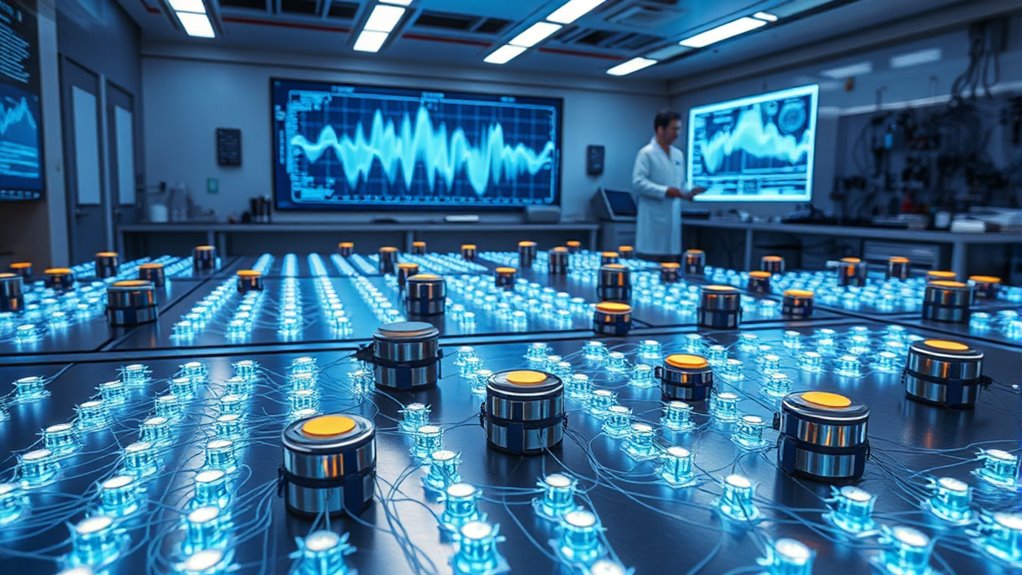

Quantum sensors show great promise for detecting tiny signals that often precede earthquakes, potentially improving early warning systems. While they can sense minute changes in gravitational and magnetic fields more accurately than traditional tools, predicting quakes with certainty remains challenging due to inconsistent signals and technical limits. This technology isn’t a miracle cure yet, but ongoing advancements are promising. Stay tuned to discover how emerging science aims to turn hope into reality.

Get the latest gadgets delivered free — and shop member deals
- Fast, free delivery on millions of items
- Access to Prime Big Deal Days deals on October 6–7
- Prime Video, Amazon Music and more included
Key Takeaways
- Quantum sensors offer enhanced sensitivity to detect faint seismic precursors, improving early earthquake warnings.
- Current technology is promising but still faces challenges in accuracy and reliable pattern recognition.
- Seismic precursors are often weak or inconsistent, limiting the certainty of predictions.
- Quantum sensor development is ongoing, aiming to integrate with existing monitoring systems for better forecasts.
- While not a complete solution, quantum sensors represent a significant step toward more effective earthquake prediction.

Earthquakes often strike without warning, but recent advances in quantum sensor technology promise to change that. These cutting-edge sensors are designed to detect subtle shifts in Earth’s crust long before a quake occurs, offering the potential for early warnings that could save lives. The key lies in understanding seismic precursors—small, often overlooked signals that hint at an impending earthquake. Quantum sensors excel at picking up these faint signals because of their exceptional sensor sensitivity, which surpasses traditional seismic instruments. Unlike conventional equipment, quantum sensors leverage quantum properties to detect minute changes in gravitational or magnetic fields, making them highly capable of sensing the earliest signs of tectonic stress accumulation.
Furthermore, ongoing research focuses on quantum-enhanced detection methods, which aim to improve the accuracy and reliability of these sensors in complex geological environments. As you consider these developments, it’s important to recognize that seismic precursors aren’t always straightforward or consistent. Sometimes, these signals are weak, inconsistent, or even absent, complicating efforts to reliably predict earthquakes. That’s where sensor sensitivity becomes vital. Quantum sensors can detect fluctuations that are orders of magnitude smaller than what older technologies could perceive. This enhanced sensitivity means that, theoretically, you could identify warning signs days or even hours before a quake strikes, giving communities precious time to prepare or evacuate. However, translating this scientific potential into practical, real-world warning systems is still a work in progress. While the technology shows promise, it’s not yet foolproof, and researchers are actively working to refine sensor accuracy and reduce false alarms.
You might wonder if these innovations will truly revolutionize earthquake prediction. The answer is that quantum sensors hold significant promise, but they are not magic. They work best as part of a broader, integrated approach that includes geological monitoring and data analysis. Currently, scientists are testing these sensors in earthquake-prone regions, aiming to establish reliable seismic precursor patterns. If successful, you could see a future where early warnings become more accurate and timely, giving you and your community a critical edge in disaster preparedness. Still, it’s essential to maintain realistic expectations, as predicting earthquakes with absolute certainty remains a complex challenge. The progress made in sensor sensitivity and understanding seismic precursors fuels hope, but it’s important to remember that this technology is evolving. While quantum sensors might not eliminate all surprises, they represent a significant step forward in harnessing the power of quantum physics to better understand and perhaps someday predict one of nature’s most unpredictable phenomena.
As an affiliate, we earn on qualifying purchases.
Frequently Asked Questions
How Soon Could Quantum Sensors Be Widely Deployed Globally?
You might wonder how soon quantum sensors could be widely deployed globally. While they hold promise for improving earthquake early warning systems, sensor deployment logistics remain challenging. It could take several years before large-scale adoption, as researchers work to refine technology and address costs. You should stay informed, because advancements could eventually enhance early alerts worldwide, saving lives and reducing damage.
What Are the Current Limitations of Quantum Sensor Technology?
You should know that quantum sensors face significant limitations, mainly due to quantum noise, which can interfere with accurate readings. Only about 10% of current sensors are properly calibrated, making reliability an issue. These challenges hinder widespread deployment, as overcoming quantum noise and ensuring precise sensor calibration are essential for reliable earthquake prediction. Until these issues are addressed, the technology remains promising but not yet ready for global use.
Can Quantum Sensors Predict Other Natural Disasters?
You might wonder if quantum sensors can predict other natural disasters. While these sensors excel at detecting subtle changes, their quantum limitations and sensor scalability issues currently hinder broad application. These challenges mean quantum sensors aren’t yet reliable for forecasting events like hurricanes or floods. As technology advances, you could see improvements, but for now, predicting other natural disasters remains limited by these fundamental constraints.
What Are the Costs Associated With Developing Quantum Earthquake Sensors?
You should consider the cost analysis involved in developing quantum earthquake sensors, as they can be expensive due to advanced technology and research needs. Budget constraints play a significant role, potentially limiting rapid deployment or widespread use. You’ll need to account for high research and development costs, specialized equipment, and skilled personnel, making it essential to weigh the investment against the potential benefits of more accurate earthquake prediction.
How Do Quantum Sensors Compare to Traditional Seismic Detection Methods?
You see, quantum sensors outshine traditional seismic methods with their exceptional sensitivity, capturing tiny tremors others might miss. Their quantum sensitivity allows for precise detection, but you must carefully calibrate sensors to guarantee accuracy. Unlike conventional tools, these sensors promise to provide more detailed, earlier warnings. While calibration can be complex, quantum sensors hold the potential to revolutionize earthquake detection, offering hope for safer, smarter seismic monitoring.
earthquake early warning devices
As an affiliate, we earn on qualifying purchases.
As an affiliate, we earn on qualifying purchases.
Conclusion
While quantum sensors promise a new dawn in earthquake prediction, they’re still charting uncharted waters, like explorers chasing shadows. Though the technology holds exciting potential, it’s not yet the crystal ball we hope for. Stay hopeful, but keep your feet on the ground—this breakthrough is a marathon, not a sprint. As we stand at the edge of discovery, remember, every step forward is a beacon guiding us through the storm.
magnetic field sensors for earthquake detection
As an affiliate, we earn on qualifying purchases.
As an affiliate, we earn on qualifying purchases.
gravitational sensors for seismic activity
As an affiliate, we earn on qualifying purchases.
As an affiliate, we earn on qualifying purchases.
Halloween Picks
halloween
As an affiliate, we earn on qualifying purchases.