
TL;DR

Get the latest gadgets delivered free — and shop member deals
- Fast, free delivery on millions of items
- Access to Prime Big Deal Days deals on October 6–7
- Prime Video, Amazon Music and more included
University of Oldenburg physicists report creating controllable three-dimensional light fields by combining two ultrashort laser pulses, then using the fields to excite electrons in potassium atoms into states previously inaccessible in experiments. The work, published in Physical Review Research, may support future studies of chiral molecules, but molecular sensing applications have not yet been demonstrated.
Physicists at the University of Oldenburg report that they created controllable three-dimensional light fields from two intersecting ultrashort laser pulses and used them to generate electron states not previously accessible in experiments. In tests with potassium atoms, the team excited electrons and released them from the atoms while measuring successive stages of their state evolution, a result that could open new ways to study how light interacts with matter.
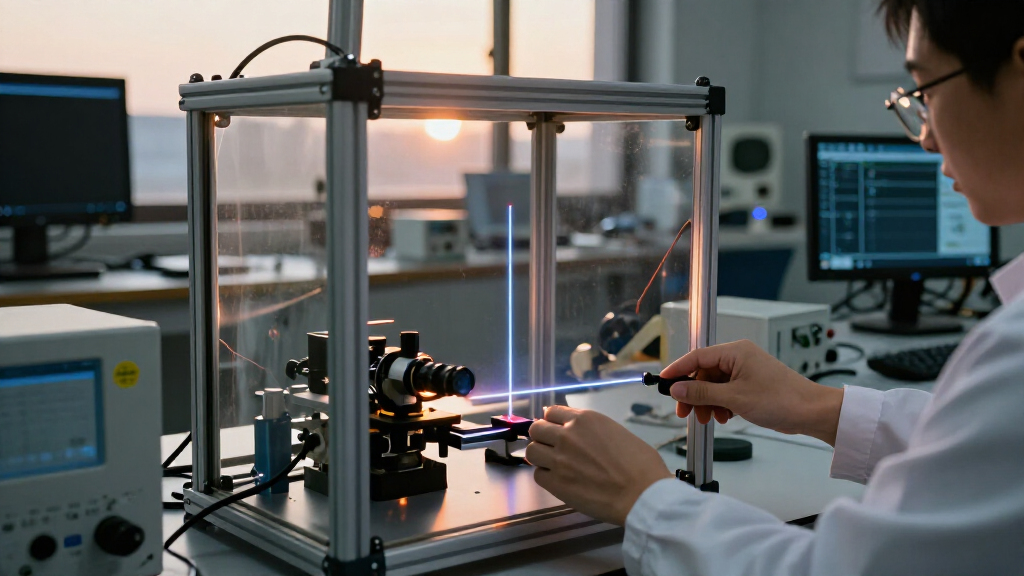
The researchers combined two specially shaped femtosecond laser pulses—brief bursts lasting a few quadrillionths of a second—from beams of different colours. The beams met at a point in a vacuum chamber, producing a light field that oscillates across all three spatial directions. The team could control the field’s shape, according to the study account published by The Quantum Insider and the University of Oldenburg.
To demonstrate the technique, the physicists used the field to selectively raise electrons in potassium atoms into higher-energy, or excited, states, and then release them from the atoms. They recorded changes at short intervals, capturing successive stages of the electron states’ evolution. The researchers describe the measurement as a way to form a time-sequenced view of quantum processes, analogous to using strobe flashes to track motion.
The results were reported in Physical Review Research. The study shows the method working in an atomic experiment; its proposed use to detect or distinguish chiral molecules remains a potential application rather than a result demonstrated in this work.
New Tools for Tracking Electron States
The result expands the ways researchers can shape light and use it to probe electron behavior. Reaching and observing states that had been inaccessible in experiments may let scientists test how particular light patterns influence matter, and may help investigate interactions that are difficult to isolate with conventional light fields.
The team also points to possible relevance for chiral sensing. Chiral molecules have mirror-image forms that cannot be superimposed, and the two forms can behave differently. If future experiments establish that three-dimensional light fields can reliably distinguish such forms, the technique could add a new option for studying molecules relevant to biology and medicine. That prospect is not evidence that the method can already identify or separate chiral compounds.
As an affiliate, we earn on qualifying purchases.
From Laser Interference to Molecular Chirality
The reported technique depends on controlling how two laser beams overlap, rather than using a single beam alone. By selecting pulses of different colours and shaping their paths so they converge, the team produced a field with variation in three dimensions. The study’s central experimental step was then to use that field to prepare and observe electron states in potassium.
Chirality provides the researchers’ longer-term motivation. Many biological molecules and pharmaceutical compounds occur in mirror-image forms, which may have different properties. The Oldenburg team says theoretical work indicates that three-dimensional light fields may themselves have chiral properties, making them candidates for investigating molecular handedness. The current experiment supplies a basis for exploring that idea, not a completed molecular test.
“With our method, we can generate electronic quantum states that have previously only been described theoretically and also make them spatially visible.”
— Matthias Wollenhaupt, University of Oldenburg research-team leader
As an affiliate, we earn on qualifying purchases.
Molecular Sensing Still Awaits Testing
The reported demonstration used potassium atoms, not chiral molecules. The study account does not establish whether the method can distinguish mirror-image molecules in practice, how sensitive such a measurement might be, or whether it could separate the forms. Those questions require further experiments.
The available report also does not specify the technique’s performance limits, how broadly it can be applied to other atoms or molecules, or what equipment and measurement conditions would be needed for routine use. The potential applications should therefore be understood as research directions, not immediate analytical or medical capabilities.
electron excitation laser equipment
As an affiliate, we earn on qualifying purchases.
As an affiliate, we earn on qualifying purchases.
Testing the Fields on Chiral Molecules
The next research step suggested by the team is to investigate whether three-dimensional light fields can be used to probe molecular chirality. Further work would need to test the fields on suitable molecules and establish whether their responses differ measurably between mirror-image forms.
For now, the published study establishes a method for creating the fields and demonstrates their use in controlling and tracking electron states in potassium. The researchers have not announced a date for a molecular test or a follow-up milestone, so the timing and scope of subsequent experiments remain unknown.
As an affiliate, we earn on qualifying purchases.
Key Questions
What did the physicists demonstrate?
They combined two differently coloured, shaped ultrashort laser pulses to create controllable three-dimensional light fields, then used the fields to excite and release electrons in potassium atoms while tracking changes in their states.
What is new about the electron states?
The researchers report generating electronic quantum states that had previously been described theoretically but had not been accessible in experiments. They also measured successive stages of the states’ evolution.
Can the method already identify chiral molecules?
No such result is reported. The experiment demonstrated the technique with potassium atoms; identifying or distinguishing mirror-image molecules is a proposed future application.
Where was the study published?
The research was reported in Physical Review Research, according to the University of Oldenburg and The Quantum Insider.
Source: rss
Halloween Picks
halloween
As an affiliate, we earn on qualifying purchases.