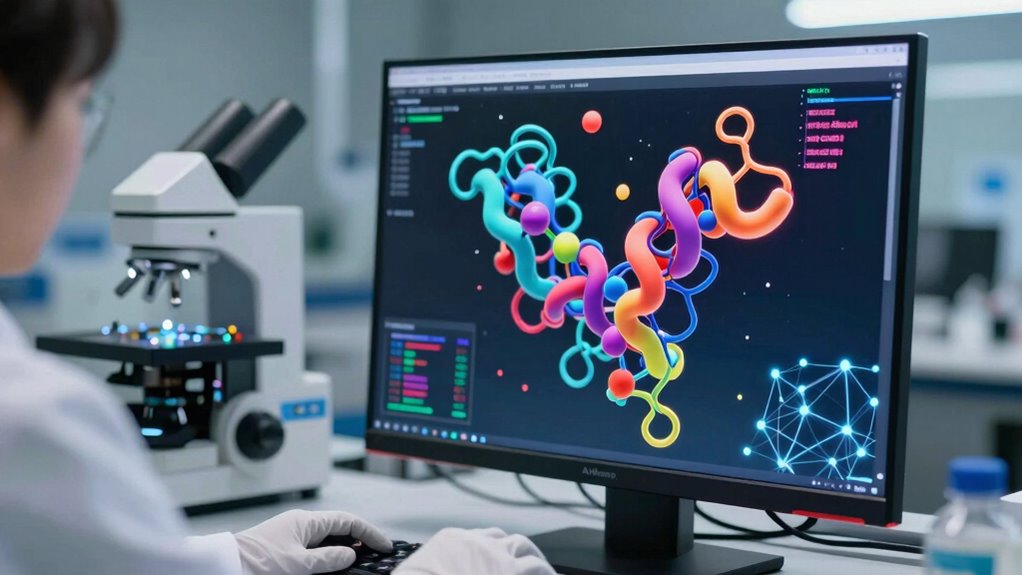

AI helps you analyze massive protein data sets quickly and accurately by using machine learning to identify patterns and predict protein structures. It turns complex structural information into visual formats like 3D models and heatmaps, making it easier to interpret. New visualization tools and virtual reality environments let you explore proteins from different angles and in real time. Keep reading to discover how these innovations are transforming scientific discoveries and advancing fields like medicine and biotechnology.

Get the latest gadgets delivered free — and shop member deals
- Fast, free delivery on millions of items
- Access to Prime Big Deal Days deals on October 6–7
- Prime Video, Amazon Music and more included
Key Takeaways
- AI rapidly analyzes large protein datasets, identifying patterns and structural features beyond manual capabilities.
- Machine learning models predict protein folding and functions, accelerating data interpretation.
- AI-generated visualizations, like 3D models and heatmaps, make complex data more comprehensible.
- Advanced visualization tools and virtual reality enable immersive exploration of massive protein structures.
- Continuous improvements in AI-driven visualization streamline research workflows and foster scientific breakthroughs.

Have you ever wondered how scientists decode the complex structures of proteins? It’s a challenging task because proteins are made up of long chains of amino acids that fold into intricate three-dimensional shapes. Understanding these shapes is essential since a protein’s function depends heavily on its structure. Traditionally, scientists relied on labor-intensive experiments and manual analysis to study protein folding, but this approach is slow and often limited by the sheer volume of data. Now, artificial intelligence is transforming this process, especially with tools that excel at data visualization, making it easier to interpret massive protein data sets.
AI revolutionizes protein structure analysis, transforming slow manual work into rapid, accurate, and visual data interpretation.
AI algorithms can analyze enormous amounts of protein data quickly and accurately, helping scientists identify patterns that would be nearly impossible to detect manually. Through machine learning, AI models learn from existing data, improving their ability to predict how proteins fold based on amino acid sequences. This capability accelerates the process of decoding protein structures, shortening what used to take years into months or even weeks. As AI models process data, they generate visual representations—data visualization—that make complex structural information more accessible. Instead of sifting through rows of raw data, you see clear, 3D models and heatmaps that highlight key features of protein folding, revealing how different segments interact and stabilize each other.
Data visualization plays a vital role in this scenario because it bridges the gap between raw data and human understanding. When AI tools translate protein folding predictions into visual formats, you can quickly grasp the spatial relationships and conformations that define a protein’s function. These visual insights are essential for designing new drugs, understanding disease mechanisms, or engineering proteins for specific purposes. Because AI can handle massive data sets, it not only speeds up discovery but also enhances accuracy, reducing errors that might occur with manual interpretation. Additionally, integrating knowledge of contrast ratio and color accuracy from home theater projectors can help improve visualization clarity and detail in complex models. Furthermore, advancements in data visualization techniques are enabling more immersive and detailed exploration of protein structures, further aiding scientific discovery. Moreover, the development of interactive visualization tools is allowing researchers to manipulate models more intuitively, fostering a deeper understanding of these complex molecules. Incorporating virtual reality environments is also opening new avenues for immersive exploration of protein structures, making the learning process even more intuitive.
Moreover, AI-driven data visualization tools are continuously evolving, offering interactive features that allow you to manipulate models in real-time. You can rotate, zoom, and explore different angles of a protein structure, gaining a more intuitive understanding of its shape and stability. This immediacy and clarity empower researchers to make informed decisions faster, leading to breakthroughs in fields like medicine, biotechnology, and bioinformatics. The integration of advanced visualization techniques enhances the ability to interpret complex data sets visually, further streamlining research workflows. Ultimately, AI’s ability to analyze and visualize large-scale protein data is revolutionizing how scientists read and interpret these complex biological molecules, opening new frontiers for scientific advancement.
protein structure visualization software
As an affiliate, we earn on qualifying purchases.
As an affiliate, we earn on qualifying purchases.
Frequently Asked Questions
How Accurate Are AI Predictions in Protein Structure Determination?
AI predictions in protein structure determination are quite accurate, especially with advances in protein folding algorithms like AlphaFold. You can rely on AI for precise data interpretation, which helps reveal complex protein shapes efficiently. While not perfect, AI markedly reduces errors and accelerates discovery. You should still verify predictions with experimental data, but overall, AI greatly enhances your ability to understand protein structures accurately.
What Are the Limitations of AI in Analyzing Protein Data?
You face frustrations with AI’s limits in deciphering protein diversity and data visualization. While AI rapidly analyzes vast data, it struggles with ambiguous or incomplete information, leading to inaccuracies. Its reliance on existing data means it might miss novel structures or rare variants. Additionally, complex, multifaceted protein interactions can overwhelm AI systems, causing gaps in understanding. These limitations highlight that AI complements, but doesn’t fully replace, human expertise in protein analysis.
How Does AI Handle Novel or Unseen Protein Sequences?
AI handles novel or unseen protein sequences through novel sequence adaptation, allowing models to generalize beyond known data. It uses advanced algorithms for unknown protein modeling, predicting structures and functions of unfamiliar sequences effectively. By training on diverse datasets, AI can recognize patterns in new sequences, enabling it to make accurate predictions even when encountering completely novel proteins. This adaptability accelerates discovery and understanding of previously uncharacterized proteins.
What Ethical Concerns Arise From AI Use in Protein Research?
You should be aware that using AI in protein research raises ethical concerns like data privacy, especially when handling sensitive genetic information. Additionally, bias mitigation is essential, as AI models can inadvertently perpetuate biases present in training data. Ensuring transparency and fairness helps maintain trust, prevents misuse, and promotes responsible scientific progress. Addressing these issues safeguards individual rights and promotes ethical standards in groundbreaking protein studies.
How Accessible Are AI Tools for Small Research Labs?
Imagine opening a treasure chest—AI tools are becoming more accessible, but small research labs often face hurdles. Funding challenges can limit your access, and concerns over data privacy might make you hesitant. While some user-friendly platforms are emerging, you’ll need to stay vigilant about secure data handling. Overall, AI’s availability is improving, but you’ll still find barriers, especially without ample resources and support.
As an affiliate, we earn on qualifying purchases.
Conclusion
As you immerse yourself in the world of proteins through AI’s eyes, imagine a vast, intricate map unfolding before you—each data point a shining star guiding your discovery. With AI illuminating these complex landscapes, you’re empowered to navigate the tangled web of biological information with clarity. Together, you and this technology become explorers, unearthing secrets hidden in the molecular cosmos, opening doors to breakthroughs that once seemed beyond reach.
AI protein folding analysis tool
As an affiliate, we earn on qualifying purchases.
As an affiliate, we earn on qualifying purchases.
virtual reality protein exploration
As an affiliate, we earn on qualifying purchases.
As an affiliate, we earn on qualifying purchases.
Fall Picks
fall essentials
As an affiliate, we earn on qualifying purchases.