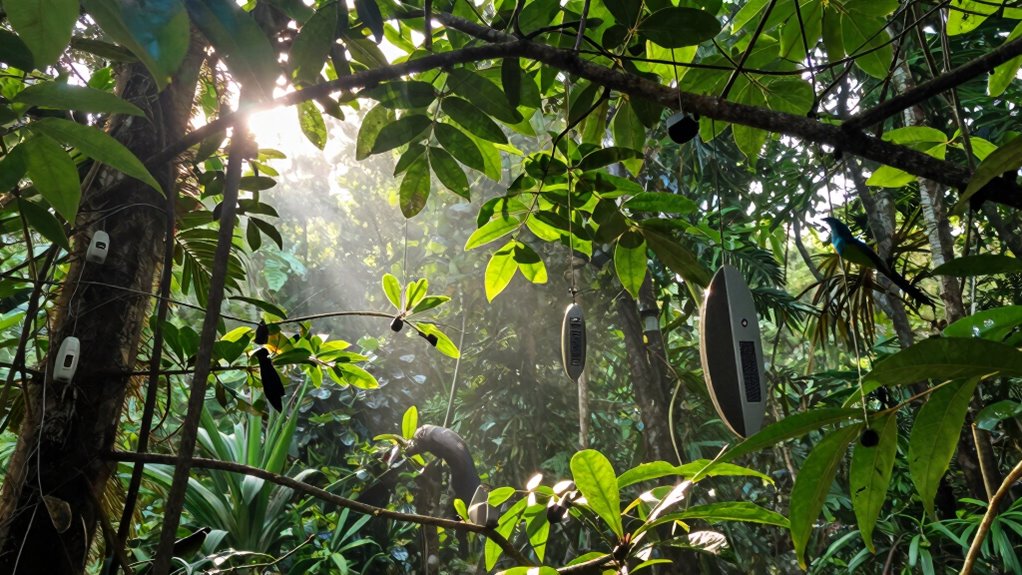

Bioacoustics allows you to listen to entire ecosystems by capturing and analyzing animal sounds that reveal complex interactions and environmental health. Using specialized equipment like hydrophones and acoustic sensors, scientists monitor wildlife, migration patterns, and ecosystem changes non-invasively. Machine learning helps identify subtle patterns and rare species, improving conservation efforts. If you want to understand how natural soundscapes tell us stories about our environment, keep exploring these fascinating acoustic techniques.

Get the latest gadgets delivered free with Prime
- Fast, free delivery on millions of items
- Prime Video, Amazon Music and more included
- Member-only deals all year
Key Takeaways
- Bioacoustics captures diverse sounds from multiple species, providing a comprehensive view of ecosystem activity.
- Advanced sensors and machine learning analyze complex soundscapes to identify species and ecological interactions.
- Continuous acoustic monitoring reveals changes in species behavior and ecosystem health over time.
- Underwater and aerial recordings enable scientists to monitor entire marine and terrestrial ecosystems remotely.
- Sound analysis uncovers hidden ecological patterns and responses to environmental stressors across habitats.

Have you ever wondered how animals communicate across vast distances or how their sounds reveal the health of an ecosystem? Bioacoustics, the study of sound in biological contexts, gives you a window into these mysteries. By capturing and analyzing sounds from various species, scientists can decode complex interactions within ecosystems, revealing patterns that are often invisible to the naked eye. It’s like giving nature a voice, allowing you to listen in on animal behaviors and environmental changes without disturbing the wildlife. Smart home safety/automation technologies can even be integrated to monitor environmental sounds and alert you to unusual activity, enhancing conservation efforts. Marine communication is a prime example of bioacoustics’ ability. Underwater, many marine animals rely on sound to navigate, find food, and communicate. Whales, dolphins, and even some fish produce sounds that travel long distances through water, making sound an essential part of their lives. When scientists deploy hydrophones—underwater microphones—they can monitor these sounds to track migration patterns or detect changes in marine populations. For instance, shifts in whale song patterns can indicate stress from noise pollution or shifts in prey availability, providing early warnings about ecosystem health. This non-invasive method allows you to listen to the ocean’s stories, revealing how marine life responds to environmental pressures and human activity. Bird migration is another fascinating aspect bioacoustics uncovers. As seasons change, countless bird species migrate thousands of miles, guided partly by their calls and songs. By recording these sounds, scientists can monitor migration timing and routes, even with vast distances involved. These recordings reveal not just the presence of certain species but also their breeding status and population health. If a decline in specific calls is detected, it might signal challenges like habitat loss or climate change impacts. Listening to bird migration through bioacoustics helps you understand the delicate timing and interconnectedness of ecosystems, emphasizing the importance of preserving habitats critical for their survival. Advances in acoustic monitoring technology have made it possible to gather data over long periods and in remote locations, expanding our understanding of ecological dynamics. Understanding the interconnectedness of species within ecosystems can help inform conservation strategies and promote biodiversity. Additionally, integrating technological advancements such as machine learning can improve the accuracy of sound analysis, revealing even more subtle ecological patterns. These innovations also enable researchers to detect rare or elusive species, broadening our knowledge of biodiversity.
underwater hydrophone for marine research
As an affiliate, we earn on qualifying purchases.
As an affiliate, we earn on qualifying purchases.
Frequently Asked Questions
How Accurate Are Bioacoustic Recordings in Identifying Individual Species?
Bioacoustic recordings can be quite accurate in identifying individual species, especially when analyzing unique sound signatures linked to their species behavior. You rely on how sound propagation affects recordings, but accuracy can vary depending on environmental conditions like background noise and terrain. While some species have distinct calls, others may overlap, making precise identification challenging. Overall, advancements improve accuracy, but you should consider context and environmental factors for best results.
Can Bioacoustics Detect Unseen or Rare Species Effectively?
You can detect unseen or rare species effectively using bioacoustics, especially since silent predators and cryptic communication often go unnoticed visually. Studies show bioacoustic monitoring can identify elusive species by their unique calls, even if they’re rarely seen. This technology captures subtle sounds that reveal the presence of hidden creatures, making it a powerful tool for conserving biodiversity and understanding ecosystems that might otherwise remain silent and unseen.
How Do Environmental Changes Affect Bioacoustic Data Quality?
Environmental changes can impact bioacoustic data quality by increasing sound wave interference and habitat noise. When habitats are disturbed, background noise levels rise, making it harder to distinguish specific animal calls. Changes like deforestation or urbanization introduce new sounds, which can mask or distort acoustic signals. You need to account for these factors, using advanced filtering techniques to guarantee accurate recordings and reliable data analysis despite these environmental challenges.
What Are the Limitations of Current Bioacoustic Technology?
Current bioacoustic technology faces technological constraints that act like a fog, obscuring full ecosystem understanding. You find that data processing struggles to keep pace with massive soundscapes, risking lost insights. Limitations in sensor sensitivity and range also hinder your ability to capture faint or distant signals. These challenges mean you must often compromise on data quality or coverage, leaving parts of the natural symphony unheard and the ecosystem’s story incomplete.
How Do Researchers Differentiate Overlapping Sounds in Complex Ecosystems?
You analyze overlapping sounds by using sound pattern analysis techniques to identify unique acoustic features. Researchers compare these patterns against habitat acoustic signatures, which serve as reference profiles for specific environments. This process helps distinguish individual species’ calls even in noisy, complex ecosystems. By focusing on distinctive frequency, timing, and amplitude patterns, you can effectively separate overlapping sounds and gain a clearer understanding of the ecosystem’s diverse vocal activity.
acoustic sensor for wildlife monitoring
As an affiliate, we earn on qualifying purchases.
As an affiliate, we earn on qualifying purchases.
Conclusion
You now have a glimpse of how bioacoustics is transforming our understanding of ecosystems. By tuning in to nature’s symphony, you can uncover hidden interactions and monitor health like a modern-day Galileo with a megaphone. It’s as if you’ve got a secret radio to Earth’s wildest conversations—no need for a time machine here. Embrace this sonic revolution and realize that listening closely can truly help save and preserve our planet’s vibrant, delicate balance.
bioacoustics sound analysis equipment
As an affiliate, we earn on qualifying purchases.
As an affiliate, we earn on qualifying purchases.
As an affiliate, we earn on qualifying purchases.
Halloween Picks
halloween
As an affiliate, we earn on qualifying purchases.