TL;DR

Get the latest gadgets delivered free with Prime
- Fast, free delivery on millions of items
- Prime Video, Amazon Music and more included
- Member-only deals all year
Building your own AI workstation used to be cheaper, but in 2026, prebuilt options often match or beat DIY on price, time, and reliability. Your choice depends on control, support, and workload fit, not just cost.
Making the call between building or buying your AI workstation no longer comes down to just saving a few bucks. In 2026, the landscape has shifted. Price tags are tighter, component shortages hit DIY parts, and the real value lies in how quickly and reliably you get your machine up and running. Build vs Buy a Prebuilt AI Workstation.
If your goal is to start training models, run inferences, or develop AI tools fast—without sacrificing support—the decision is more nuanced than ever. This guide breaks down when it makes sense to build, when to buy, and how hybrid strategies are reshaping the game.
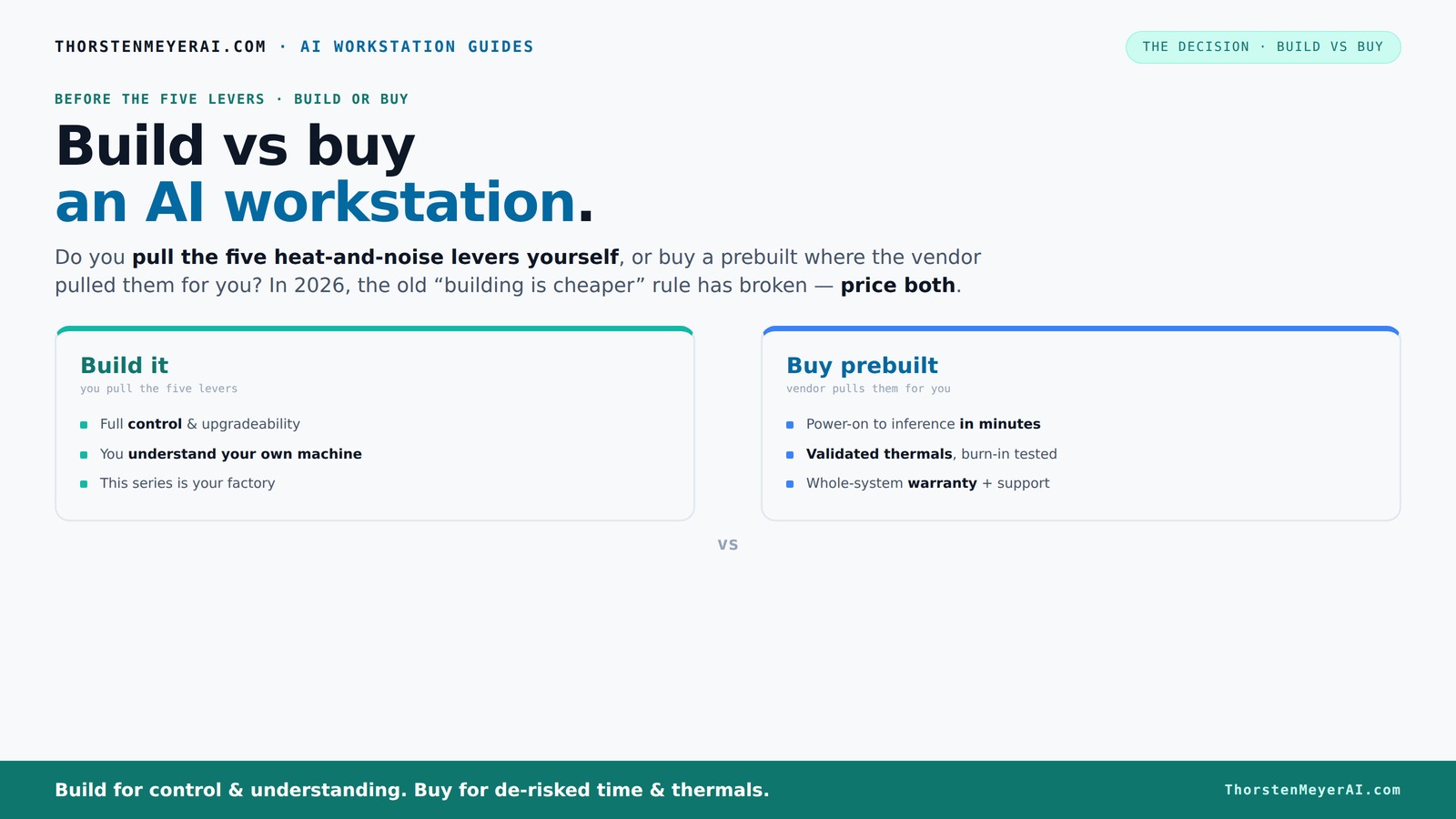
Build vs buy
an AI workstation.
The real question behind this whole series: do you pull the five heat-and-noise levers yourself, or buy a prebuilt where the vendor pulled them for you? And in 2026, the old “building is cheaper” rule has broken. Match your situation in Part 3.
Key Takeaways
- Component shortages in 2026 mean prebuilt AI workstations often match or beat DIY prices, reversing the traditional rule.
- Support, warranty, and validated thermals make prebuilt options less risky for critical AI workloads.
- Matching your workload to the right specs—GPU VRAM, RAM, storage—is essential for performance and efficiency.
- Hybrid solutions offer a compromise—buy a validated foundation, then customize key components.
- Total cost of ownership includes hidden labor, maintenance, and upgrade costs; consider these over 3 years.
As an affiliate, we earn on qualifying purchases.
Why the old rule ‘build cheaper’ no longer applies in 2026
Building your own AI workstation used to save you money—by sourcing parts individually, you could often beat prebuilt prices. But today, shortages and bulk buying have flipped that script.
For example, a custom build with a high-end GPU like the RTX 4090 or A100 now costs around $2,500—$3,000, while top-tier prebuilt systems from vendors like Lambda or Puget often match or beat these prices, thanks to their bulk discounts. The days of DIY always being cheaper are gone for now.
Plus, the time to assemble, troubleshoot, and tune your rig adds hidden costs—especially if you need it fast or lack thermal/airflow expertise. The key takeaway? Always price both options today, not just rely on past assumptions. Build vs Buy a Prebuilt AI Workstation.
Beyond cost, consider the opportunity cost: the time you spend building and troubleshooting could be better spent on your actual AI projects. Moreover, component shortages mean that sourcing reliable parts for a DIY build might lead to delays or compromised performance, which can offset any initial savings. In contrast, prebuilt systems often come fully assembled and tested, giving you a predictable timeline and performance baseline. Therefore, understanding the full scope of costs and risks helps you make a more strategic decision rather than just chasing the lowest sticker price.
As an affiliate, we earn on qualifying purchases.
Who pulls the thermal and performance levers—vendor or you?
Managing heat, noise, and performance in a high-power AI workstation is a balancing act. If you build it yourself, you control cooling, fan curves, undervolting, and airflow. This control allows you to optimize for silence, performance, or thermal efficiency based on your specific needs, which can be critical for sustained workloads or noise-sensitive environments. However, it requires a deep understanding of thermal dynamics and hardware tuning, as discussed in assistive technology and solutions, as improper setup can lead to overheating, throttling, or hardware failure, ultimately affecting your productivity and hardware lifespan.
Prebuilt systems, on the other hand, come with preconfigured thermal solutions that are tested and validated by the vendor. For instance, companies like BIZON rigorously test their systems under load for 48 hours to ensure stability and prevent thermal throttling. This means you get a machine that’s optimized out of the box, reducing trial-and-error and minimizing downtime due to thermal issues. But this comes at the cost of less customization and potentially higher noise levels if the vendor’s cooling solution prioritizes performance over silence.
The tradeoff is clear: DIY offers granular control to fine-tune thermal and performance parameters, which can be advantageous for specialized workloads or quiet operation. Conversely, prebuilt systems provide a reliable, tested thermal profile that ensures stability and longevity, especially important in mission-critical AI tasks. Your choice depends on whether you value customization and control over convenience and reliability, and how much time and expertise you’re willing to invest in thermal management.
As an affiliate, we earn on qualifying purchases.
Defining Your Workload Needs
Before deciding whether to build or buy, it’s essential to clearly define your workload requirements. Are you training large language models that demand multiple high-end GPUs? Or are you running inference tasks with moderate hardware? Understanding your computational needs, data throughput, and latency tolerances will shape the hardware specifications you require. technology, gadgets, and productivity tips can help guide your hardware choices.
For instance, intensive training workloads benefit from multiple GPUs with high VRAM, fast interconnects, and ample RAM. Conversely, lighter workloads might suffice with a single GPU or mid-range components, saving costs and power. Accurately aligning your workload with hardware ensures you avoid overspending or underperforming, making your investment more effective.
This step also helps in evaluating whether a prebuilt system can meet your needs or if a custom build is justified. It’s the foundation for making an informed decision that balances performance, cost, and future scalability.
As an affiliate, we earn on qualifying purchases.
Applying the Knowledge: Case Studies
Consider two scenarios: a startup AI developer with a tight deadline and limited technical expertise, versus an established research lab with dedicated hardware engineers.
The startup might find that buying a prebuilt, validated system from a reputable vendor offers the quickest route to operational readiness, with minimal setup and troubleshooting. The prevalidated thermals and support can save days or weeks, enabling faster project deployment.
In contrast, an experienced research team with in-house hardware skills might prefer building a custom rig tailored precisely to their workload, optimizing for maximum performance and thermal efficiency. They can upgrade components over time, customize cooling solutions, and fine-tune settings for specific tasks. However, this approach requires more time, expertise, and risk management.
Both cases highlight that understanding your specific context and needs is critical. The right choice depends on balancing speed, control, expertise, and long-term goals. For more insights, visit home theater, audio equipment, and gaming upgrades.
Frequently Asked Questions
Is it cheaper to build or buy an AI workstation in 2026?
It depends on your specs and workload, but recent trends show prebuilt systems often match or beat custom builds on price, thanks to component shortages and bulk buying. Always price both options for your exact configuration. For detailed guides, see Build vs Buy a Prebuilt AI Workstation.
What hidden costs come with building my own workstation?
Hidden costs include time spent troubleshooting, thermal tuning, upgrading parts, and ongoing maintenance. These can add 20-30% to the initial investment over three years, especially if you lack experience. Moreover, delays due to sourcing parts can extend project timelines, leading to opportunity costs and potential project overruns. The complexity of thermal management and ensuring component compatibility also means that DIY builds may require additional investment in tools, testing, and possibly professional consultation, further increasing total ownership costs.
How much performance do I lose by buying prebuilt?
High-quality prebuilt workstations often come with validated thermals, optimized cooling, and professional support, meaning you won’t lose much—if any—performance compared to a DIY rig, especially under sustained AI loads. In fact, prebuilt systems are often tuned for optimal airflow and thermal efficiency, which can translate into more reliable performance over time. Any minimal differences are usually offset by the convenience, reduced setup time, and lower risk of thermal issues that can cause throttling or hardware degradation in DIY setups.
Which is better for local LLMs and AI training?
If you need custom GPU configurations or specific cooling, building offers more control. You can tailor hardware and thermal solutions precisely to your workload, which can improve performance and stability. However, for most standard AI training tasks, a validated prebuilt provides enough power, stability, and support, saving you significant setup time and reducing risk. The decision hinges on whether your workload requires bespoke hardware or if off-the-shelf solutions meet your needs efficiently.
When does a hybrid approach make sense?
When you want a reliable, validated base—like a prebuilt system—and only need to upgrade or customize certain parts, such as adding a second GPU or extra RAM. This approach reduces initial setup time, leverages the stability of tested components, and allows you to tailor performance for specific AI tasks. It’s especially advantageous if you lack the time or expertise to build from scratch but still want some degree of customization and future-proofing without the full cost and effort of a completely custom build.
Conclusion
In 2026, building or buying your AI workstation isn’t just about initial cost or speed. It’s about balancing control, support, workload fit, and future plans. The smartest move is to weigh your specific needs—then choose the path that gets you working, fast and confident.
Remember, the right machine isn’t just the fastest or cheapest. It’s the one that works best for your unique AI journey.
Halloween Picks
halloween
As an affiliate, we earn on qualifying purchases.