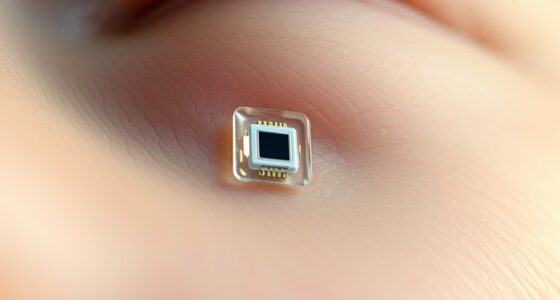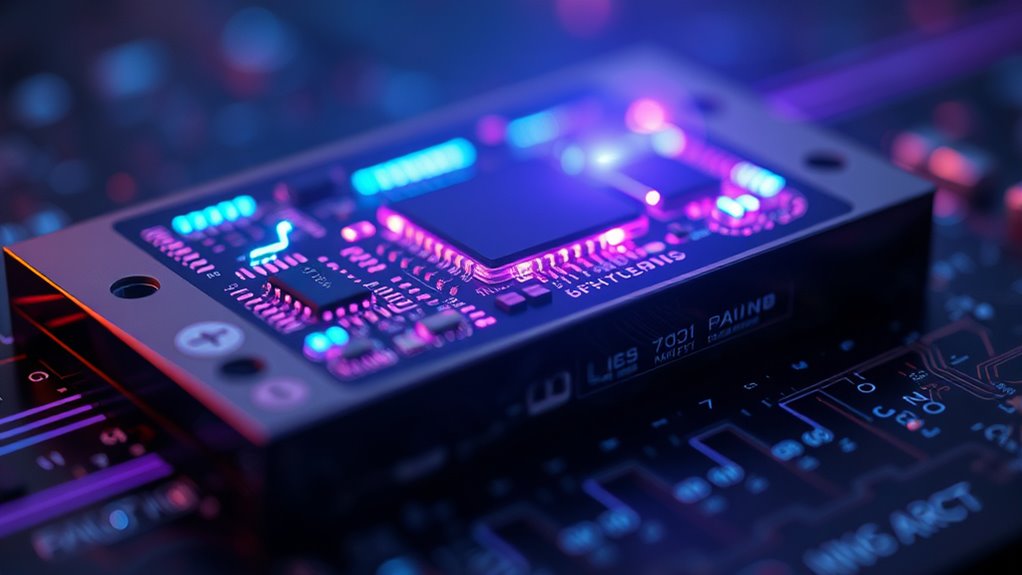

Terahertz spectroscopy on a chip has enabled the discovery of quantum light traps, compact structures that confine and manipulate quantum light signals at terahertz frequencies. By integrating microstructures and specialized supports, you can now generate, control, and detect quantum phenomena in small, portable devices. This breakthrough simplifies complex setups and offers new possibilities for on-site analysis. If you continue exploring, you’ll uncover how these innovations are revolutionizing quantum sensing and communication technologies.
Key Takeaways
- Chip-based terahertz spectroscopy enables compact, high-resolution analysis of quantum light trapping phenomena.
- Engineered microstructures support localized terahertz modes, revealing quantum light confinement on a chip.
- Integrating sensors and detectors enhances sensitivity and allows real-time observation of quantum light traps.
- Miniaturized systems facilitate portable, on-site quantum photonics research and diagnostics.
- This approach overcomes traditional equipment limitations, advancing quantum sensing and information processing technologies.
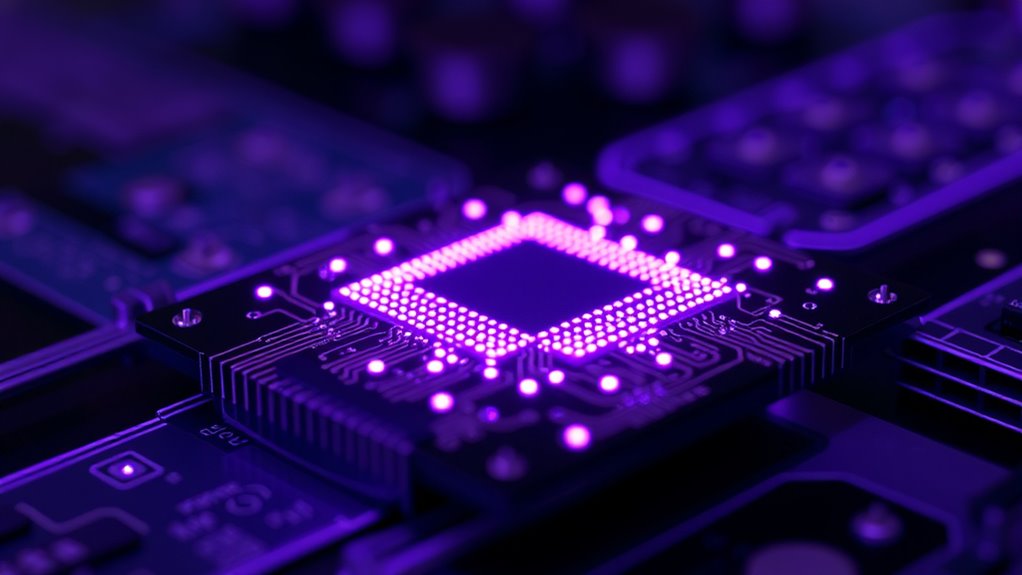
Terahertz spectroscopy, a powerful tool for analyzing materials and biological samples, traditionally requires bulky and expensive equipment. You might imagine large, complex systems with massive antennas and precise optical components that are hard to transport and maintain. This setup limits its widespread use, especially outside specialized labs. However, recent advances have paved the way for miniaturizing this technology onto a chip, making it more accessible and versatile. By integrating terahertz components into microfabricated platforms, researchers can now perform high-precision spectroscopy in compact, portable devices, opening new possibilities for on-site diagnostics and real-time monitoring.
One of the most exciting breakthroughs involves revealing quantum light traps using terahertz on a chip. These traps are tiny regions where quantum light—such as photons—can be confined and manipulated. Understanding and controlling these traps is vital for developing quantum information systems and advanced sensors. With chip-based terahertz spectroscopy, you can probe these quantum phenomena directly, observing how light interacts with matter at an incredibly small scale. This level of detail was previously unattainable without large equipment, but now, integrated circuits allow you to scan, analyze, and even manipulate quantum light within a compact device.
Revealing quantum light traps on a chip enables direct, high-resolution probing of photon interactions at tiny scales.
The key to this innovation lies in engineering microstructures that support specific electromagnetic modes at terahertz frequencies. When you design these structures carefully, they can create localized fields that trap photons, enabling you to study their properties with high resolution. This approach not only simplifies the setup but also enhances sensitivity, since the confined light interacts more strongly with samples. You can imagine a chip that captures the essence of a full-scale laboratory, yet fits in your hand, providing rapid, precise insights into quantum behaviors.
Moreover, this on-chip technology makes it easier to integrate with other electronic and photonic systems. You can embed sensors, detectors, and control electronics directly onto the same platform, streamlining the process of analyzing quantum light traps. This integration reduces noise, increases stability, and accelerates data collection, allowing you to perform experiments that were once cumbersome and time-consuming. In practical terms, it means more accessible quantum research, portable devices for field applications, and faster development cycles for new technologies. Additionally, advancements in asset division strategies can facilitate collaborative funding and resource sharing for such innovative projects.
Top picks for "terahertz spectroscopy chip"
Open Amazon search results for this keyword.
As an affiliate, we earn on qualifying purchases.
Frequently Asked Questions
How Does Terahertz Spectroscopy Compare to Other Spectroscopic Techniques?
Terahertz spectroscopy stands out because it probes low-energy excitations like phonons and spins, which other techniques might miss. You can perform it quickly with compact, chip-based systems, making it more accessible and versatile. Unlike UV or IR spectroscopy, terahertz offers unique insights into quantum phenomena and material properties. However, it has lower spatial resolution and sensitivity, so you may need complementary methods for a complete analysis.
What Are Potential Real-World Applications of Quantum Light Traps?
You can use quantum light traps to improve quantum computing, enhance secure communication, and develop ultra-sensitive sensors. These traps help manipulate and store quantum information more efficiently, making your devices faster and more reliable. They also enable better control over light-matter interactions, which could lead to breakthroughs in photonic technologies. As a result, you’ll see advancements in secure data transfer, medical imaging, and environmental monitoring.
Can This Chip-Based Approach Be Scaled for Commercial Use?
Yes, this chip-based approach can be scaled for commercial use. You’ll find that advances in manufacturing techniques, such as microfabrication and integration with existing semiconductor processes, make mass production feasible. As a result, you can expect reduced costs and increased availability. The technology’s compact size and compatibility with current electronic systems mean it’s ready for integration into various applications, from communications to sensing, paving the way for widespread commercial adoption.
What Materials Are Used to Fabricate These Terahertz Chips?
You might think silicon is the go-to material, but these terahertz chips often use gallium arsenide or indium phosphide because of their excellent electronic properties. Researchers also explore materials like graphene for flexibility and tunability. These choices are vital for optimizing performance, ensuring the chips can efficiently generate, detect, and manipulate terahertz signals. So, the right material selection is key to advancing this technology’s potential.
How Does Temperature Affect the Performance of Quantum Light Traps?
Temperature critically impacts the performance of quantum light traps. As you lower the temperature, you reduce thermal noise, which allows the traps to confine and manipulate quantum light more effectively. Conversely, higher temperatures increase thermal fluctuations, causing energy losses and reducing efficiency. Maintaining a stable, low temperature is essential for ideal operation, ensuring you achieve precise control over quantum states and maximize the device’s sensitivity and performance.
Conclusion
This breakthrough shows that when you bring terahertz spectroscopy onto a chip, you’re opening doors to precise quantum control. As the saying goes, “A journey of a thousand miles begins with a single step.” By harnessing quantum light traps, you’re paving the way for future innovations in communication and sensing technologies. Keep pushing boundaries—sometimes, the smallest steps lead to the biggest discoveries.